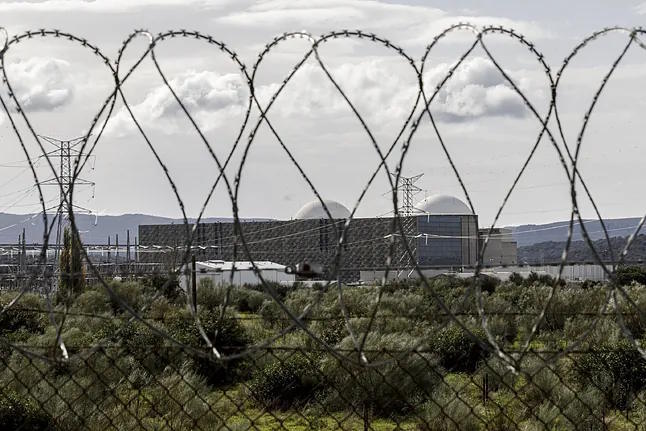
Nuclear energy is gaining ground in the European political debate, but not in the energy mix. Electricity generated by the atomic parks of the Twenty-Seven has been in free fall for two decades. Only since the war in Ukraine, its production has decreased by 15%. This decline is partly due to the entry of renewables into the electrical systems of the Member States. But also, to its replacement by natural gas, another controllable technology whose support is becoming increasingly important to prevent blackouts in critical moments. The 'B-side' of replacing uranium with gas is a greater vulnerability of the European Union to commercial flows that largely depend on Washington, where Donald Trump has declared economic war on Europe.
In 2022, then German Chancellor Olaf Scholz considered keeping the last three active nuclear power plants in the country open due to the lack of Russian gas. Just a few days ago, Friedrich Merz, leader of the Christian Democratic Union (CDU) and winner of the recent federal elections in Germany, acknowledged the "need" for a national "nuclear moratorium" to halt the closure of reactors. Berlin is back to square one, but it is not alone.
Since the energy shock caused by the war in Ukraine, competitiveness and supply security have escalated in the priorities of the European bloc. The atomic blackout dominates the political debate in Spain, while Belgium or the United Kingdom are restarting shut down plants, opening new reactors, or both. More recently, Brussels' Clean Industrial Plan has endorsed state aid for energy infrastructures, including nuclear power plants.
This political shift has not yet been reflected in the EU's energy balance. According to the latest Eurostat data for 2023, updated last week, electricity generation in the Twenty-Seven's nuclear plants amounted to 619,601 gigawatt hours (GWh) that year. The figure was 1.7% higher than in 2022, although this improvement was only due to the gradual recovery of the French park, whose activity was hampered in 2022 by successive technical problems. Furthermore, this slight rebound is far from compensating for so many years of decline.
The nuclear curve in Europe has gone through three phases. Between 1990 and 2004, its golden age, electricity produced in the community block reactors soared by almost 27%. In 2024, it peaked at 928,438 GWh, leading to a two-year stabilization period. The decline began in 2006, and from then until 2023, the last monitored year, the volume of atomic electricity plummeted by over 32%.
Until European governments make progress in a potential nuclear resurgence, and this is reflected in an increase in generation, markets have begun to anticipate a considerable increase in natural gas demand. Consulting firm McKinsey notes in a recent analysis that over the past 25 years, global natural gas demand has increased by 80%. Currently, this fuel satisfies almost a quarter of global energy needs.
In its latest projection from February, McKinsey foresees a slight increase in global natural gas demand in the coming years, followed by a stabilization that they maintain, at least, until 2048. Meanwhile, ICIS Analytics points out that in 2024, European gas demand increased by 8% due to the reactivation of industrial consumption. And they expect this trend to continue in 2025.
Among other uses, McKinsey predicts that some of this gas will be used as a "transition source" in the progress towards net zero emissions by 2050: "Electrification can only advance at a certain speed, and the adoption of low-carbon emerging technologies, such as hydrogen, is too slow today."
The consultancy emphasizes that economic blocks generating electricity are "eager for more gas," albeit for different reasons. The US, due to the growing demand for artificial intelligence (AI) and industrial relocation, urgently needs a "base load" energy, something that "could be replicated worldwide." In the EU, governments are supporting more gas plants to ensure a capacity "sufficiently reliable and flexible to cope with the intermittency of renewables."
In 2023, with a 12% increase from the previous year, the US was the world's largest exporter of LNG, referring to liquefied natural gas that travels by ship. In the European Union, Washington has replaced Moscow as the primary supplier of non-EU gas. In 2023, it accounted for more than 19% of the Twenty-Seven's imports, compared to 5.7% in 2021.
"Anyone who thinks that the United States is going to give gas to Europeans because we are friendly is very mistaken. For Trump, gas is a bargaining tool just like tariffs," warns a senior executive in the sector. Russia and the US accounted for 34.2% of the EU's gas purchases in 2023, compared to just under 23.5% for uranium, whose abundance and distribution "greatly limit geopolitical risks," according to Eurostat.