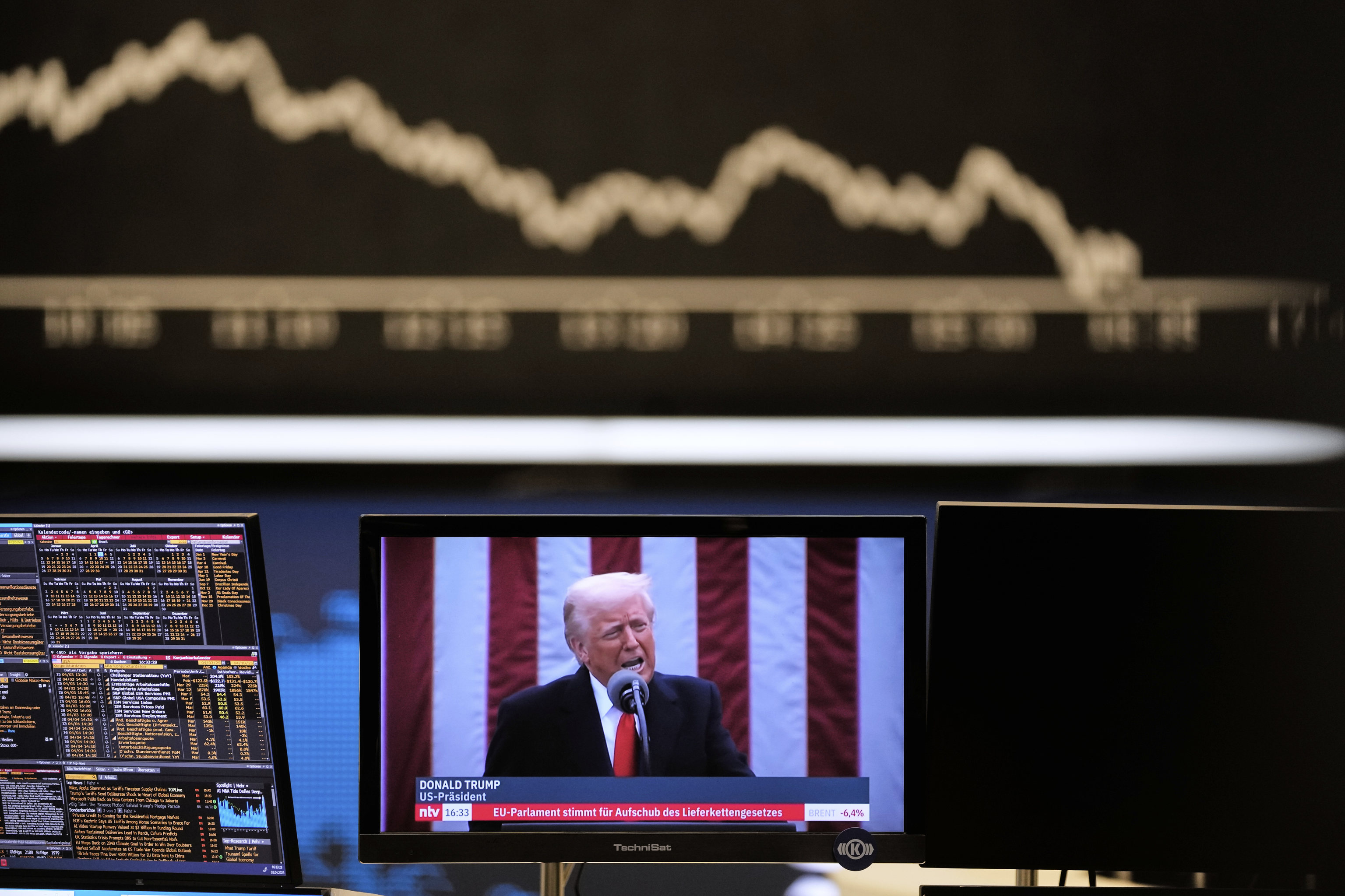
Was the announcement on 'Liberation Day' a surprise?
Yes and no. In the summer of 2023, The Washington Post featured an article on its front page indicating that Trump had already outlined a plan to impose a tariff of at least 10% on all products entering the country. The defense of tariffs has been a constant, also during the campaign. So, it can hardly be said that it was unexpected. However, markets, analysts, and world governments expected more bark than bite, and a repetition of what was experienced in the first term. Protecting some sectors, making a lot of noise, and Trump claiming victory with cosmetic measures. Nothing could be further from the truth.
Do the tariffs affect all products from all countries?
No. There are a series of exemptions, at least for now, for pharmaceutical products, which are one of the president's obsessions. Semiconductors, despite also being a recurring product in the administration's complaints, which do not understand why they should depend on South Korea or Taiwan. Wood, some metals, and especially "minerals not available in the US". Additionally, the White House has not convincingly explained why Russia and Belarus, like Iran, Cuba, or North Korea, are not on the lists and whether that means they are the only ones exempt, even though bilateral trade is very low due to imposed sanctions.
Are they truly "reciprocal"?
No, not at all. The US administration has invented a formula with no scientific value to arbitrarily determine what it considers other countries 'charge' for American products. It does not take into account, despite what they claim, local tariffs or bureaucratic obstacles. It is completely false, so Trump's imposed battery is not reciprocal. Additionally, even countries with trade deficits with the US are punished with a 10% tariff.
Is China the most affected country?
Yes and no. The "reciprocal" (sic) tariff announced on Tuesday amounts to 34%, much higher than that of the EU because its trade deficit is even larger. But this must be added to the 20% surcharge that Trump had already applied since taking office, which puts them at 54%, as they are the only ones that accumulate. But if we also add what Trump had already imposed in 2016, and that Biden did not completely reverse, the amount is over 75% on each good entering the US. By volume, it is obviously the most affected country, but others like Vietnam, which have almost a 50% tariff and depend drastically on their exports, will fare much worse.
What's the deal with Washington and the lost islands?
The internet has been filled in the last few hours with jokes, parodies, and memes, after tariffs of 10% were imposed on Heard and McDonald, Australian islands, near Antarctica, inhabited only by penguins and seals. Or that Saint Pierre and Miquelon, a French territory off the Atlantic coast of Canada, in front of Nova Scotia, with a few thousand inhabitants, have tariffs of 99%, the highest of all. Why? Because they export a negligible amount of lobsters to the US. But since they barely buy anything American, as they trade with Canada and France, the trade deficit is total. And by using an absurd formula that only takes that deficit into account, a ludicrous surcharge now emerges. There are many other islands, like Christmas, Cocos, or Norfolk, in Oceania. But to everyone's surprise, there is a surcharge on the British Indian Ocean Territory, part of which is the remote Chagos archipelago, which London is about to hand over to Mauritius. The irony? The largest island, Chagos, hosts the joint US and UK naval and air base Diego Garcia and has no indigenous population.
When do these protectionist measures take effect?
Very soon. Surcharges on vehicles manufactured outside the US began to be applied from midnight on Wednesday to Thursday. Also at midnight, but on April 5, the base tariff of 10% will be applied to all trading partners. And on April 9, in a week, the so-called reciprocal tariffs, including those on European goods, will be implemented.
Trump instigated a trade war by imposing new tariffs on imports of washers and solar panels, steel and aluminum, and billions of dollars in consumer, intermediate, and capital goods from China throughout 2018 and 2019. With a few exceptions, Biden kept almost all of Trump's tariffs in place. This led to higher revenue than before, obviously, but trade declined in categories of goods subject to tariffs. According to data from the Tax Foundation, the net damage is significant.
But, could they not be implemented?
Given Donald Trump's track record, anything is possible. With Canada and Mexico, he played cat and mouse for weeks or months, in this term and his first term. Announcing tariffs and then suspending them, applying extensions and then qualifying them. So, although the rhetoric is very strong, and the White House has insisted on Thursday that they will not back down, it is not out of the question, especially if the market reaction is very strong. Whether in full or in part, with more exemptions for products or with reductions based on bilateral negotiations. Countries like Israel announced on the 1st that they were eliminating all tariffs on all American products. This did not exempt them from a wrongly named reciprocal tariff of 17%, but it could change.
Can anyone stop the Government?
There is no simple answer. To impose this protectionist round, Trump has invoked the International Emergency Economic Powers Act (IEEPA), just as he has invoked laws from 1798 to deport immigrants without trial or Emergency Laws to send troops to the border. Therefore, it is foreseeable that the "day of economic independence" will also end up in court, as the IEEP requires that there be an "unusual and extraordinary threat," and a trade deficit is hardly considered as such. Just as the expulsion of Venezuelans could hardly be justified by the existence of a criminal gang made up of Venezuelans, which is not a foreign power trying to invade. But having said that, and unlike the other cases, it is difficult for a court to overturn Trump's decision, as economic policy has much more leeway. Therefore, it would be up to Congress to act if it wants to stop him.
What power does Congress have?
The debate is interesting. On the same Thursday, the Senate approved, with the support of four Republican senators, a proposal by Democrat Tim Kaine against the tariffs imposed on Mexico and Canada. The legislation, which would push to remove the restrictions, thus regaining legislative powers granted by the Constitution but delegated to the Executive over time, still needs approval from the House of Representatives, the lower house, which also has a Republican majority. That is why Trump is pressuring those most critical of the tariffs one by one. The same Senator Kaine said this Thursday that he will launch another initiative to reverse the 10% base tariff on the entire planet. A long and complicated struggle.
Does this put pressure on the Federal Reserve?
Very much so, even more than before, squeezed by inflation and the increasing possibility of a contraction or recession. With markets in the red and uncertainty soaring, it is not far-fetched to imagine Trump blaming the Federal Reserve, which he reproaches for not lowering interest rates further. Powell's term as chairman expires in May 2026, but his future is not guaranteed.
Trump's chief tariff advisor, Peter Navarro, said last Sunday that the US would collect up to six trillion dollars over the next decade, about 600 billion dollars a year. Tariffs are taxes on imports that the Customs and Border Protection agency collects when foreign goods cross the border. The money (about 80 billion dollars last year) goes to the Treasury Department and is used for federal government expenses. Although theoretically, Congress has the authority to dictate how it should be used, Trump has made it clear that he wants these resources to finance tax cuts.