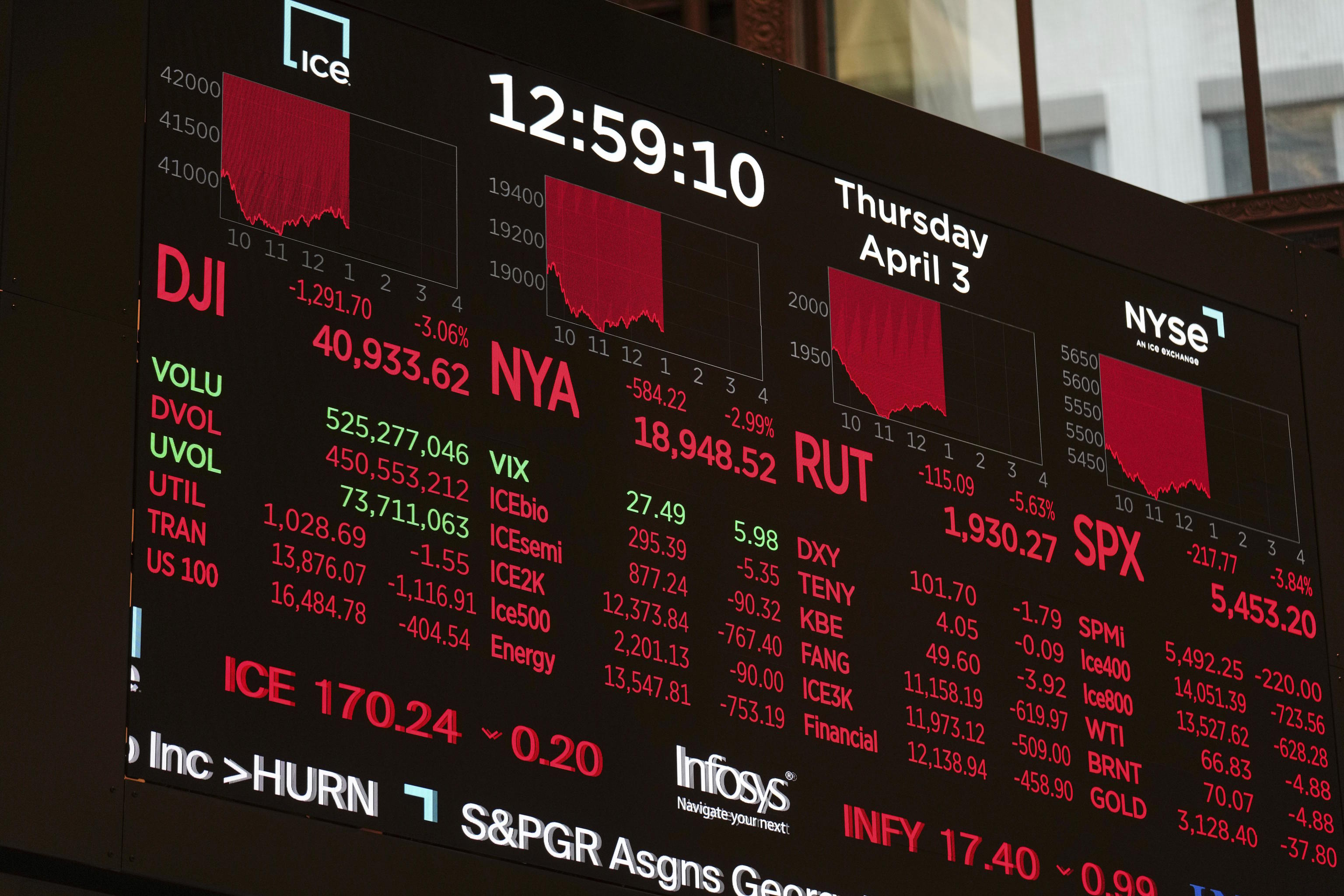
On April 2, President Donald Trump celebrated from the White House Rose Garden, with music, laughter, and applause, the "Economic Independence Day of the United States." On April 3, still in shock, the markets, with nothing to celebrate, received "the stupidest trade war in history," as described by the Wall Street Journal, dyeing all indices red in the most disastrous session since the Covid outbreak and destroying over two and a half trillion dollars. Futures had warned early Wednesday when details of tariffs on the entire planet were revealed. Japan, South Korea, and Vietnam set the tone on Thursday at dawn, with Wall Street delivering the final blow in a devastating day, not just due to the losses or imminent retaliations, but for signaling the end of an era. The start of a new era marked by uncertainty, hostility, and fear of a new Great Recession.
"The global economy is fundamentally different today than yesterday. The global trade system anchored in the United States has ended. Our old relationship of increasingly deep integration with the United States has ended. The 80-year period in which the United States assumed economic leadership has ended. This is a tragedy, it is also the new reality," perfectly summarized by Canadian Prime Minister and former Governor of the Bank of England, Marc Carney, while China and the European Union reacted against the bullying of the leading global power and warned that the response will be immediate and equivalent: "if you touch one, you touch all," said Ursula von der Leyen.
The day was a disaster from start to finish, with major stock indices falling up to 5.6% and destroying $2.7 trillion in market value, the darkest day since March 16, 2020, when around $3.5 trillion was lost as Covid-19 spread and countries locked down. The shares of the big tech companies, the "magnificent seven," whose leaders supported Trump at his inauguration on January 20, collectively lost around $850 billion, the largest single-day drop recorded, according to MarketWatch. The feeling is that a contraction, a recession, or even stagflation (low growth and high inflation) is almost inevitable now.
The Dow Jones dropped 1,700 points, 4%. The Nasdaq, 5.9% dragged down by Nvidia (-7%), Apple (-9.2%), and Amazon (-9%). The S&P 500, another 4.8%. Along with them, the shares of Nike (-14%) or Ralph Lauren (-16%), which manufacture in Asia, gold, bitcoin, oil on its worst day in almost three years, and even the dollar, with a significant depreciation to the lowest level of the year, a sign of lost confidence, as economic textbooks say when a country closes its market doors, its currency theoretically strengthens. Yet, the feeling is that the flow of international funds will be cut off as prices rise. "It is important that all investment, planned or already announced, be suspended until we clarify things with the United States," said French President Emmanuel Macron in a meeting with business leaders. "What message would we send if major European players started investing billions of euros in the United States when they are attacking us?"
Aware of the terrible image for an administration that came to power largely by exploiting citizens' discontent over rising prices and loss of purchasing power, the Government rushed to television, almost in desperation, especially when news spread that one of the major automakers, Stellantis, will temporarily lay off 900 people due to tariffs. So they came out defending the indefensible with far-fetched arguments, such as the EU rejecting American meat because they "envy its beauty as their calves are weak."
"There will be a brief period of uncertainty, and then we will return to the prosperity that the president has envisioned," said Agriculture Secretary Brooke Rollins. "We need greater self-sufficiency. We need to manufacture more of our own products. We need a foreign policy that prioritizes the interests of our citizens, and we need an economic policy that does the same," argued Vice President JD Vance. Treasury Secretary Scott Bessent, taking it a step further, even argued that before the crises of 1998 or 2007, the market had been bullish, implying that the current losses are great news because they would mean "taking the United States off the path of past recessionary trends and putting us back on a solid growth trajectory."
"Let Donald Trump lead the global economy. He knows what he's doing. He's been talking about it for 35 years. We have to trust him," urged Commerce Secretary Lutnick on CNN. When the journalist asked why the American people should trust someone who declared bankruptcy six times, the response was: "Business is about taking risks. Sometimes things don't go well, but he always bounces back." The president himself, in his only statements of the day, somewhat rare, said as they boarded the helicopter on their way to Florida, first to one of his golf courses and then to Mar-a-Lago, that "everything is going very well. We will have 6 or 7 trillion dollars coming into our country. The markets are going to experience a boom," promising without giving much importance to the chaos.