China's Ministry of Commerce has announced today that it will impose additional 34% tariffs on all U.S. products starting April 10 in response to the widespread tariffs imposed by Donald Trump. The Asian country was one of the most affected with a 34% rate added to the existing 20%.
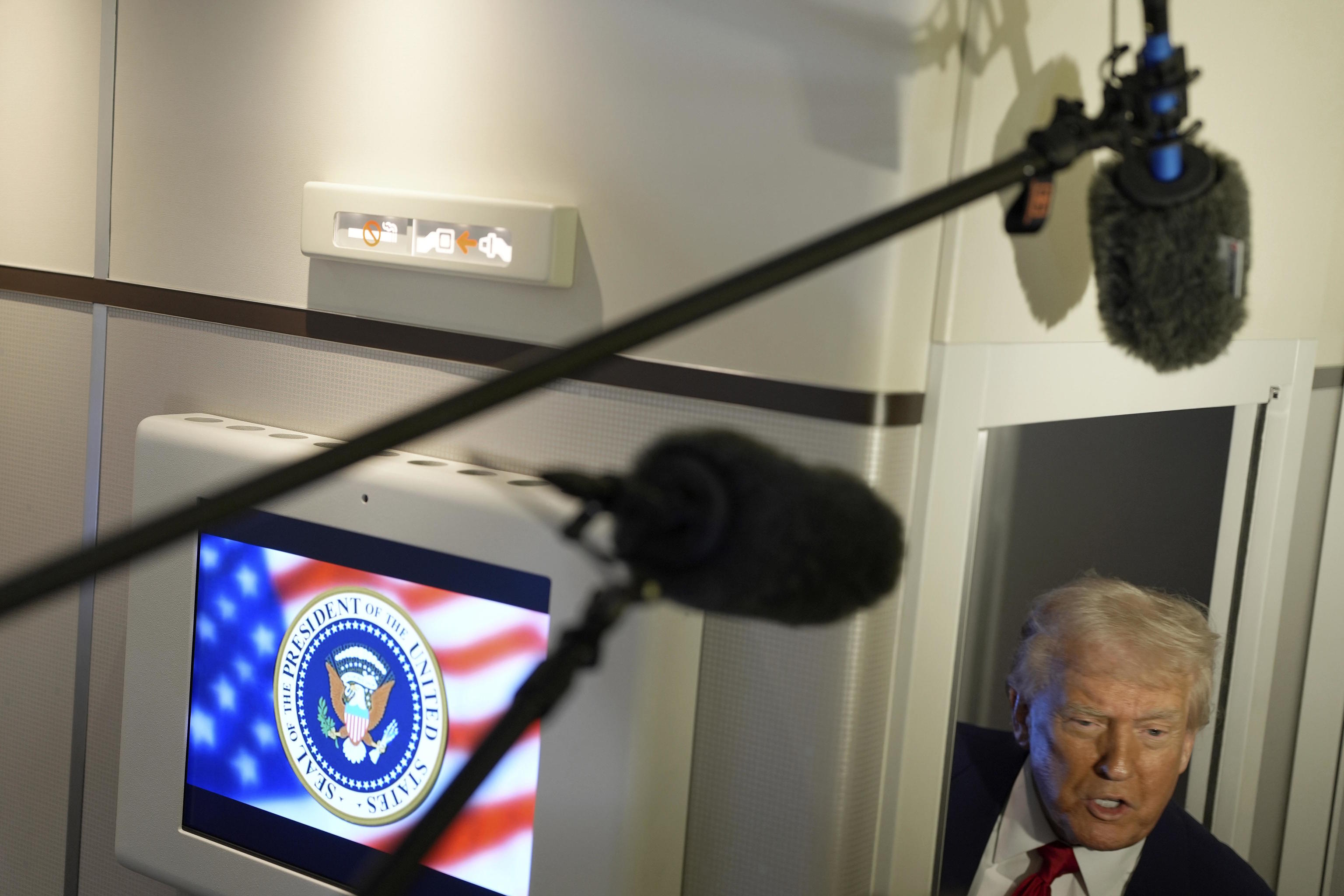
Meanwhile, the U.S. President stated in a conversation with accompanying reporters on Air Force One that he would be open to negotiating with other countries, depending on whether they had something "phenomenal" to offer in return, as reported by AP. Despite the global commercial turmoil, Trump offered an optimistic assessment of market reactions, comparing the situation to a patient needing surgery. "I think it's going very well. It's like when a patient needs surgery. I said it would be exactly like this," he commented.
Stock markets continue to decline. Asian indices have recorded losses for the second consecutive day. The Nikkei, which dropped as much as 4.24%, finally fell by 2.75% on Friday. The Ibex35 plummeted more than 5% this morning, with banks being the most affected values in a black day, with over 5% declines in all cases and close to 10% in the case of Banco Sabadell.
On the other hand, the Managing Director of the International Monetary Fund (IMF), Kristalina Georgieva, warned that tariffs pose a "significant risk" to economic growth and urged the U.S. and its partners to "work constructively to resolve trade tensions and reduce uncertainty."
Spanish Textile Industry Awaits Support Measures
The Spanish Federation of Apparel and Fashion Companies (Fedecon) has received with "expectation" the package of measures to support the internationalization of Spanish companies affected by tariffs announced by Pedro Sánchez yesterday, as reported by Servimedia. "This proposal, although general, directly affects us as a sector deeply involved in export-import trade and with a significant weight in the Spanish economic and business framework," highlighted Fedecon, who emphasized that this funding will be allocated to areas such as increasing industrial productive investment or addressing internationalization projects.
Ibex 35 Plummets Nearly 6% Mid-Session
The Ibex 35 was down 5.8% in the mid-session, dropping below 12,420 points, dragged down by the banking sector and influenced by the Wall Street debacle. The Spanish selective was the one that best weathered the impact of tariffs yesterday, registering a 1.2% drop, while its European counterparts lost over 3%.
Today, the Ibex 35 is the European index with the most significant losses in the mid-session: London down 2.01%; Paris down 2.22%; Frankfurt down 2.58%; and Milan down 5.06%.
China to Impose 34% Tariffs on All U.S. Products Starting April 10
China's Ministry of Commerce has announced that it will impose additional 34% tariffs on all U.S. products starting April 10 in response to the widespread tariffs imposed by U.S. President Donald Trump.
Additionally, it announced on Friday that it will restrict exports of a series of rare materials used in electronic components, the aerospace industry, and other sectors.
Tariffs Increase Risk of Recession for the U.S., According to S&P Global
The tariff hike announced by Donald Trump exceeded most expectations, both in scope and magnitude, contributing to an increased probability of recession in the world's largest economy, according to S&P Global.
While the agency does not foresee a recession defined by the NBER (depth, duration, and broad dispersion of weakness, not just two consecutive quarters of negative growth) in the next 12 months, it admits that the subjective probability of it happening "has likely increased from 25% in March to 30%-35%."
In its analysis, S&P Global warns that the impact on GDP from the ongoing trade war "depends on the retaliatory actions of trading partners and how tariff revenues are used," noting that tariffs are a regressive tax that will disproportionately affect low-income households as a percentage of their spending. Thus, it is likely that the erosion of purchasing power, worsening stock market conditions, and high investment uncertainty will further weaken growth.
Regarding prices, it highlights that the impact on short-term inflation will be significant, likely averaging around 4% by the fourth quarter, up from the previous forecast of 3%. In this regard, S&P Global estimates that the additional cost of imports would add between seven tenths and one percentage point to the CPI compared to the previous forecast. "If there are no significant side effects, inflation figures should return to the 2% target by mid-2026," it adds.
Hereu Calls Tariffs an "Economic Aberration"
The Minister of Industry and Tourism, Jordi Hereu, has described the tariffs announced by the Trump Administration as an "economic aberration," while advocating for a united response to this economic policy, both at the national and European levels.
"I hope that the economic business sector of the United States also reacts because it is evident that it has to demonstrate to the U.S. government that this is not only something that can be criticized from a political point of view, it is an economic aberration that is generating, it is working for economic depression," expressed the minister in statements to RTVE collected by Europa Press.
In this regard, Hereu stated that the U.S. grew last year and now "all indicators show a decrease," with the stock markets being "a thermometer" of this situation.
Regarding the measures to be taken or possible negotiations to address these tariffs, Hereu clearly advocated for "having a plan based on unity," as he does not believe that any European country will try to negotiate alone, as separately all regions are "much weaker."
Cuerpo Points Out Tariffs Could Subtract "Several Tenths of GDP" from Spain and Europe
The Minister of Economy, Trade, and Business, Carlos Cuerpo, stated today that the 20% tariffs imposed by the United States could impact the growth of the Spanish and European economies. "There are already several analyses on the table regarding the aggregate impact, in any case, both for Europe and Spain, which are indeed pointing to impacts of several tenths of GDP," he noted in an interview with Onda Cero collected by Europa Press.
However, the minister explained that Spain's direct exposure to the tariff policy of U.S. President Donald Trump is much lower than that of other European partners. Nevertheless, he emphasized that indirectly, anything affecting Spain's trading partners will have an impact on its economy.
Thus, he clarified that while the aggregate impact may be "limited," it could be "significant" for some sectors or even for some companies. "And this is precisely the work we have to do now, moving from macro to micro, because that is where we will have to be very surgical with the aid, measures, and diagnosis," he added.
Brent Crude Oil Falls to Lowest Level Since 2021
Oil prices continue to decline on Friday following the announcement of widespread tariffs by the United States, with Brent crude, the European, African, and Middle Eastern benchmark, reaching its lowest level since 2021.
By 10:30 Spanish time, the price of Brent North Sea for June delivery fell by 2.97% to $68.06, its lowest level since December 2021. Meanwhile, West Texas Intermediate (WTI), the U.S. benchmark, for May delivery, plunged by 3.12% to $64.86, a low not seen since May 2023.