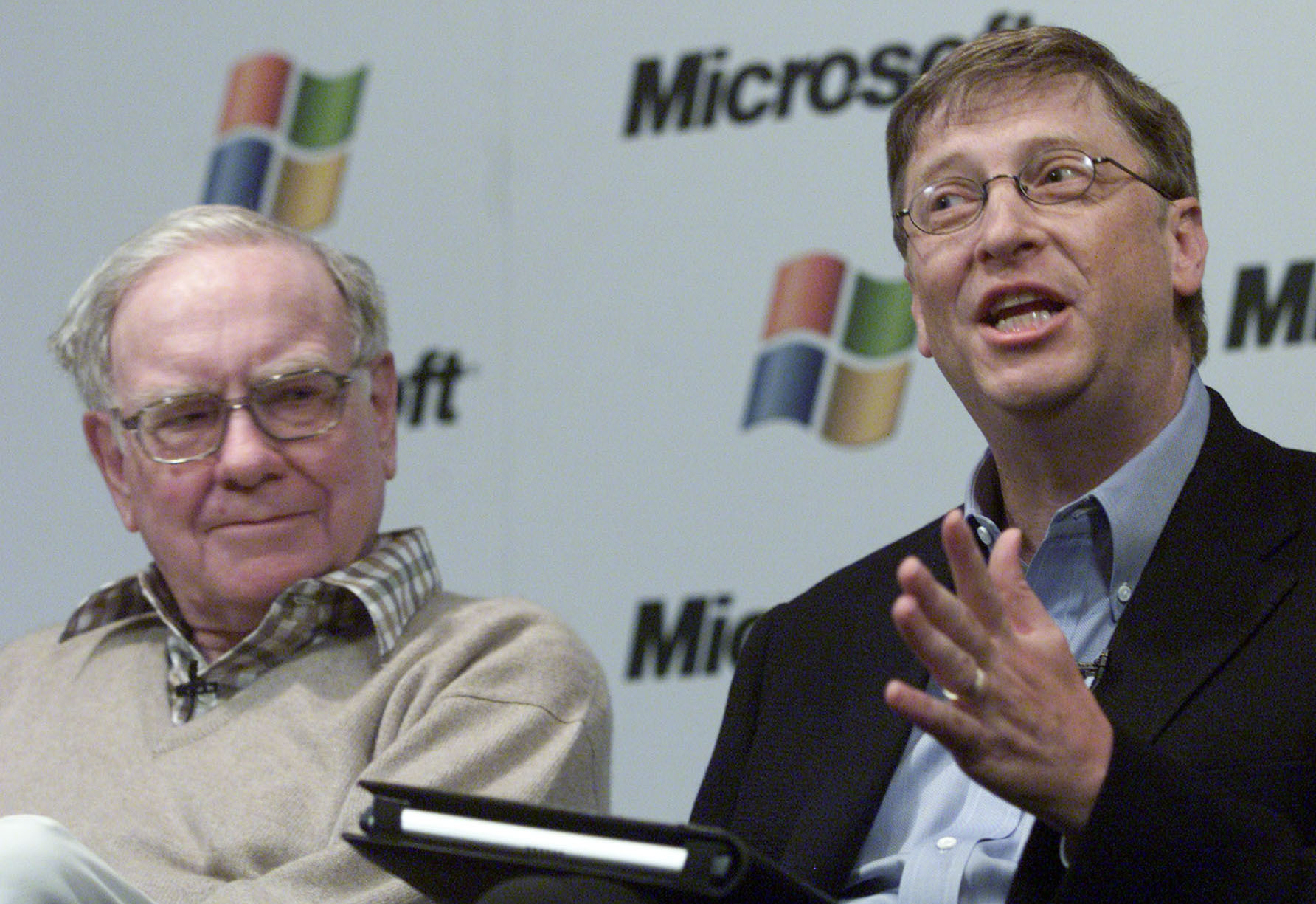
"Greg will maintain the culture." This is how, four years ago, in May 2021, Charlie Munger, the 'number two' at the world's largest publicly traded holding company, Berkshire Hathaway, announced to the world who would succeed Warren Buffett, perhaps the most successful investor - and certainly the most popular among everyday investors - in stock market history. Buffett, sitting next to Munger, remained unfazed.
This Saturday, a year and a half after Munger's passing at the age of 99, it was Buffet who announced that he will step down as the head of Berkshire at the end of January, the conglomerate he started building 60 years ago, which had a market value of $1.164 trillion ($1.031 trillion euros) at the close of the market on Friday. Berkshire Hathaway is thus the ninth most valuable publicly traded company in the world and the only one among the top ten that does not operate in the technology sector, along with Saudi Aramco, the Saudi oil monopoly (which is not actually a private company, as 97.62% of its capital is owned by the state of that country).
Buffett's retirement, who turns 95 on August 30, is a historic event in American capitalism. If there is anyone who symbolizes the idea of 'popular capitalism' on this side of the Atlantic, it is Buffett. When Berkshire Hathaway went public on March 16, 1980, its Class A shares (those with true voting rights) were priced at $290 (equivalent to 987 euros today, adjusting for inflation). Its price on Friday was $809,350, or 716,150 euros.
Buffett has achieved this remarkable value multiplication by following his own rules, with few concessions to trends. He has never done stock splits. He has never paid dividends. This is particularly relevant considering that Berkshire Hathaway currently has $347.7 billion in cash (307.7 billion euros), which would allow it, for example, to buy Inditex, Iberdrola, and Banco Santander in cash. In fact, Berkshire Hathaway's cash reserves are growing, as a year ago Buffet started selling shares of invested companies, starting with Apple, and has not made major acquisitions because, he says, "I can't find anything worth buying."
The case of Apple is emblematic of Buffet's strategy. The creator and main shareholder of Berkshire Hathaway has always invested in companies that, as he says, "have a wide moat." In other words, like a medieval castle, they enjoy a dominant position in their market and are 'shielded' from competition. This is how he started by investing in a textile company in his city, Omaha, the capital of Nebraska, called Berkshire Hathaway, and over time came to have significant stakes in companies like Coca-Cola, the Chinese electric car giant BYD, American Express, the food company Kraft Heinz, the oil companies Chevron and Occidental, or the Wall Street giant Goldman Sachs, which he literally saved from collapse during the 'subprime mortgage' crisis with a rescue that generated fabulous profits. He has invested in solid companies with rock-solid balance sheets. Buffett is the epitome of a 'value' investor, as opposed to a 'growth' investor. His bets have always been for the medium and long term.
This approach has also had its challenges. Buffett has never invested in technology. This led him to miss out on the dot-com boom in the nineties (arguing, quite logically, that "I don't understand how that business works") and the second wave of Silicon Valley with social networks and artificial intelligence. Jeff Bezos offered him to invest in Amazon, and he declined. Similarly, he is an opponent of cryptocurrencies. This has led investor Peter Thiel, a supporter of these assets, ally of Donald Trump and Elon Musk, and advocate for replacing democracies with 'techno-authoritarian' regimes, to call him a "psychopathic grandpa." Perhaps it is a sign of the times that Thiel, who injects himself with teenage blood to theoretically live longer, calls Buffett "psychopathic," whose best-known hobbies are bridge and women.
Buffett has also set a style. His annual letters are an example of irony, wisdom, and a certain edge. Also, his quotes. A centrist Democrat, he has said, "of course there is a class struggle, and my class has won it," and has lamented that his secretary pays a higher tax rate than he does, despite him, with an estimated fortune of $169 billion (150 billion euros), being the fifth richest man in the world and, again, the only one among the top ten who has not made his fortune in the technology sector.
In reality, Buffett could be twice as rich if he had not donated endless amounts of money to various causes, including some controversial ones, such as abortion. The Omaha billionaire is left-leaning, although many of his political positions do not have much impact in reality. Buffett, for example, still has his home in Omaha, in a discreet one-story chalet, no fence nearby, in a residential area, but if one knocks on the door (as the author of these lines did in January 2016), a security guard will answer because in reality, the billionaire is only there for Berkshire's annual meeting.
Similarly, Buffett is an advocate for higher taxation of investors like himself, but he is also known for how he has maximized all avenues of the U.S. tax system to pay as little as possible - sometimes nothing - to the IRS. His list of lovers is epic, although no one has ever spoken about them. Not even Steve Spielberg dared to include him in the movie 'The Post,' in which Meryl Streep plays Catherine Graham, the owner of the 'Washington Post,' who was in a relationship with Buffett just when the newspaper went public (which was a success thanks, among other things, to Berkshire not only advising her but also investing in the company). Genius and figure, Warren Buffett, the man of 'popular capitalism' on Wall Street, is retiring.