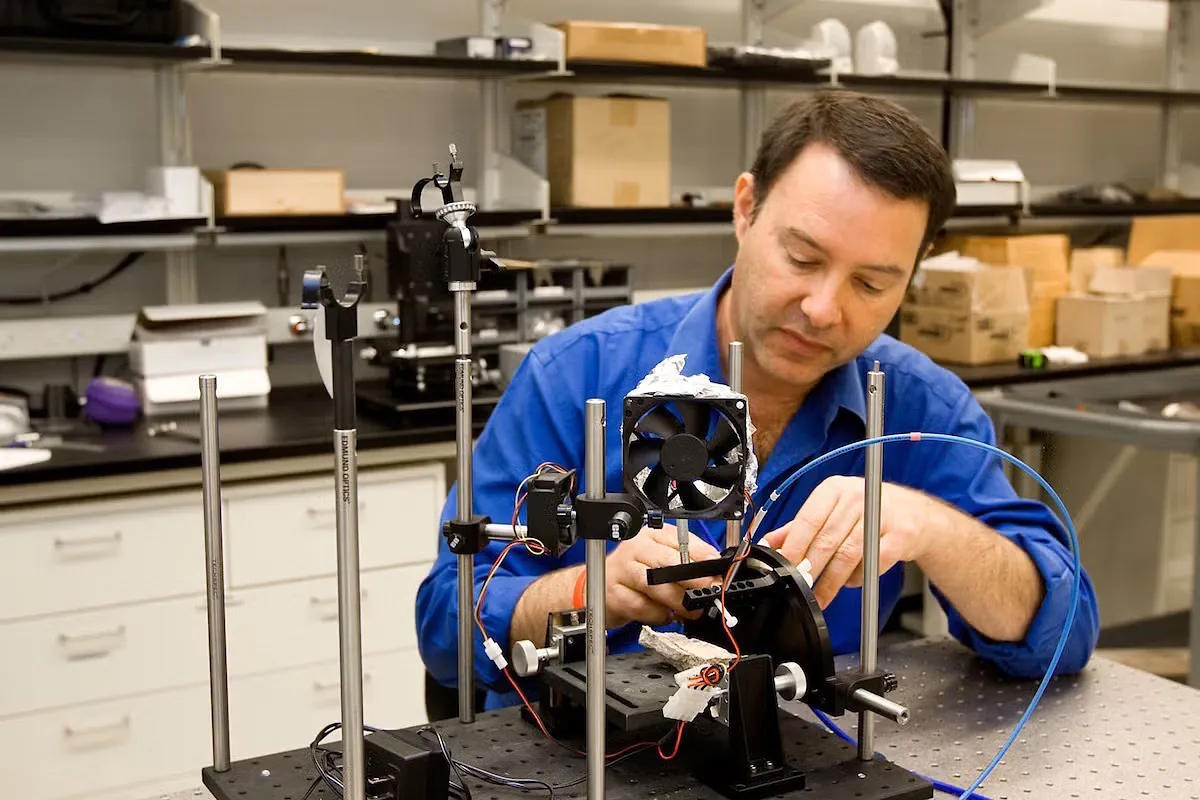
If you have any questions about Mars, Jim Bell is one of the most suitable people to answer them. This planetary scientist and professor at Arizona State University has been heavily involved in NASA's Martian missions since the 90s. And although he has also participated in the development of other robotic spacecraft that have explored comets or the Moon, the former director of the Planetary Society of the US confesses that he has a passion for the red planet.
"It fascinates me for a combination of elements. If you see photos of Mars, it looks like a familiar place, it reminds you of Earth, but at the same time, it is very hostile, very cold, and its atmosphere is very thin. Today there is no oxygen or water on its surface, but long ago it was much more similar to Earth. And compared to Jupiter or Neptune, it is close, it takes between six months and a year to get there, so we can send many missions, one after another, based on the result of the previous mission, and build a program to search for evidence of past life and a habitable environment, which is what both NASA and the European Space Agency (ESA) have done," he explains during an interview.
The meeting with this newspaper takes place in Puerto Naos, on the island of La Palma, where he participated this week in Starmus, the largest science and music festival: "I lived in a place with a very dark sky like in La Palma. Well, not as dark, because this is incredible. But with the telescope my parents gave me when I was 12, I learned to know and love the sky," recalls Bell, who says he is "very excited" to be able to visit during this trip El Roque de los Muchachos of the Institute of Astrophysics of the Canary Islands (IAC), one of the most important astronomical observatories in the world.
Those first astronomical observations he made as a child in Coventry (Rhode Island) with his first telescope and Carl Sagan's programs cemented a passion for space that was born watching astronauts on the Moon on TV - he was seven years old when the last Apollo mission concluded in 1972. "I remember watching them from home driving the rover (robotic vehicle) on the Moon, it was very inspiring for me. And as at that time my country was trying to win the Cold War against the Soviets, it was big news and very exciting."
Years later, he would have a very prominent role in the construction of the legendary rovers that have been exploring Mars in recent decades. The twins Spirit and Opportunity - launched in 2003 - were designed to work for three months but lasted many years: almost 15 in the case of Opportunity, which succumbed to a large dust storm in 2018, while Spirit explored Mars for six years until it got stuck in a sandy area. Currently active on the red planet are Curiosity, which arrived in 2012, and Perseverance, since 2021. And both are in good shape. "It is difficult to predict how long an instrument will last, but once they reach space, if they start working well, they usually work for a long time; it also happens with communication satellites. Other times they have problems as soon as they arrive. So we have been very fortunate with the Martian rovers."
But for these robotic devices to explore and make amazing discoveries with their portable laboratories, they must first successfully land on Mars, something very complicated. So much so that the phase of entry into the Martian atmosphere, descent, and landing is known as the "seven minutes of terror". How does he experience those critical moments when the entire mission is at stake? "It is very stressful, just like the launch. You work for years on your precious machine and you put it on top of a bomb. It has to arrive safe and sound and then land on the surface. You always hope that things will go well because everyone has done the maximum number of tests possible. But the only real test takes place when you launch. I once described it to my family like this: you see the rocket take off or the vehicle land, and you feel like singing and dancing, but at the same time, you feel like vomiting because you are very nervous," describes the researcher, who has also participated in some missions that failed. "One crashed on Mars, and another one that was going to explore comets exploded in Earth's orbit. I assure you it is not fun at all."
While humanity manages to overcome the obstacles for astronauts to one day travel to Mars, the rovers are paving the way, looking for traces of past life on this planet, water, and exploring the viability of building a future human colony. "We know for sure that Mars had water and was much more similar to Earth about 3.4 billion years ago, at the beginning of the Solar System's history. As soon as Earth cooled enough for oceans to form, life emerged; perhaps the same happened on Mars, we do not know because unfortunately, potential evidence of it is not visible on the surface. If there was life on Mars, it was probably simple, unicellular bacteria."
Every time Curiosity drills a hole or Perseverance collects a sample, says Bell, "they could discover something incredible, some evidence of a cell, a fragment of DNA, or some other molecule that can only be made by life as we know it. It has not happened yet, but we are getting closer," he assures.
For example, in March, the discovery of the most complex organic molecules found to date thanks to Curiosity was announced. Although they are very ancient, about 3.7 billion years old, they have been preserved. "The authors of the study have been very careful and emphasize that they are not proof of past life, but they are the most complex molecules found," he states.
Water, he explains, can remain in the subsurface of Mars, as it is believed that much of the water that was there was probably lost because there was no magnetic field. "We know that there is water in the subsurface of the icy poles, at high latitudes. If we were to drill there, we could extract ice cores, as we do in Antarctica or Greenland, which would give us information about the planet's climatic history. And that water would be critical for future manned missions to Mars."
"The surface is very hostile to organic molecules, to any molecule really. There is a very thin atmosphere, high-energy radiation all the time, almost no water, and yet these molecules can survive. And it must be considered that they may not be biological, as we have seen similar molecules, long hydrocarbon chains, in meteorites coming from deep space," clarifies the scientist, who explains that his theory is that "at greater depths, even more isolated material from the hostile surface could be accessed."
Furthermore, it does not rule out the possibility of life currently existing on this inhospitable world, in the depths of the subsurface, or on some moons of the outer Solar System: "It depends on how much water there is, whether it is liquid, or what sources of energy are accessible. It is not crazy to think about the existence of life in the deep subsurface in various places in our solar system. It used to be crazy to think about it, but now it may be plausible. The difficulty lies in getting there, accessing the deep subsurface."