In Chicago in 1956, Spencer Stuart founded the firm that bears his name, marking a before and after in the professionalization of the executive search sector. With a clear international perspective, in a moment of business opening after World War II, the company quickly expanded to cities like New York, London, Frankfurt, or Paris, becoming a global reference in headhunting. Today, it has more than 60 offices spread across around thirty countries, including Spain, where it is revolutionizing the world of talent acquisition with practices such as Leadership Advisory Services (LAS), one of the key growth drivers today.
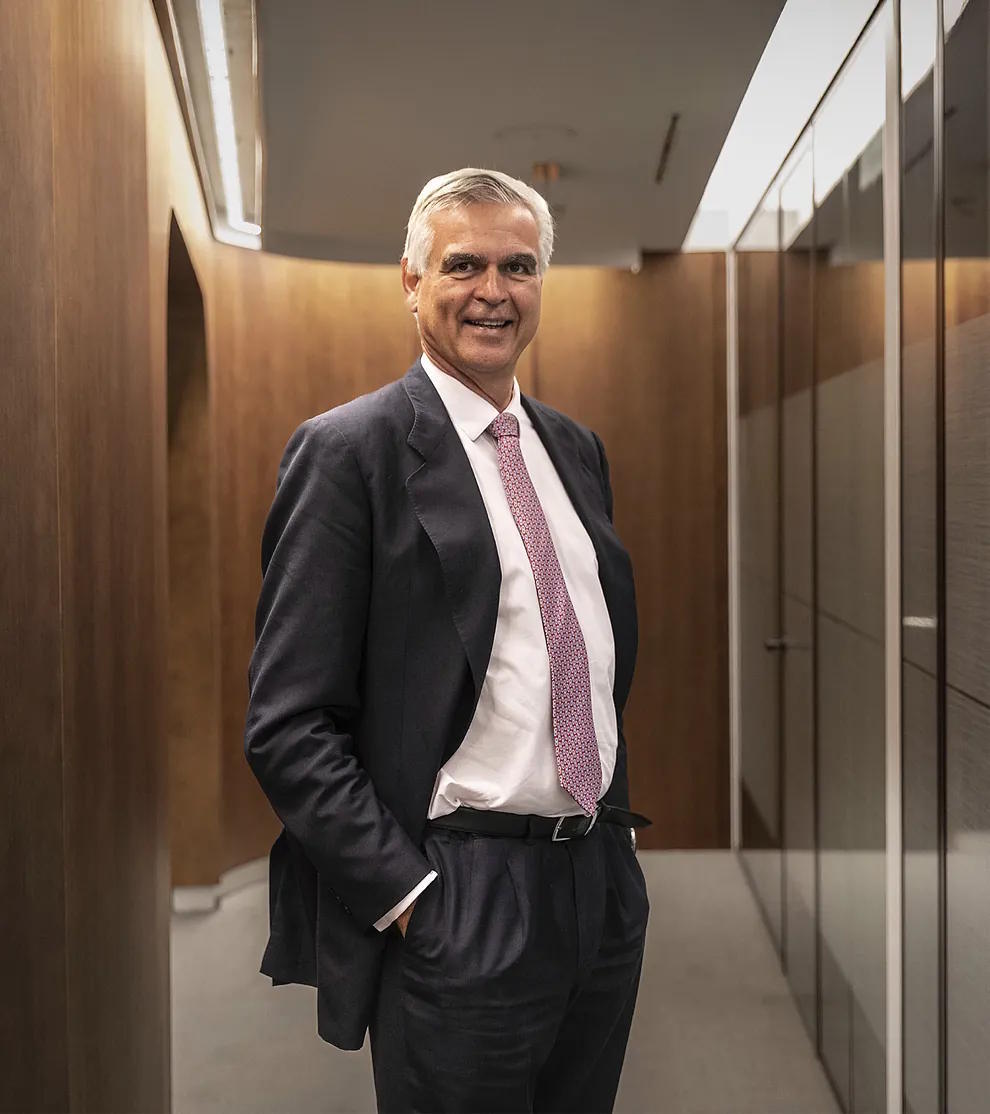
Arturo Llopis is one of the dozen partners of the firm at the European level who, in addition to the traditional work of searching for executives and board members, has specialized in LAS. A responsibility he carries out with a focus on Spain but in constant connection with companies in the European environment. "The traditional headhunter has to shift towards 2.0," starts the conversation with Actualidad Económica at the company's offices in Madrid. His over two meters in height give him away. A former professional basketball player - with stints at FC Barcelona and the national team - and a graduate in Economics and Computer Science from Harvard, before joining Spencer Stuart, he was the CEO of a venture capital fund for a decade and previously worked as a senior manager at Bain & Company for six years, specializing in supporting private equity operations in various industries.
Today, he is one of those headhunters he defines as "2.0," providing comprehensive advisory services that go beyond the search for executives or board members, offering solutions to company's top management teams, such as designing succession plans and developing successors for key positions, enhancing executive talent in company integrations and acquisitions, team effectiveness exercises, and support in alignment processes and corporate culture transformation. All of this is summarized as "understanding the problem, finding and implementing the solution." "The headhunter advisor goes beyond just placing people," concludes Llopis.
Today, he plays in the champions league of business leadership, where only a few compete, and he has taken several lessons from the basketball court: isolating oneself from pressure, understanding the environment, and making quick decisions are some of the qualities acquired from elite sports. But above all, resilience: "Complex problems are not solved with simple answers," he states. Therefore, his work as a talent scout goes beyond the search for the CEO. The services he provides through the LAS practice already represent 25% of the company's revenue in the United States, 20% in Europe, and 15% in Spain, reflecting "a high growth potential in the sector," especially in our country.
What exactly sets him apart from a traditional talent scout? "Before starting the CEO search process, you have to take a step back. What I first propose to the client is what their challenges and needs are, and what resources they have within the company to solve the problem," he explains. His first axiom is: "If you have it inside, don't look outside." "First, you have to identify internal talent and develop it. Once developed, it is compared with the market, and a decision is made if there is a better external candidate after carefully assessing capabilities and competencies. And the fifth step, which is very important, is the day after because once the CEO is appointed, that's when the real problems start. Therefore, what we try to do with advanced leadership services is to help the CEO accelerate their results and integration into the company."
Once the process is described, the key question arises... or rather, the two fundamental and inseparable questions: What do companies demand and what real qualities should a senior executive have? "Companies demand specific professional experiences and managerial skills, but what they don't know is that they have to demand other types of qualities. In a world as complex as the current one, which is advancing so rapidly, the ability to adapt and understand complex problems and solve them quickly is very important, as well as the ability to read the environment and adapt to the corporate culture," details Llopis.
In his opinion, the essential competencies in a CEO are summarized in results orientation, strategic vision, influencing ability, delegation and team leadership, as well as the ability to create and develop those teams and be aware of changes and implement them. And what role does salary play in negotiations at this level? "It depends on the circumstances. It's a mix of the project, salary, and the CEO's self-perception. All three are important, but none is critical," he points out. In any case, it is by no means the first condition of the contract to address with a senior executive.
From experience, he has learned that one of the most common mistakes companies make when facing CEO succession or executive team renewal processes is haste. "A CEO succession process lasts two years, whether internal or external," assures the headhunter. And he explains: "First, you have to define the problem, and we dedicate a lot of time to that because when you can describe a problem, you have 50% of the solution. You also have to define the potential of the individuals because when you are a CEO, you face the loneliness of power, of making the final decision, and for that, you need to have a special potential," he concludes.
Spencer Stuart has worked with most of the companies in the Ibex, with family and private companies, and with venture capital funds, always in the field of top-level executive search and high-impact comprehensive advisory services. When facing these types of processes in family businesses, the difficulty is twofold. "In families, consensus can be more complex, especially when different generations coincide, and sometimes family needs can be more important than economic or business needs. Normally, these are institutions based on long-term trust and tend more towards internal candidates, but that bias, which works well in continuous situations, can be a problem in times of crisis or exceptional circumstances and can backfire," explains Llopis. "Our obligation is to tell the truth to the client, and if a candidate with their last name falls below what is available in the market, we tell them," he concludes.
There are endemic issues in the labor market that can be extrapolated to top management selection processes, such as the low percentage of women, who barely occupy 19% of positions; however, others are unrelated to this professional level, such as talent crisis or ageism. Regarding the former, Llopis is clear: "If a company cannot find the talent it needs, it can develop it internally." And as for the latter, even clearer: "We are an American company, I am expressly forbidden to ask about age. Furthermore, age should not be an impediment for a person to be a good solution to a problem that a company needs to solve."
What topics does Arturo Llopis ask about in a job interview? The man who whispers to CEOs has his own manual, strategies, and tricks. And he doesn't reveal them. He does suggest, in a joking tone, that "it's a process like Sherlock Holmes." His interviews last four hours, and he uses real-time cases, putting the candidate in multiple situations and analyzing how they handle them to assess their potential. In his opinion, "great leaders are those who can address complex situations from different perspectives." And that's where he leaves it.
Spencer Stuart plays in the top-tier of executive leadership, at the peak of a pyramid where it competes with few firms. And Llopis is fully aware of his critical position and that "when you are playing at the top, the risk of making a mistake is very high." That's why he emphasizes the value of "reading and understanding people and problems and being able to solve them." Against artificial intelligence tools, he defends critical thinking as an essential skill of the headhunter in these processes and insists: "The headhunter advisor, the 2.0, goes beyond the traditional people placer."