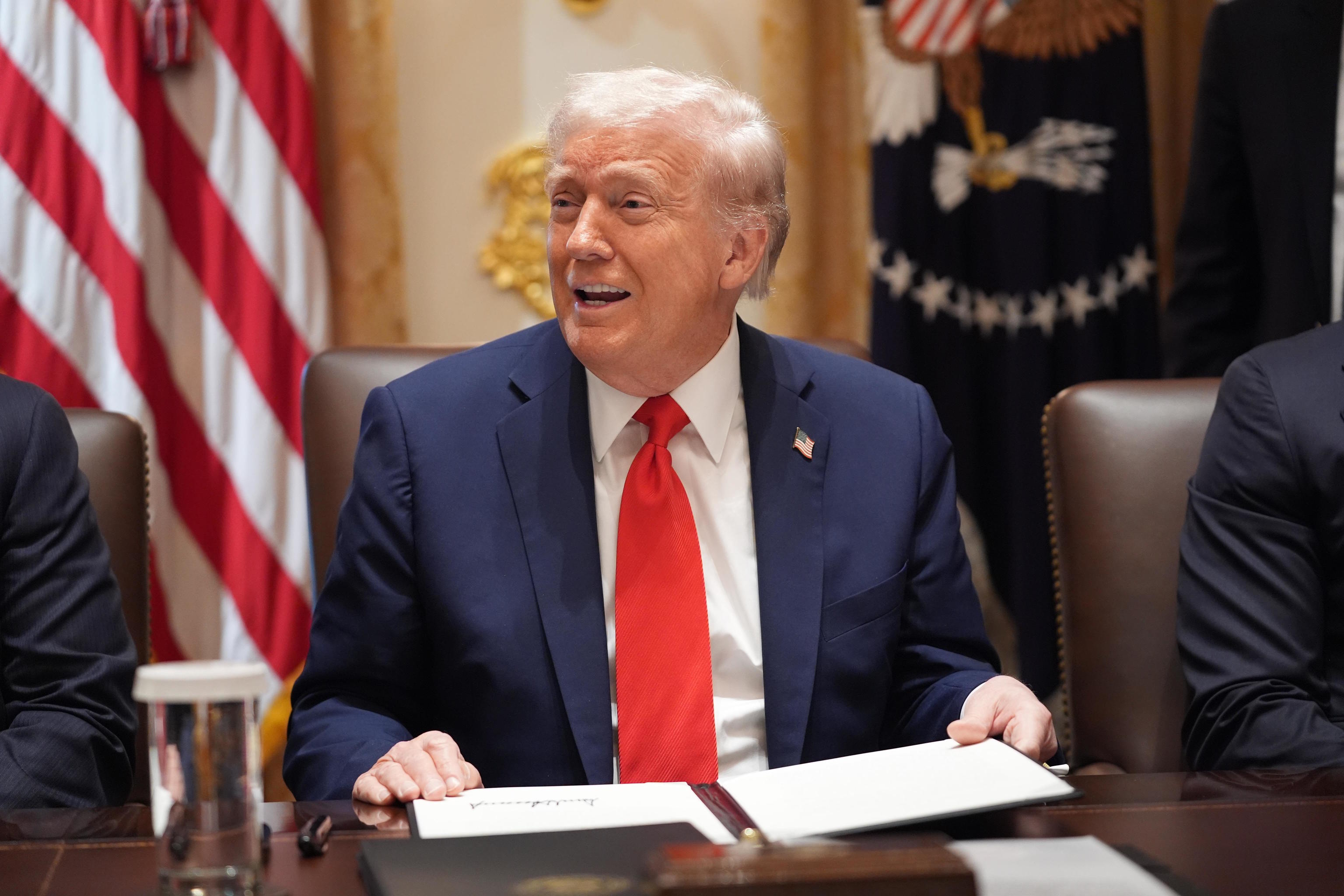
Donald Trump and the Trumpist worldview of International Relations have scored their first major victory of this term with this week's agreement (provisional, partial, full of conditions) between Hamas and Israel. For the U.S. president, it is an essential anchor in his narrative, which with memes, photographs, and biblical quotes seeks to perpetuate himself as "the great peacemaker." He came to power with four main ideas in foreign affairs: immediate peace between Ukraine and Russia; peace between Israelis and Palestinians with the release of the hostages on October 7. A positive change in relations with China. And a gradual withdrawal of his country from the rest of the world's problems and conflicts, based on the MAGA universe's core belief that the U.S. should dedicate its efforts, resources, and priorities to the well-being of Americans, not to being the world's police. Only one, with all the doubts and nuances, is moving in the promised direction.
During these first nine months in power, Trump has brutally revolutionized domestic politics and shaken up international politics with his annexationist threats, his insistence on abandoning or breaking the rules-based international system, and the disconnection from his historical allies. But he has not achieved many of his goals. There is no end in sight to the Russian invasion. Relations with China have not improved, and in fact, he has prompted Moscow and Beijing to strengthen their ties, while the rest of the world does not follow the White House to isolate and punish the Asian giant's economy. Far from focusing solely on Make America Great Again, Trump has bombed Iran or boats in Venezuela while threatening the Caribbean coasts or the lands of Greenland.
Hence the importance of what is happening in Gaza. Trump, who has invented and repeated time and time again that he has ended seven wars this year (in addition to having promoted the Abraham Accords in his first term) and therefore deserves the Nobel Prize, has been involved in this process in an unprecedented way and style. Ironically, given that the world of diplomacy has been governed for centuries by opposite codes, his style, his personality, his ego, and his total indifference to the rest of the world's opinion are what allowed the agreement signed yesterday by Hamas and Benjamin Netanyahu. In a Hobbesian world, his formula of deterrence through intimidation has worked to bring both Israelis, skeptical and reluctant to stop due to their overwhelming military superiority, and the Arab world, willing to break historical taboos, together.
The terms of the agreement are more than precarious. The first phase is critical for Washington because it involves a ceasefire and the release of hostages and prisoners, Trump's great obsession, just on the eve of the Nobel announcement, which he craves to put himself on the same level as Barack Obama, one of the most inexplicable laureates of the century. Phase 1 of the Agreement does not solve the underlying problem, nor do the intermediate ones. Everything is up in the air, from the timetable for Israeli withdrawal to Hamas disarmament. Governance and the reconstruction of the Strip in the future are a pipe dream. And the Palestinian Authority is completely out of the picture, oblivious to everything that has been negotiated, irrelevant. There is no solid proposal for the day after the reconstruction, and the Israeli commitment is minimal and built on the public promise to never allow a Palestinian state. The uncertainty is enormous, and the chances of developing a definitive long-term solution are minimal. But as a veteran of negotiations explains, at least "Palestine goes from hell to a nightmare."
Trump's brilliance does not lie in the 20 points of his proposal, which in general terms have been on the table for over a year. It was outlined by Joe Biden's team and France, Saudi Arabia, and other actors have suggested the same structure since at least 2024. Trump's great merit, unlike all his predecessors, is having leverage over Benjamin Netanyahu. The Israeli Prime Minister ignored Barack Obama and Joe Biden. He disregarded, disrespected, and even humiliated them, skillfully playing on the Democrats' weaknesses in the matter, with American public opinion, and with lobbying capacity in the Capitol. Trump is insensitive to that logic.
He is a volatile president, absolutely pro-Israeli, indifferent to the requests of the Palestinian National Authority, and has appointed absolute loyalists to the Israeli cause in his foreign leadership. But at the same time, all of that does not dictate all his actions and has not allowed Netanyahu, who has visited the White House four times in 2025, to completely impose his narrative. He has made it clear that they are friends, intimate, but that he is in charge and that he had to sign the agreement. He told him in January, in March, in June, and now he has forced his hand.
In these months, Trump has sometimes been reactive, talking about expelling the entire population from Gaza, sanctioning the International Criminal Court, having his ambassador pressure Israeli judges handling cases against the Likud leader. But he has also distanced himself in unique ways, such as directly negotiating with Hamas, something the U.S. had never done. Or forcing Netanyahu to apologize by phone, with an iconic photo of the moment, to Qatar for attacking the Palestinian negotiating delegation in Doha. Similarly, he has leaked some calls between them, shouting at him or reproaching him for "always being negative," as happened just a few days ago.
Experts in the Middle East, negotiators, those who have closely followed the region in recent decades, are also digesting a new phase. Many detest the proposal on the table because they see it as incomplete, insufficient, full of cracks. But they cling to it because there is nothing better, nor can they conceive of anything better right now. They believe that ignoring Palestinian leaders and resurrecting the figure of a pseudo-mandate, especially with a Briton like Tony Blair at the helm, is degrading. But perhaps it is the only way to stop the killing on the ground. They believe that Trump is an impossible, divisive, brutally partial and unpredictable figure, with his own agenda to urbanize and develop the absurd area. But he is the only one with enough strength to force Israel and to use his influence with the Gulf countries to seek something much more ambitious, which could offer Tel Aviv a much more satisfactory framework of stability and security.
Furthermore, Trump has a profile that allows exploring unimaginable paths for an unthinkable moment. Because the situation, from a geostrategic point of view, is unprecedented. Israel has never had such overwhelming military dominance, almost neutralizing all its enemies. In the 90s, the great security obsession was Syria, then Iran. Now Netanyahu can bomb seven rivals almost simultaneously with almost no consequences. At the same time, Palestine has never had so much support. In Europe, the Global South, the UN, and even on campuses and gradually in U.S. public opinion. And it has never seemed more fragile, weak, without any political power. And all this alongside a U.S. with immense military and economic power, willing to use it.
The White House presents this success in biblical terms, saying "blessed are the peacemakers". And it is undoubtedly an injection of optimism and confidence that will be felt in all scenarios, from commercial to the NATO world. It can give the president renewed strength to pressure Vladimir Putin, after losing faith in the relationship opportunities he thought he had with the Russian leader. And Trump's personal involvement, placing himself at the top of the governance process in the Strip, can ensure his constant pressure. But at the same time, it is a huge risk. For his reputation if he fails. For his mood if he is frustrated by the results. For his ambition if he succeeds.