Fran, born in Santiago de Cuba, feels very far from home but also does not want to return. "If I can avoid it, I don't want to go back to Cuba ever again. I want the war to end and be able to choose where I will live," he says. Alongside an Ecuadorian prisoner, they are the only Spanish speakers in one of the largest prisoner camps in Ukraine. In their daily lives, Fran bonds with a group from Sierra Leone, Sri Lanka, Nepal, or Somalia, even though they can hardly communicate. They are united by their darker skin color compared to their Slavic companions and the feeling of being ignored castaways by those who hired them to fight and die on the front lines. They are foreign mercenaries of Vladimir Putin.
The prison we are in is overflowing. So much so that they have set up three shifts a day for work and sleep. Before us, in the yard, we see the captured Russian soldiers resting during the morning shift, all uniformed and with buzz cuts. Heads bowed, conversations in whispers, limping from war wounds... Most gather where the sun shines. "Life in Cuba is crap," Fran continues. "I saw an ad on Facebook, in Spanish, created by the Russian Ministry of Defense. They offered about $2,000 a month to join the army and paid for our trip from Cuba. I was so desperate that I didn't even think about it. With $2,000 in Cuba, I would live like a king." The average salary on the island is around $20.
- Did they give you military training in Russia before going to war?
- Nothing. They send you straight there. As soon as you sign your contract, you become their merchandise.
- How did you communicate with your Russian commanders?
- They used a phone with Google Translate.
Some prisoners are reluctant to speak with us, but others seem eager. Dimitri is from Vladivostok, a city on the far eastern end of Russia, bathed by the Sea of Japan, 15,000 kilometers away. He has a very ugly wound on his leg caused by a drone. He is missing a piece of flesh in his thigh, yet his superiors insisted on sending him to assault an enemy position.
- Not for all the money in the world would I enlist. I'm here to avoid a prison sentence for hitting a plainclothes policeman.
- If you had known what this war was, what would you have done?
- Well, serve my sentence to the end. Now I'm going to be lame for the rest of my life, but at least I'm alive. My comrades complain about the conditions of this prison, but I tell them, "Blyat [damn], we came here to kill them, what did you expect?".
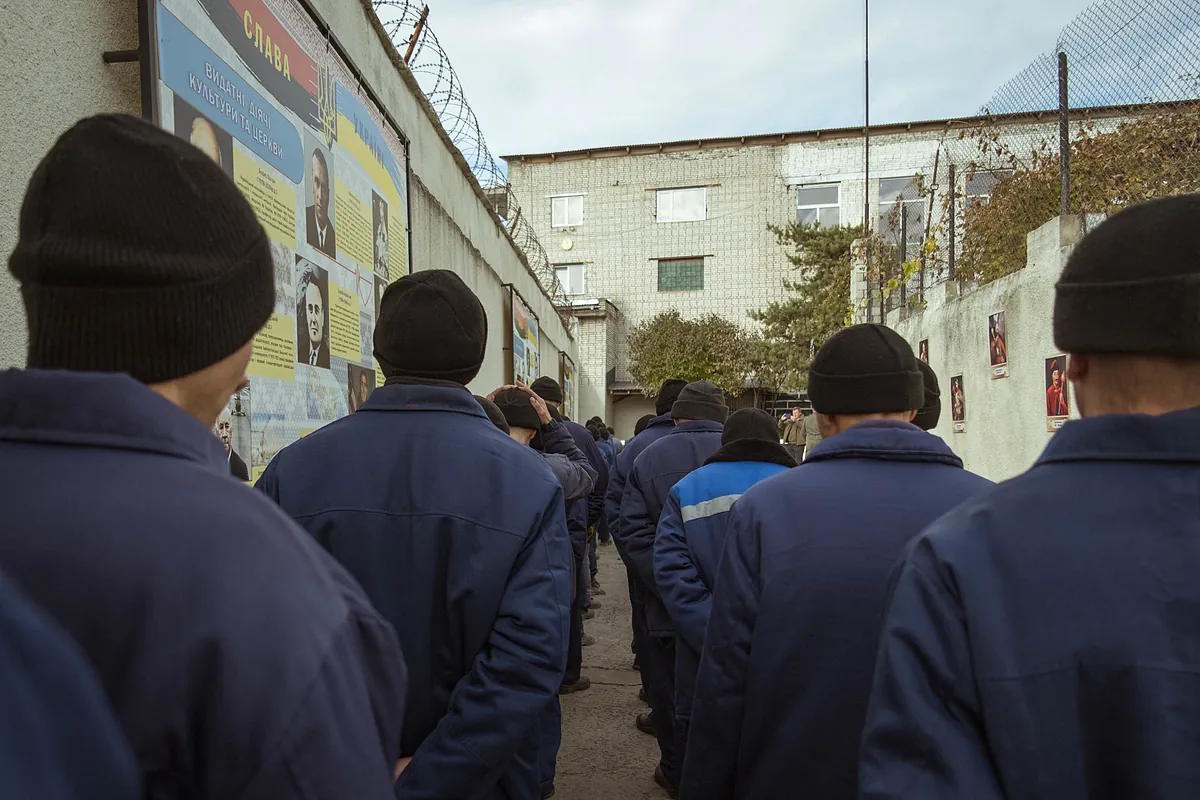
The age of the prisoners is striking. Some are well over 50, an age where one is not fit to spend weeks in the harshness of the trenches. Others are barely 18 years old. Many of them have committed war crimes and are under investigation by the authorities, such as shooting civilians, but in the yard, they all seem calm and peaceful. Without uniforms, weapons, or freedom of movement, their human condition returns them to a state of gregarious submission. We are warned that in the presence of others in the yard, most will not speak openly because they know there are informants among them who, once exchanged, will report them to the Russian Federal Security Service or FSB.
But in private, things change. A few prisoners agree to speak with us. Valeri, 18 years old, still with a childlike face, admits that he joined the Russian army on the advice of his friends, who did the same. At the recruitment office, they were told they would all be together, but he never saw them again. He also did not tell his mother, who knows he is imprisoned in Ukraine through official communication but with whom he has not yet spoken. "In reality, I came for money, to help my very poor family, but also for an ideal. We don't want the West to invade us."
- But Valeri, the West doesn't want to invade you. Where did you hear that?
- [After a few seconds of silence] They say it all the time on Russian television.
The only soldier from Moscow we find is Anton. When asked about the reasons for being there, he presents the full range of Russian propaganda to justify his presence: the genocide of Russian speakers in Donbass, the Nazi-fascist regime in Kiev, the presence of NATO soldiers fighting against Russia...
- Nikita, do you still believe in all those things?
- Nikita, I'm a Spanish journalist, I've been to Ukraine 15 times to report on this war. I haven't found that new Third Reich the Kremlin talks about. Do you think it's possible that Russian propaganda has deceived you?
- [He thinks for a few seconds] Yes, it's possible.
Up close - although it may seem obvious to say - the Russian soldiers, invaders of a country that is not theirs, become people with fears, missing their families, and an enormous capacity to assimilate mass manipulation. In a way, they too are victims of Putin's war. Of the four who speak with us in private, two beg us to send a message to their mothers via WhatsApp and one more, to his wife.
Life in prison is routine and monotonous. In addition to the Russian prisoners, there are separatists from the pseudo-republics of Donetsk and Luhansk, in other words, Ukrainians who are considered traitors here and have been there the longest. They speak Russian but hardly interact with prisoners from the Russian Federation.
Vasili, one of them, born in Luhansk, admits while lifting weights in the outdoor gym that for his fellow Ukrainian rebels who fought alongside them, they have become a kind of "second-class citizens" within the camp. "We mind our own business here. I fought for Russia because I have always felt closer to that country than to Ukraine, but there are some Russians who despise us," he says, while his five companions nod in silence.
Furthermore, the separatists have been in prison the longest. "They believe we don't want to hand them over to their authorities. That's false," our guide comments. "The problem is that no one claims them from the other side. They are also discriminated against for that."
At 12:30 in the afternoon, meals begin. An alarm puts everyone on alert. They line up in a hallway decorated with photos of the founders of the Ukrainian state, mostly Cossack heroes, and a large map representing the entire country, including Crimea, as part of Ukraine.
One by one, they enter the dining hall, where other prisoners have cooked a soup and rice with meat served to their companions. The guests of the day - us - will also eat the same food. It's a menu that's not bad at all and is complemented by a loaf of bread (bujanka), also made in the prison by another prisoner who, as he tells, was a mechanic in the Russian army.
After eating, all of them have to go back to work. As dictated by the 1951 Geneva Convention, the tasks cannot be arduous.
We enter a pavilion where everyone is manufacturing garden chairs and sofas. Each person does something different in an assembly line that never stops. Once again, foreign mercenaries work together at one end of the room, while the Russians are at the other end.
One of them, from Sri Lanka, says he didn't enlist for money but because, lacking legal papers to stay in Russia, authorities demanded he enlist to obtain them. Then we meet Yuri, a well-mannered and educated Russian. When asked about his reasons for fighting, he gets straight to the point: "I didn't want to kill, I wanted to die." Faced with this statement, we ask him to explain. "I'm not well. I need psychological help, but no one gives it to me. I have suicidal thoughts all the time. I thought that joining the army and coming to Ukraine to fight would give me the opportunity to die without having to kill myself."
- How long did you fight on the front?
- Nothing. Three days where I didn't even fire a shot. We were asked to advance towards Dobropillia [Donetsk region]. We were supposed to infiltrate in small groups of three or four. The sky was full of drones. We took refuge in a hole, and the Ukrainians found us. They started throwing grenades into the shelter and asking us to surrender. That's how I ended up here.
- If you had mental problems and suicidal tendencies, how did you pass the Russian army's psychological exam?
- They don't care about that. They just want people for the front line.
Yuri leaves the room crying. He crosses paths with Igor, a 44-year-old man who looks 60. His story is like many in this prison: he was in jail for drunk driving for the second time. He claims he had alcohol problems, and the authorities offered him to enlist to serve his sentence. In the first missions, he was wounded in the leg, and despite that, they kept sending him to the front without letting his wound heal. "I protested through official and unofficial channels. It didn't help," Igor says.
There is a small room with seats to watch Ukrainian television and rest areas with dozens of bunk beds. In them, we find the books they read during their stay in the prisoner-of-war camp: some adventure novels, classics of universal literature, and even the Bible. On the way out, we come across Fran, the Cuban. - Is this war as you thought it would be? - Of course not. I survived three months, and I consider myself very lucky. Sometimes we would go out on an assault with 20 soldiers, and only two or three of us would make it alive to the Ukrainian trench. I never want to see war again.