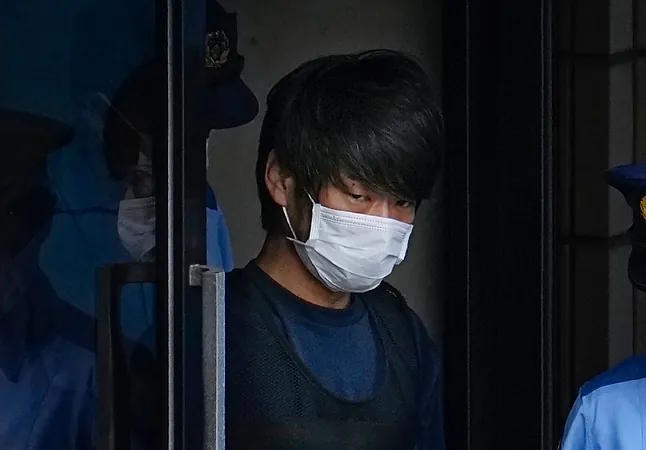
Shinzo Abe, the Japanese prime minister who has spent the most time in office, was shot dead in July 2022 while giving a campaign speech before the Upper House elections. More than three years after the crime, the trial against the confessed killer, Tetsuya Yamagami, who pleaded guilty to the murder, began on Tuesday in Tokyo.
"I acknowledge that everything was my doing," Yamagami responded to the reading of charges.
In the Nara District Court, a criminal case that has been delayed mainly due to the lengthy psychiatric evaluation process that Yamagami (45 years old) has undergone began. This evaluation was necessary for the Prosecution to determine his fitness to stand trial. Yamagami pleaded guilty at the start of the session. The sentence will be announced in January 2026.
Yamagami stated after his arrest that he attacked Abe due to his ties with the controversial Unification Church, a powerful ultraconservative organization with strong links to the Liberal Democratic Party (LDP), the party that has almost continuously governed Japan since the post-war period.
Yamagami told the police that his mother, a member of a church known for holding mass weddings and pressuring its followers to make generous donations, had given large sums of money to the religious group, over 100 million yen (around 565,000 euros), an amount she raised by selling the family home and what was left of her husband's life insurance, who had committed suicide when Yamagami was only four years old. After this, the family fell into poverty.
Japanese media reported that Abe had a close relationship with the church, as did, as a subsequent investigation after the former prime minister's death revealed, 179 of the then 379 LDP parliamentarians, who pledged to sever all ties with the organization.
The shooter explained that he harbored a lot of resentment towards the church, holding it responsible for his family's ruin. "I will never forgive the church or the Japanese who align with it," he posted on his Twitter account in 2019.
"The tragedy of the former prime minister was the catalyst to focus on the issues that led to the murder. These include the relationship between politicians and the religious organization, as well as the use of religion as a form of parental abuse. Therefore, we hope that the trial of the perpetrator of the crime will lead to uncovering the truth about what caused the shocking crime," states an editorial from Asahi, one of Japan's most widely circulated newspapers.
The start of the trial coincides with the visit to Japan of U.S. President Donald Trump, who maintained a close personal relationship with Abe during his first term in the White House. During the bilateral summit that Trump held in Tokyo with Japan's new leader, Sanae Takaichi, on Tuesday, the memory of the late prime minister was very present. Takaichi, who considers Abe her political mentor, gave Trump the golf club Abe used as a gift.
The former Japanese prime minister took office in 2006. He was targeted by several political scandals and resigned a year later. He returned to the helm of the government in 2012, with Japan still reeling from the devastating 2011 tsunami and the subsequent Fukushima nuclear disaster. He won a marathon of six national elections over seven years. In August 2020, he announced his resignation due to his struggles with ulcerative colitis.