In South Korea, the former president who is currently in preventive prison accused of insurrection for declaring a brief martial law almost a year ago, in what was an attempted coup, left the presidential residence after his dismissal wearing a red cap with the 'Make America Great Again' message popularized by Donald Trump. The noisy followers of the former conservative leader Yoon Suk-yeol, in the many demonstrations they staged in Seoul, even asked the American president for help to "save democracy" in their country from communist forces.
Trump arrived in South Korea on Wednesday not to rescue the Asian country from communists, but to verify that the current president Lee Jae-myung, with a progressive stance, will comply with the commercial agreements (350,000 million dollars in investments in United States) that both administrations closed in the summer in exchange for the Republican ceasing his tariff attacks against one of his traditional allies in the region.
In the third and final stop of his Asian tour, Trump also seeks to strengthen a key security partnership for Washington, as he did on Tuesday in the bilateral summit held in Tokyo with Japanese Prime Minister, Sanae Takaichi. For the Trump administration, as well as for the previous U.S. administration, strengthening the Pacific tripartite of democracies (Washington-Tokyo-Seoul) is crucial to contain China's military expansion and North Korea's nuclear threat, which on Wednesday morning fired a cruise missile into the sea with the intention of "demonstrating nuclear capabilities to enemies."
After a meeting between Trump and Lee, the South Korean promised to increase defense spending (currently representing approximately 2.4% of GDP) and to request from Washington the supply of fuel rods to build nuclear-powered submarines and match the levels of Chinese and North Korean submarines, thus "reducing the burden on U.S. forces." South Korea, like Japan, is under the U.S. nuclear umbrella.
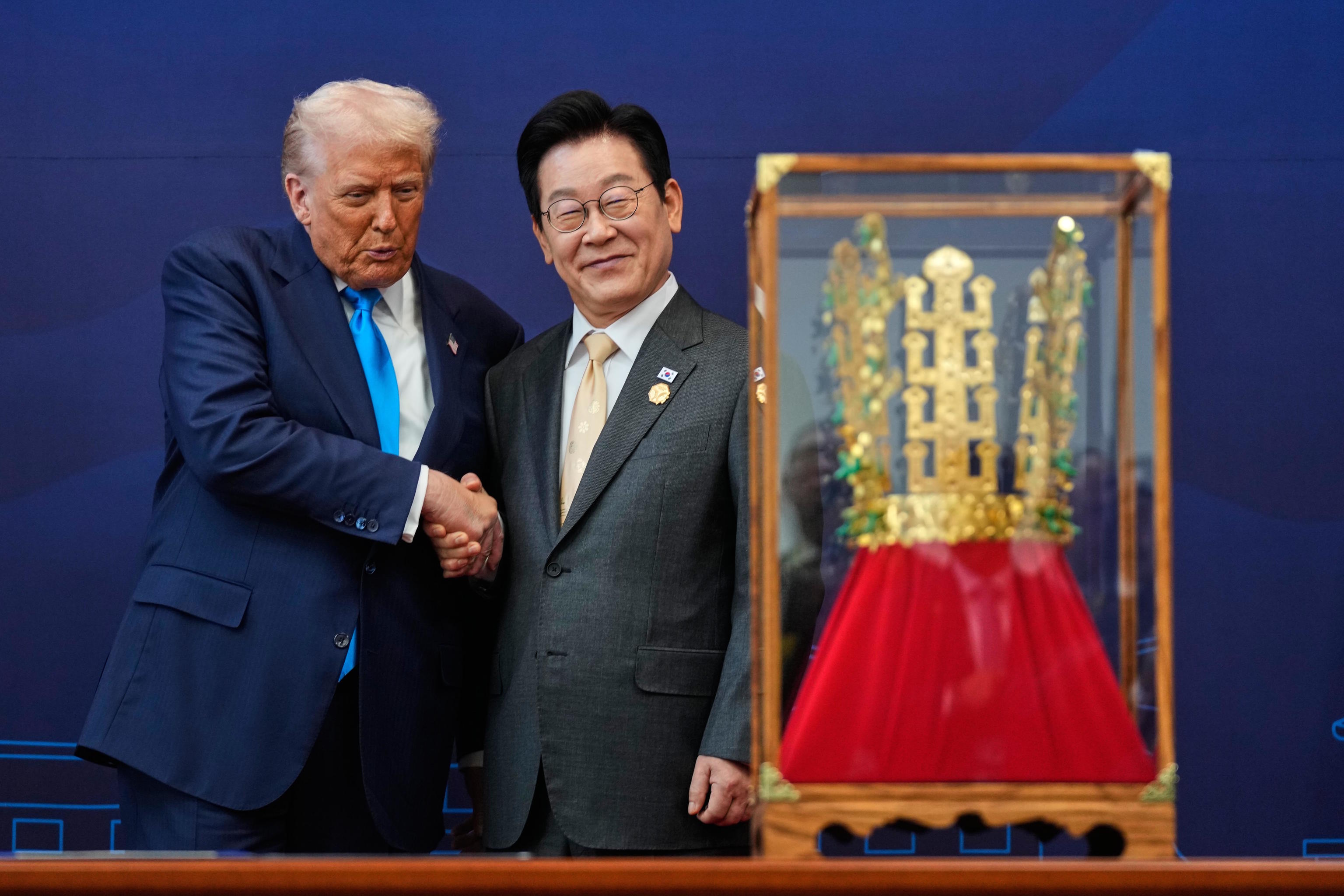
Trump was courted again, this time by South Korean authorities, with an honor guard ceremony playing the YMCA on trumpets, the popular Village People song, and a 21-gun salute. The South Korean president awaited him at the National Museum of Gyeongju, one of the ancient capitals of the country, famous for its royal tombs, Buddhist temples, and pagodas, which will host this week the Asia-Pacific Cooperation Forum (APEC).
The suitability of holding such a significant event, which will host important world leaders, in this city with 240,000 inhabitants lacking an international airport and many necessary infrastructures, starting with enough luxury hotels to accommodate foreign dignitaries and top executives, has been questioned. It has not even been confirmed that the major event that will take place within the APEC framework, the face-to-face meeting on Thursday between Trump and Chinese President Xi Jinping, will take place in neighboring Busan, South Korea's second-largest city.
Five kilometers from the APEC summit venue in Gyeongju, coinciding with Trump's arrival, there was a demonstration against the American president, with criticisms of him being received with honors and all the ceremonial pomp after hitting South Korea, a historic ally, with tariffs and demands for increased defense spending. "No to kings. Trump is not welcome," read some signs raised by protesters, including some left-wing opposition politicians from minority parties.
The summit between Lee and Trump was the second presidential meeting after their talks in August, when the South Korean traveled to Washington after the U.S. administration imposed a 15% tariff on imported South Korean products, lower than the 25% Trump had threatened Seoul with, in exchange for billions in investments. The agreement includes the purchase of $100 billion in liquefied natural gas and other energy products from the U.S. And, more importantly for Washington, a cooperation pact in shipbuilding to counter China's dominance in this field, which gives Beijing a significant military and economic advantage over the U.S.
Before starting trade talks, Lee awarded Trump the highest national decoration of Korea, the Grand Order of Mugunghwa. "A recognition of his contribution to peace on the Korean Peninsula," explained the South Korean presidential office. Along with the decoration, the South Korean leader presented Trump with a replica of a gold crown from the Silla era, one of the ancient Korean kingdoms.
THERE WILL BE NO SUMMIT WITH KIM JONG-UN
Trump has put an end to the big question of the American leader's trip on Wednesday by confirming that there will be no lightning summit with North Korean leader, Kim Jong-un. In recent days, Trump had publicly expressed his desire to meet with the dictator several times. "I would love to see him, if he wants, if he receives this message," Trump said on Monday. U.S. and South Korean officials have stated that there are no concrete preparations underway for a possible meeting, and Trump himself confirmed that he will meet with Kim. If it had taken place, it would have been the fourth summit between the two leaders, who met on three occasions between 2018 and 2019 during the Republican's first term.
"I know Kim Jong-un very well. We get along very well. We really couldn't agree on the timing. President Xi is coming tomorrow, and that is very important for the world, for all of us," said Trump. "I am looking forward to seeing him, and that was really our goal for this visit, but we will have other visits and work very hard with Kim Jong-un and everyone to solve things," he added.
Trump surprised the world once before by convincing Kim to accept the invitation to attend the historic first summit in Singapore in 2018. There was no progress in that meeting on nuclear disarmament, nor in the other summits in February 2019 in Hanoi or in June 2019 in the demilitarized zone between the two Koreas, when Trump crossed the dividing line to meet Kim. Despite the visible opening of new dialogue channels, negotiations stalled because Pyongyang demanded the lifting of international sanctions before advancing in the denuclearization process.
In recent months, Seoul has warned that the North Korean regime is more determined than ever to expand its nuclear arsenal as its main deterrent against any threat of attack from the U.S. or neighboring South Korea, which hosts U.S. bases with over 28,000 soldiers. In early October, Pyongyang flexed its nuclear muscles by unveiling for the first time a new solid-fuel intercontinental ballistic missile, the Hwasong-20, capable of reaching the entire continental U.S. territory.
The Stockholm International Peace Research Institute (SIPRI), one of the leading centers on defense and armament, published a study this year estimating that Pyongyang has around 50 nuclear warheads and enough fissile material to produce up to 40 more. The White House has long warned that the North Korean regime is ready to conduct a new nuclear test, the first since 2017 and the seventh under Kim's leadership of the hermetic Asian country.
Kim, who continues to strengthen ties with Vladimir Putin's Russia, has so far rejected any contact with the Trump administration. According to South Korean media reports, he refused to accept a letter from Trump requesting a resumption of bilateral talks.