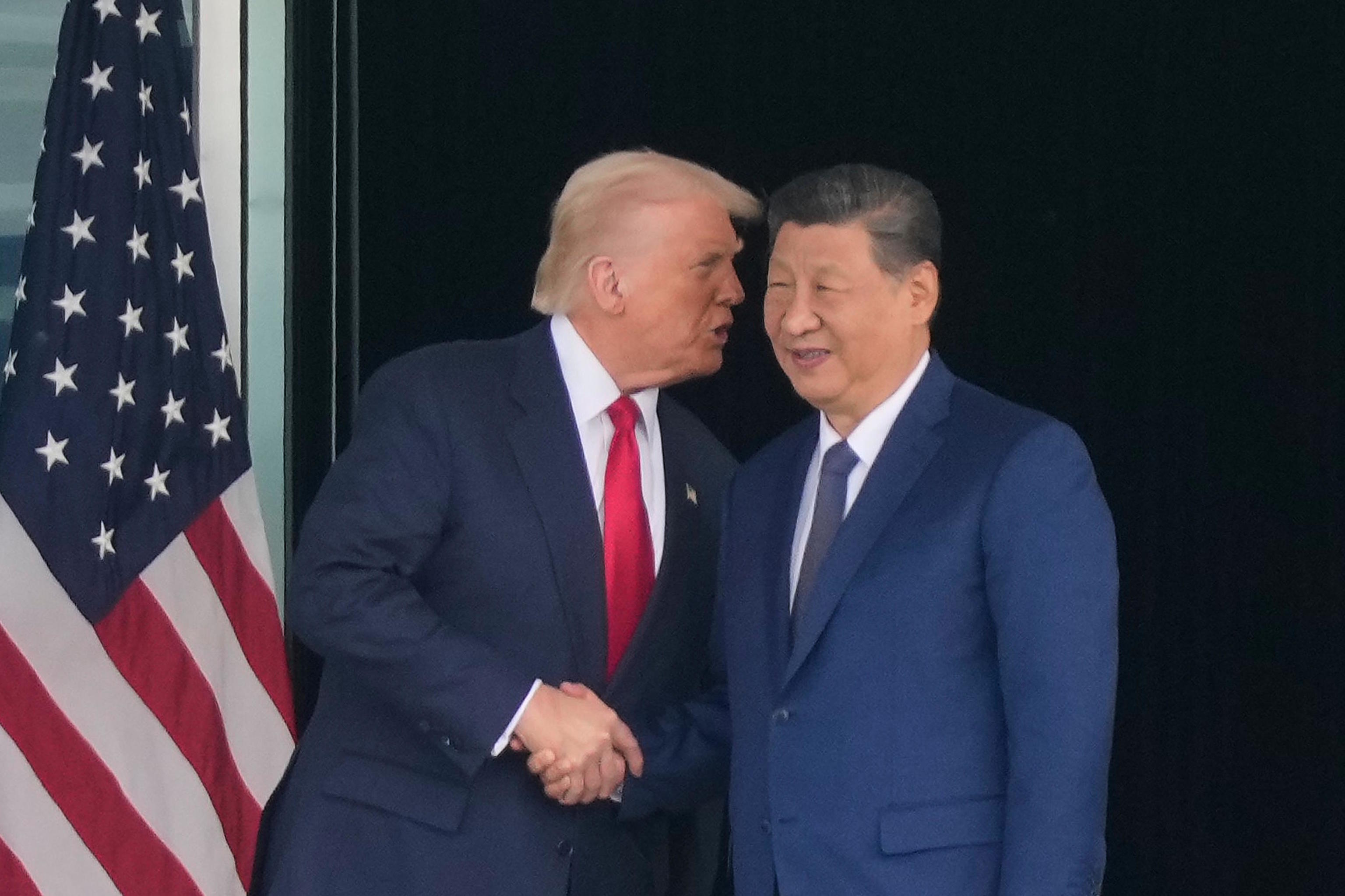
With global trade at stake, the two most powerful men on the planet met for an hour and 40 minutes in the reception room of a South Korean Air Force base near Busan city airport. Donald Trump and Xi Jinping, the presidents of the United States and China, the two superpowers engaged in a fierce battle for global hegemony, had many outstanding issues to discuss in this first face-to-face meeting since the American returned to the White House in January.
The major news was that, as Trump stated after the meeting, the two leaders had committed to halting the tit-for-tat in the trade war initiated by the American earlier in the year. Beijing would thus postpone the implementation of its new controls on the export of rare earths, essential elements for powering all kinds of technology, from advanced semiconductors to military aircraft. In return, Washington withdraws its threat of additional 100% tariffs on Chinese products. "The rare earths issue is resolved," Trump affirmed.
After a firm handshake (with a more talkative Trump, as usual, and a colder and more distant Xi, as usual), before continuing the closed-door meeting, Xi stated in front of the journalists that both leaders should "guide the direction of bilateral relations and work together to achieve more practical and beneficial successes."
The Chinese president added that China's development does not contradict the U.S. vision of "Making America Great Again", clearly referencing Trump's famous slogan. In turn, the American praised Xi as a "great leader," predicting that the two countries will maintain a "fantastic relationship for a long period of time."
An extension of the truce has positive echoes in both Washington and Beijing. Trump can boast at home as a great negotiator after sitting down with his great rival. For Washington, the goal was to demonstrate that its firm stance against China has yielded results. Xi, on the other hand, aimed to show strength by confronting the world's largest economy, resisting coercion, and indicating that he has learned to counterattack with retaliations that are as damaging as those of the U.S. "We have never intended to challenge or replace anyone," Xi assured in the meeting. "We have focused on managing our own affairs well and sharing development opportunities with countries around the world. This has been one of the keys to China's success."
Trump arrived exuberant at this summit after being feted and showered with gifts during his Asian tour, wooing allies like Japan and South Korea with trade agreements aligned with Washington's demands. Xi landed in Busan after reaffirming his unquestionable authority at home by setting the course for the next five-year plan, the centralized planning system.
The Chinese leader also welcomed Trump's commitment to make a State visit to Beijing in April next year. This is a valuable political gift for Chinese propaganda to portray Xi as a great global statesman, capable of organizing a grand military parade accompanied by Russian President Vladimir Putin and North Korean leader Kim Jong-un, and then maintaining a good rapport with Trump.
In the more geopolitical realm, there were two main complex issues: Xi's support for Russia's Vladimir Putin and China's threats to Taiwan, which does not renounce the use of force to take control of an island that de facto operates as an independent country.
While Trump stated that the Taiwan issue was not discussed in the meeting, regarding the war in Ukraine, he said that Beijing and Washington will "work together." Trump had asked China to help convince Putin to end the war in Ukraine. Xi, on the other hand, has pressured the U.S. to change its position of full support for Taiwan, at least publicly stating opposition to the island's independence.
It does not seem likely that Beijing will let go of Putin's hand, who always boasts of the "limitless partnership" he has renewed several times in recent years with Xi. China has been a vital support for Moscow since the West began imposing sanctions on the Russian regime, and Washington has accused the Chinese government of fueling Putin's war machinery by selling the Russians materials with dual-use capabilities, both civilian and military.
In the commercial field, the two countries had already reached an initial truce agreed upon in the first meeting in Geneva in May 2025 and expanded during subsequent meetings of their negotiating teams. At that time, Trump's imposed tariffs were suspended, which had raised tariffs on Chinese products to 145%. These were reduced to 30%, while China's retaliatory tariffs of 125%, were lowered to 10%.
The 20% difference corresponded to punitive tariffs related to fentanyl. Washington accused Beijing of not doing enough to stop the shipment of the chemical precursors necessary to manufacture this synthetic drug causing havoc in the U.S. These are the tariffs that Trump committed on Thursday to halve - reducing the total tariff burden, including tariffs imposed by the previous U.S. administration, from 57% to 47% - in exchange for a new commitment from Beijing to intensify its campaign against these chemical precursors.
"China and the United States should focus on the long-term benefits of cooperation, rather than getting caught in a vicious circle of mutual retaliation," emphasized Xi. The U.S. president also stated that China will invest more in the U.S. and that Trump will buy a "huge amount" of American soybeans and other agricultural products, adding that a formal trade agreement will soon be signed.
Protests at the Korean stronghold
The most important political summit of the year (which Trump described as the "G2") took place in a military stronghold surrounded by fences and barbed wire, an unglamorous location for such an important meeting, shielded against anti-Chinese and anti-American protests that were scheduled. In South Korea, on one hand, there is a strong ultraconservative movement that embraced conspiracy theories about how China, along with North Korea, had infiltrated agents in Parliament with the intention of undermining South Korean democracy. Former President Yoon Suk-yeol, who is in pretrial detention on charges of insurrection, clung to this to justify the brief martial law he decreed almost a year ago.
In the polarized Asian country, protests against Donald Trump have also begun to make noise, especially in recent months, shaking a historic ally like Seoul with his trade war. Among the protesters who gathered in recent days were lawmakers from minor left-wing parties criticizing the current progressive South Korean leader, Lee, for courting Trump, yielding to the Republican's commercial demands, and gifting him on Wednesday with several presents, including a replica of the gold crown of an ancient Korean medieval king.
The only world leader who has withstood Trump's tariff slaps has been Xi, who has spent the entire year exchanging commercial blows and sanctions with Washington. In this dispute, Beijing played with a winning card, that of its monopoly on rare earth production.
After concluding the meeting in Busan, Trump boarded Air Force One to return to his country, ending his Asian tour. Xi traveled to the neighboring city of Gyeongju, which is hosting the Asia-Pacific Cooperation Forum (APEC) this week. In the summit, each delegation was composed of seven strong men from both governments. From the U.S. side, Secretary of State Marco Rubio and Treasury Secretary Scott Bessent stood out. From China, accompanying Xi, was the country's foreign minister, Wang Yi, and the vice premier in charge of trade negotiations, He Lifeng.
The last time Trump and Xi faced each other was in 2019, during the Republican's first term, on the sidelines of a G-20 summit in Osaka. At that time, discussions also focused on the early stages of the trade war. For decades, China's state investment in export industries opened the doors to the U.S. - and the rest of the world - to cheap Chinese products. In return, Beijing received significant investments and U.S. technology. The idyll was broken when, during the giant Asian's development explosion, Washington began to see Beijing as a threat to its hegemony.
Trump and Xi, despite their subsequent clashes, began their relationship on a good note, inaugurating their bilateral summits in 2017 at Trump's luxurious Mar-a-Lago residence in Florida. From that first meeting came a striking headline: Trump decided to bomb Syria while enjoying the most beautiful chocolate cake ever seen with Xi Jinping in a room overlooking the sea.