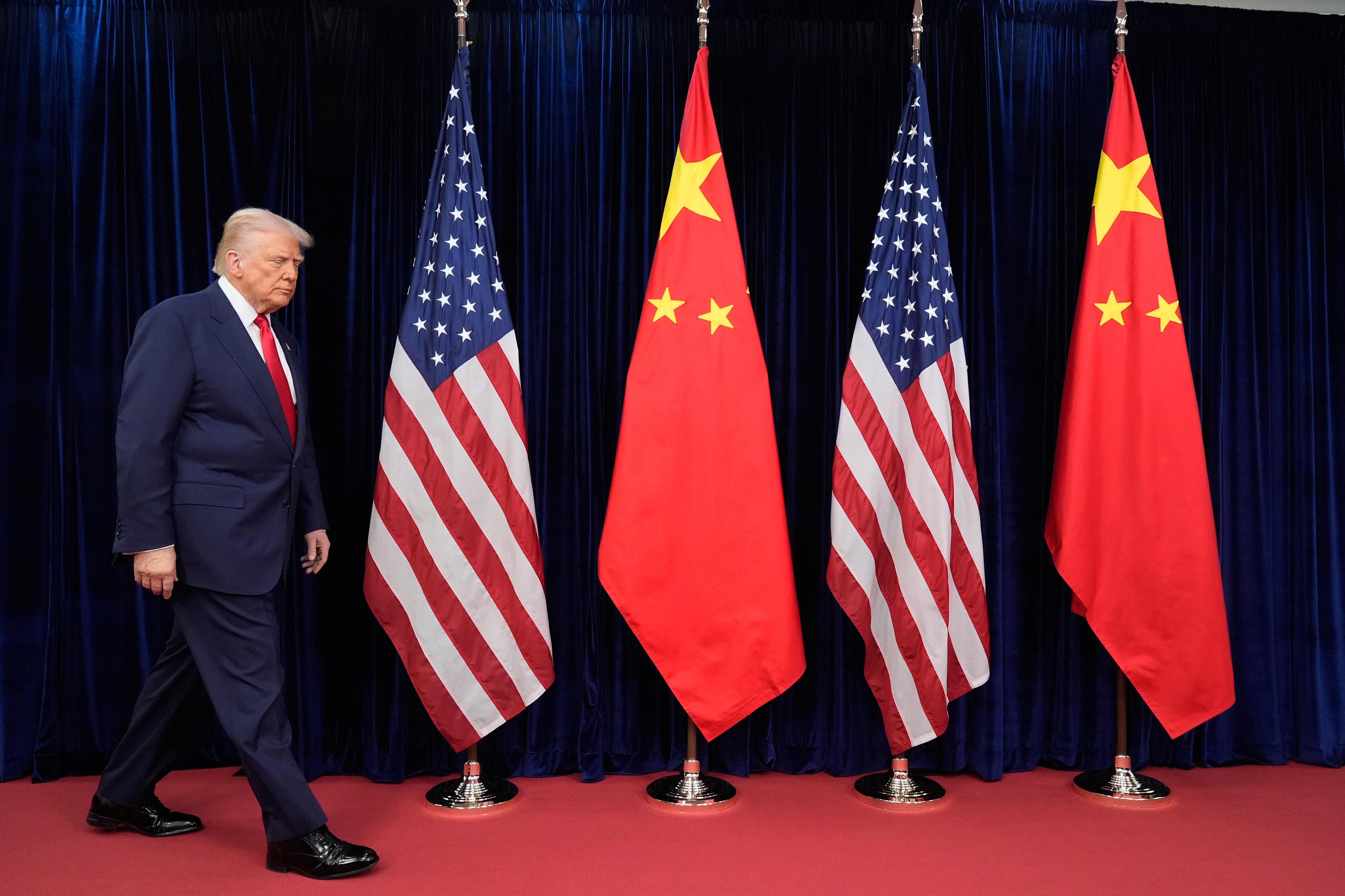
Just before starting a meeting in South Korea with Chinese leader Xi Jinping, U.S. President Donald Trump posted on Thursday on his Truth Social account a message instructing the Pentagon to immediately resume nuclear weapons testing "on equal terms" with other nuclear powers.
"Due to the testing programs of other countries, I have instructed the Department of Defense to begin testing our nuclear weapons on equal terms. That process will start immediately," Trump stated. "Russia is second, and China is far behind in third place, but they will be equal within five years," Trump noted.
Trump's post came after Russian President Vladimir Putin stated from Russia that Moscow had successfully tested its Burevestnik cruise missile, with nuclear capability, as part of efforts to "ensure the country's national security." The Kremlin also conducted tests with a new nuclear-powered underwater drone.
The last U.S. nuclear test, codenamed "Divider," took place on September 23, 1992, in Nevada. That same year, then-President George H.W. Bush announced a moratorium on underground nuclear testing.
Trump surprised with the message on his social media before spending Thursday morning in the South Korean city of Busan, where he had the first face-to-face meeting with Chinese leader Xi Jinping. A meeting aimed at reducing trade tensions between the world's two largest economies.
After a handshake and in the open minutes to the press before continuing the closed-door meeting, Xi stated that both leaders should "guide the direction of bilateral relations and work together to achieve more significant, practical, and beneficial successes."
The Chinese President added that China's development does not contradict the U.S. vision of "Making America Great Again," making a clear reference to Trump's famous slogan. Trump, in turn, praised Xi as a "great leader," predicting that the two countries will maintain a "fantastic relationship for a long period of time."
On the negotiation table were tariffs, restrictions on sought-after rare earths, or the fight against fentanyl trafficking. There was no issue related to the nuclear policy of the two superpowers on the agenda. But Trump, after the meeting, stated that "now is the appropriate time" for the U.S. to resume nuclear testing, given that other major countries have already started doing so.
Aboard Air Force One on his way back to the U.S., Trump also stated that he "wants to see denuclearization" and that Washington "is in dialogue with Moscow" on this issue and will soon address it with Beijing.
The latest report from the Stockholm International Peace Research Institute (SIPRI), one of the leading centers on defense and armament, pointed out that nuclear-armed states are strengthening their atomic arsenals and abandoning arms control agreements, ushering in a new era of threats that has ended the arms reduction policy established after the Cold War.
SIPRI reported that the United States and Russia, which possess around 90% of all nuclear weapons (5,459 in Moscow and 5,177 in Washington), relatively maintained the sizes of their respective active warheads last year, but China has accelerated the increase of its nuclear arsenal by around 100 new warheads per year, currently storing around 600.
"Of the total global inventory of approximately 12,241 warheads as of January 2025, around 9,614 were in military arsenals for potential use," stated Hans M. Kristensen, a SIPRI researcher. "Global tensions have led the nine nuclear states (United States, Russia, United Kingdom, France, China, India, Pakistan, North Korea, and Israel) to plan to increase their stockpiles."