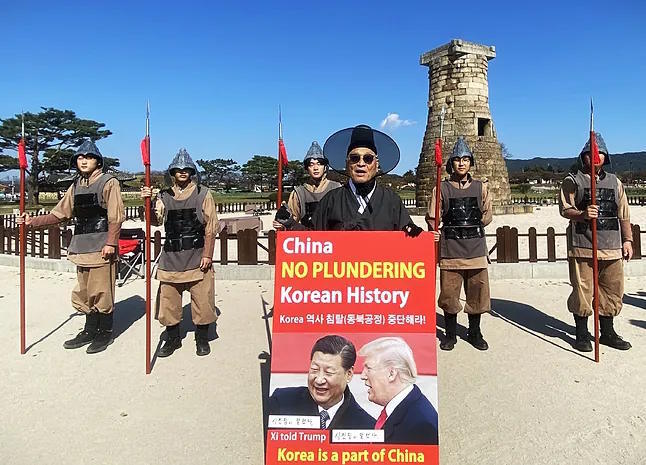
"Out China!, Out the Chinese Communist Party!, Out Xi Jinping!", shouted a group of protesters gathered in a square in the center of Gyeongju, a city in South Korea where medieval kings are buried under 20-meter-high hills that serve as stone and earth burial mounds from the ancient Silla kingdom (from 57 BC to the 10th century). This week, Gyeongju has been the epicenter of a regional summit, the Asia-Pacific Cooperation Forum (APEC), in which the Chinese president was participating.
For a long time, the relationship between neighbors Beijing and Seoul has been marked by many ups and downs. From Chinese economic retaliations after South Korea deployed a U.S. missile defense system, to accusations of illegal fishing in Korean waters, to claims of cultural appropriation. Additionally, both peoples carry a series of historical grievances. Now, anti-Chinese sentiment is growing more than ever in South Korea.
There is a noisy stream of far-right groups embracing a series of conspiracy theories pointing to China, along with North Korea, having infiltrated agents into Parliament with the intention of undermining South Korean democracy. Former President Yoon Suk-yeol seized on this to denounce electoral fraud in last year's legislative elections and justify the brief martial law he declared in December 2024. Yoon is currently in pretrial detention on charges of insurrection.
Controversies have erupted on Korean social media because several establishments in the country, such as cafes and restaurants, announced that they would refuse to serve Chinese customers. Over the past decade, according to a survey by the East Asia Institute, sinophobia in South Korea has risen from 16% to 71%.
Continuously, protests erupt at various points in South Korea, some massive and others represented by a single individual, against something or someone related to China. On Saturday morning, in the historic center of Gyeongju, a university professor named So Gilsu was protesting because, according to him, Xi Jinping had told Trump a few years ago that Korea was part of China. "He wants to plunder our history," he claimed.
Against this backdrop, the current South Korean President, Lee Jae-myung, has tried to balance the traditional security alliance with the United States and his country's dependence on China, its main trading partner and a vital market for its exports. Lee decisively won the presidential elections last June after six months of extreme political turmoil and massive protests in Seoul following the attempted coup by former leader Yoon.
The South Korean president met with Trump in Gyeongju on Wednesday, whom he honored with the highest decoration from his government, a commitment of $350 billion in South Korean investment in the U.S., and a golden crown. There were also anti-American protests in several cities in the Asian country because many do not understand their government's subservience to a president who has boasted of using commercial blackmail against his supposed allies. However, these demonstrations are more recent and less noisy than the anti-Chinese ones.
Trump left Korea on Thursday, skipping the summit and handing all the spotlight to China's Xi Jinping, who took advantage of the void left by the American to hog all the limelight and meet with other world leaders on the sidelines of the event. The Chinese leader, who had not visited South Korea in 11 years, met the host Lee for the first time.
While Trump was back home celebrating Halloween, Xi delivered a speech in front of world leaders and business figures present in Gyeongju, defending free trade and multilateralism, a stance contrary to current Washington policies of erecting trade barriers and signing bilateral agreements. Ironically, APEC was a creation of Washington in 1989 to strengthen regional economies through trade. However, the joint statement of the 21 member countries of this group (although only 14 leaders attended) made no mention of the multilateralism promoted by Xi.
On Saturday, during the conclusion of APEC, which will be held next year in the Chinese city of Shenzhen, Xi presented his proposal to the other leaders for the establishment of a global organization to regulate artificial intelligence. "A World Cooperation Organization on AI could establish governance rules and promote cooperation, turning AI into a public good for the international community," he stated.
A couple of days before the end of the summit, in the center of Gyeongju, there was another small anti-Chinese protest. However, in this case, the protesters were not targeting Xi or embracing conspiracy theories about communists wanting to steal their democracy. It was a protest for the "kidnapping" of a giant panda named Fu Bao, the son of Chinese pandas but born in a South Korean zoo, where he spent his early years until Beijing, as stipulated in the loan contracts for these animals, demanded his return. The protesters were calling for their beloved Fu Bao to come back to South Korea.