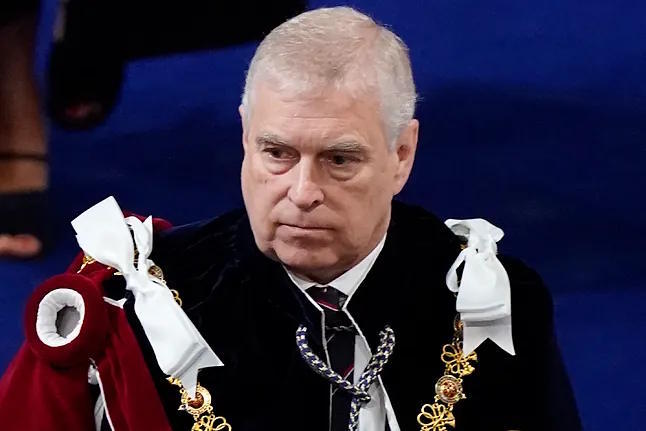
No monarchy in the world is subjected to the constant scrutiny of public opinion polls as much as the British monarchy. In the United Kingdom, companies that measure public opinion regarding the support and popularity of its institutions conduct studies at a devilish frequency, a constant reminder that the Windsors cannot ignore. It might seem contradictory that the Crown, by definition an institution with a long-term perspective that should not pay much attention to immediate concerns, worries about polls, as political parties do in pure electoral logic. However, in recent weeks at Buckingham, data weighed heavily like a millstone, such as the latest Ipsos study concluding that up to 43% of Britons believed that the royal family had mishandled the situation with Andrew since the first accusations were made against him in the sexual abuse scandal, compared to only 23% of citizens who were convinced by their actions.
This week, during a visit to Lichfield Cathedral (England), while being greeted by a small crowd of locals, Charles III was surprised by the shouts of some protesters who threw inquisitorial questions at him such as "How long have you known about Andrew and Epstein?" or "Have you asked the police to cover up for Andrew?". With composure, the monarch turned a deaf ear. But the images revealed a sense of anguish in the face of questions that implicated him in the biggest scandal in the British Monarchy in the last decade.
The harsh shouts pointed directly at the king for his lack of diligence in acting against his brother, despite the significant damage he has caused to the image and credibility of the institution. This is precisely what the polls detect. Other data also show that today only 51% of Britons consider it "very important" or "important" for the United Kingdom to maintain the Monarchy as a political system. The Throne is not at risk. Not by a long shot. Almost 80% of citizens do not believe a system change is possible at present. The proportion of those who support the Crown is much higher than those who declare themselves republicans, usually below 20%. However, the growing detachment towards what the Monarchy represents, especially among the youth, is a warning sign. In Charles III's team, an extremely active sovereign who is making remarkable efforts to enhance his role both domestically and internationally, even at the expense of his health, there is ample evidence that regenerating the image of the centuries-old Crown was impossible as long as Palace actions towards Andrew remained lukewarm.
And, as expected, the current focus is on saving the supreme good: the Crown. As it has been on many occasions. After all, we are dealing with an institution that has shown resilience and has survived countless scandals in modern times, from which it has successfully recovered. Most Britons were probably waiting for the monarch to take a decisive stand. Because the decision to strip his brother of the title of prince is as painful on a personal level as it is delicate and devastating in dynastic terms. The lack of precedents not only highlights the historical significance of the event but also underscores the sensitivity of the matter.
The Windsor dynasty -the surname replaced the German Saxe-Coburg-Gotha in 1917 by another crucial decision by George V who thereby distanced his bloodline from Germany, the enemy during the Great War- now operates, concerning the princely dignity rights of its members, under the 1917 Royal Warrant stipulating that every child of the sovereign holds the title of prince or princess from birth, along with the style of Royal Highness. The same Letters patent states that the children of the monarch's grandchildren are entitled to the same treatment, although there may be exceptions. For example, Eugenie and Beatrice, daughters of the now disgraced Andrew, have been princesses since birth, while the descendants of Anne and Edward -also siblings of Charles III- have never held such dignity, by voluntary decision of their parents.
Andrew's removal is the result of the sovereign's prerogative, who, as reported yesterday, issued a royal order to the Lord Chancellor, David Lammy, to formally revoke his brother's prince title and remove him from the Nobility Register. The significance of this move for the dynasty's future cannot be overlooked. The standard of exemplarity will now be more crucial than the right of blood to remain part of the royal family -even if not an active member, as was already the case with Andrew. This opens up inevitable scenarios of uncertainty within the Monarchy.
In 1917, the Title Deprivation Act was passed in the United Kingdom, which at the time allowed George V to strip several lords of their titles for collaborating with enemy powers, Germany and Austria. However, the current situation carries much greater significance.
After all, Andrew Mountbatten Windsor -the descendants of Queen Elizabeth II now bear the surname of the queen's husband, Philip of Edinburgh, a change that restored his pride after his famous complaint that he was "the only man in the country not allowed to give his name to his children; I am nothing but a damn amoeba"- still holds the eighth position in the line of succession to the Throne of London. Losing that status could only be done by law. It would not be enough for the Westminster Parliament to approve it; the legislatures of the other 14 nations where the British monarch is the head of state, such as Australia or Canada, would also have to approve it.
Yesterday, Prime Minister Keir Starmer made it clear that the matter is not on his government's agenda. What a mess, he almost said.
In addition to Andrew's inevitable downfall, in the statement released by Charles and Camilla on Thursday, there was an emphasis on expressing "solidarity with the victims and survivors of any form of abuse". Parliamentary monarchies today, as we know well, even in Spain, rely on their survival not only on the correct exercise of their constitutional functions but also on integrity and empathy with the citizenry to an extent unimaginable until recent times. At Buckingham, there is no doubt that the Monarchy must be exemplary or it will not endure.