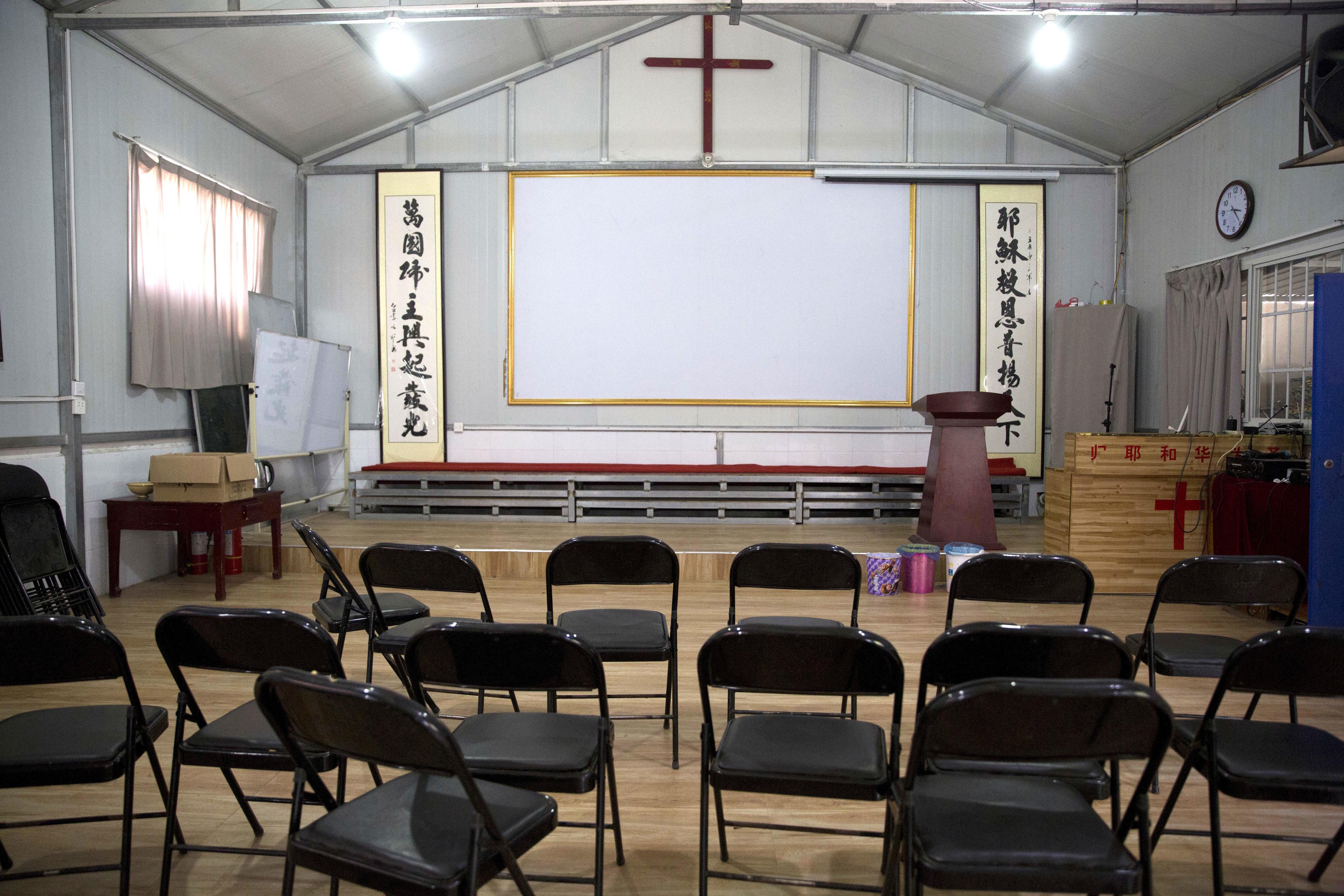
There are no signs, crosses, or hymnals. Nothing suggests that the gray door on the ground floor of an office building, next to the bathrooms and a stand selling sausages, sweet potatoes, and various snacks, leads to a church. Upon entering, on the floor, there is a rusty sign that still reads, in peeling letters, the official designation of this place: "Stationery Cooperative". Inside, what is found is a room with a small improvised altar: a low table covered with a piece of white cloth. On top, a Bible and a crucifix. Around, two rows of plastic chairs.
Feng, one of the custodians of this unconventional Christian temple, explains that when "someone suspicious" asks too many questions about what they do inside, he hangs the cooperative sign on the door. "We are in China, a country with a system that sees and knows everything, so we are not a secret church, but clandestine because we are not legally recognized by the authorities. The Police, although they come from time to time to remind us that we are being watched, have left us more or less alone for now. But we know that any day they can come and arrest us," he asserts.
As Feng has described, we are in a clandestine church "hidden" in a building of logistics and consulting companies in a major city in southern China. It is part of the All Ranges Church, a popular Pentecostal movement known as "The Weepers".
A woman we will identify as Li, Feng's wife and also a follower of this cult, explains the reason for the striking nickname. "The most heartfelt emotion, which leads to tears during prayers and expressions of repentance, is what has characterized our church, founded in the 1980s and with several branches. We resemble Protestantism in not having a unified hierarchical structure," she details.
The couple states that their pastor was arrested a couple of years ago, and now they organize the ceremonies themselves. The Weepers are one of the many clandestine churches classified by the Communist Party of China (CPC) as xie jiao, which translates as "heterodox teachings", although it is also used as a term to refer to "evil sects". These are those that are not registered with the Religious Affairs Office, the regulator of temples, because they refuse to let the atheist government appoint their pastors, who must meticulously follow the Party line.
Feng and Li say that their community consists of about thirty people, but they have agreed not to meet again for a while, neither in person nor online (as they often do through a Western application), following the latest crackdown by the authorities against clandestine Christian churches. Last week, around 30 religious leaders were arrested in raids carried out in centers across various parts of the country.
The news made quite a stir in the American press because among those arrested was the well-known founder of the Zion Church, Jin Mingri, who has thousands of followers in China and has extended his network to the United States, where his wife currently lives and reported that her husband was among those detained.
After a previous raid in 2018, when the Zion Temple in Beijing was closed in 2019, Jin began organizing online prayer groups. The group describes itself as a non-denominational evangelical church adhering to orthodox Christian beliefs. "These arbitrary detentions reflect a growing repression of religious freedom. President Xi's government seems determined to restructure religious practice to favor the interests of the CPC, and congregations that do not comply face harsh persecution," says Yalkun Uluyol, a spokesperson for Human Rights Watch.
Following the arrests, from Washington, U.S. Secretary of State Marco Rubio also publicly accused Beijing of "exercising hostility towards Christians who reject Party interference in their faith and choose to worship in unregistered churches."
According to government figures in recent years, China has a significant Christian population: around 38 million Protestants and nearly six million Catholics. Although independent groups claim that the number of believers is much higher and that, under Xi's leadership, the CPC has promoted the sinicization of religion, a term used by the Party to describe the campaign to adapt religions to Chinese political and cultural doctrines.
The Chinese Constitution recognizes five religions (Buddhism, Catholicism, Taoism, Islam, and Protestantism) and states that citizens "enjoy freedom of religious belief," but this freedom is limited in practice. In 2020, new regulations required religious groups to "accept and disseminate the ideology and values of the CPC." In recent statements, Xi argued that continuously promoting the sinicization of religions was "the only way" to achieve religious, ethnic, and social harmony, and the long-term stability of the country.
"We are not a dangerous sect, nor do we promote civil disobedience as they say. We just want to be able to enjoy our faith freely," comments Feng, from the All Ranges Church movement. "I understand that the authorities may pursue other Christian organizations with extremist and harmful beliefs, but neither we nor those from the Zion Church who have been detained fit that definition," he concludes, referring to other traditionally persecuted groups like the controversial Eastern Lightning, which also continues to maintain some clandestine churches in the Asian country.
The founder of the aforementioned congregation, dating back to the early 1990s, a physics professor named Zhao Weishan, built the creed around the belief that Jesus Christ had reincarnated in a Chinese woman, specifically in his lover. In 2012, the Chinese press began to pay special attention to these Christian preachers because, following a Mayan prophecy, they made a lot of noise in public demonstrations proclaiming that the end of the world was imminent.
A document from the Chinese Ministry of Public Security claimed that before founding the Eastern Lightning, Zhao had been part of several radical Christian sects that were dedicated to defrauding money from their followers. Zhao fled to the United States, where he received asylum and established the headquarters of his church, which has spread to many other countries such as Mexico or India. Even in Spain, where it has its headquarters in an industrial warehouse in Madrid.