Donald Trump and Xi Jinping sat face to face on October 31st for 90 minutes in a room at a military base at Busan Airport in South Korea. It was the first meeting this year between the leaders of the two superpowers, the United States and China. Many topics were discussed, mainly related to the trade war. However, after the meeting, there was an unusual omission in the official statements from Washington and Beijing: not a single mention of Taiwan, an issue that had previously held a prominent place on the agenda.
Among the officials of the self-governing island that China claims as part of its territory, there was much concern after seeing Trump "marginalize" Taiwan at the important summit with Xi. It was not the first time that, from Taipei, they privately criticized a "snub" by the Republican, although publicly they maintain that Washington's support remains as strong as ever. "It was strange that the U.S. side did not address the threats to Taiwan, but even more unsettling was that Beijing also made no reference," said a senior official from the Taiwanese Ministry of Foreign Affairs.
In recent months, spokespeople from the Asian giant have reiterated that China does not renounce the use of force to take control of an island that de facto operates as an independent country. But Trump has stated on more than one occasion that, as long as he is president, Beijing will not invade Taiwan. He hinted at this again just over a week ago. What the Republican has not addressed, unlike his predecessor Joe Biden, is whether he would order a military intervention to defend Taipei in the event of an attack by the Chinese army.
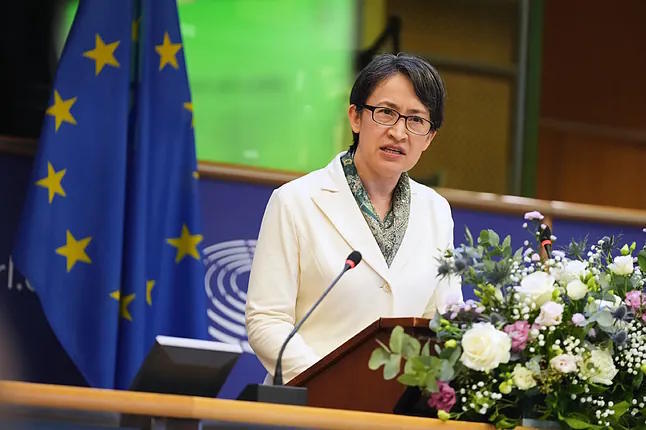
Amid this uncertain scenario regarding the traditional security umbrella from Washington covering Taiwan, the island's leaders are trying to strengthen relations with European democracies. Last Friday, Taiwanese Vice President Hsiao Bi-khim appeared at the European Parliament to deliver a speech at a conference on China attended by fifty European parliamentarians. An unexpected and unprecedented intervention in an institution that, like the United States, adheres to the principle of "one China" and does not recognize Taiwan's sovereignty or have formal diplomatic relations with the island.
"The stability across both sides of the Taiwan Strait is not only a regional concern but a cornerstone of global prosperity," stated Hsiao. "Despite being excluded from international organizations, Taiwan has stepped forward. We contribute to humanitarian aid and maintain global standards even when we are not allowed to have a voice or a vote."
The mentioned conference, to avoid angering Beijing too much, was registered as an event organized by lawmakers outside the Parliament, so direct approval from Brussels regarding the speakers was not required.
Nevertheless, the Chinese delegation to the EU criticized that the Parliament "had ignored" the strong opposition of the regime and had allowed Hsiao, considered a "Taiwanese separatist," to deliver her speech. "This represents a serious interference in China's internal politics and has dealt a severe blow to mutual trust between China and Europe," Beijing's statement pointed out.
The situation in Taiwan is usually handled delicately in the EU, precisely avoiding appearances like Vice President Hsiao's to prevent Beijing's retaliation through commercial reprisals that cause significant harm. Taiwan's only formal diplomatic relations in Europe are with the Vatican. However, there are different positions among the member states on what kind of ties should be maintained with Taipei.
Nations like Lithuania sought a diplomatic conflict with Beijing after opening a "Taiwan Representative Office," an upgrade from the name of the commercial office that Taipei has in European capitals and effectively functions as an embassy. Estonia was going to follow the same path until Beijing threatened to sever all commercial ties.
Other countries, like Spain, are not considering strengthening relations with Taiwan at this time. Vice President Hsiao, during a part of her speech where she referred to the need for greater commercial and technological cooperation, directly mentioned some nations, including Spain, the country that has deported the most Taiwanese to China.
"Taiwan is not alone. We have more and more like-minded friends around the world," Hsiao stated upon returning from Europe on Sunday. Meanwhile, the Taiwanese Ministry of Foreign Affairs reiterated that they continue to maintain close contact with Washington, their main arms supplier, and that communications with the Trump administration remain fluid.
Last summer, Taiwan's President, Lai Ching-te, had planned an official trip to Latin America. The initial plan was to make a stop in New York on the way to Paraguay, Guatemala, and Belize, three of the 12 countries that recognize Taiwanese sovereignty. However, the trip was canceled because the United States blocked Lai's intention to set foot on American soil, a gesture that would have angered Beijing amid trade negotiations. U.S. media reported that Trump himself had ordered this summer to prevent the Taiwanese from landing on U.S. territory.