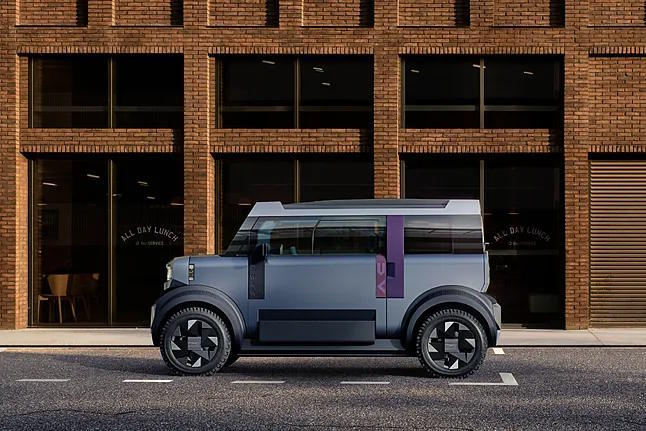
On September 12, after holding a summit with the automotive industry, the European Commission announced its intention to create a new category of cars that its president, Ursula Von der Leyen, named E-car. "We are going to work with the industry on a new initiative to manufacture small affordable cars that will be electric and manufactured in the Old Continent because we cannot allow China and other countries to conquer this market," stated the politician.
Three months later, on December 10, the EU will announce how this initiative will materialize. This was confirmed by the European Commissioner for Industry, Stéphane Séjourne.
With fewer driving aids
It would be an intermediate category between so-called heavy quadricycles - like the Silence S04 - which weigh a few hundred kilos, and the rest of conventional cars, so that these new small cars no longer have to incorporate as many safety and technology systems that make them heavier and more expensive to acquire. "The goal for manufacturers is to launch new small vehicles on the market with prices between 15,000 and 20,000 euros [before possible public subsidies], and since regulatory restrictions also influence the price, we are going to create this regulatory framework," Séjourne added.
In this sense, Japanese kei cars have always been talked about as a reference, tiny cars specific to that country and powered by small gasoline engines. Although the proposal presented by the Dacia Hipster prototype seems much more aligned. It is a car only three meters long, but capable of carrying four people and, thanks to a weight of only 800 kilos, would achieve an autonomy of up to 150 km on a single charge. On average, electric car users travel between 50 and 70 km per day.
In fact, it was the top executives of Renault (starting with Luca de Meo, the former) and Stellantis (owner of Citroën) who first invoked the need for the European automotive industry to shift towards small cars, a type of product they know very well and whose production should be led by Southern markets such as Spain, Italy, or France, where there is greater demand.
The project is so advanced that the Board of Directors of Renault (owner of Dacia) has approved its mass production provided that the legislation to be announced in a month allows it. Among these aspects, for example, the maximum speed that these E-Cars could reach is under discussion. It is mentioned around 90 km/h, but the global CEO of Citroën, Xavier Chardon, stated to this newspaper that it should be at least 110 km/h to provide greater safety for journeys.
Although the new category could go even further. Also this week, the current CEO of the Renault Group, François Provost, requested that EU regulations be frozen for a period of 10 to 15 years to promote the development of this new category, which would include cars up to 4.2 meters in length. In other words, the new Twingo could be included.
Rules for large and expensive cars
"We want differentiated legislation because there are too many rules designed for larger and more expensive cars, which means that we cannot manufacture small models under acceptable profitability conditions," said De Meo in May, also questioning the excessive influence of German car manufacturers on European regulations.
Thus, if in 2019 in Europe there were almost 50 cars that cost less than 15,000 euros, currently there is only one, as stated by John Elkann (Stellantis chairman) in the joint interview with De Meo given to the French newspaper Le Figaro. A dramatic reduction in the offer that has caused sales of these cars to drop from one million units to only 100,000. This has also been influenced, of course, by the general increase in car prices, which are now 77% more expensive than in 2020, a trend that is far from the growth experienced by salaries.