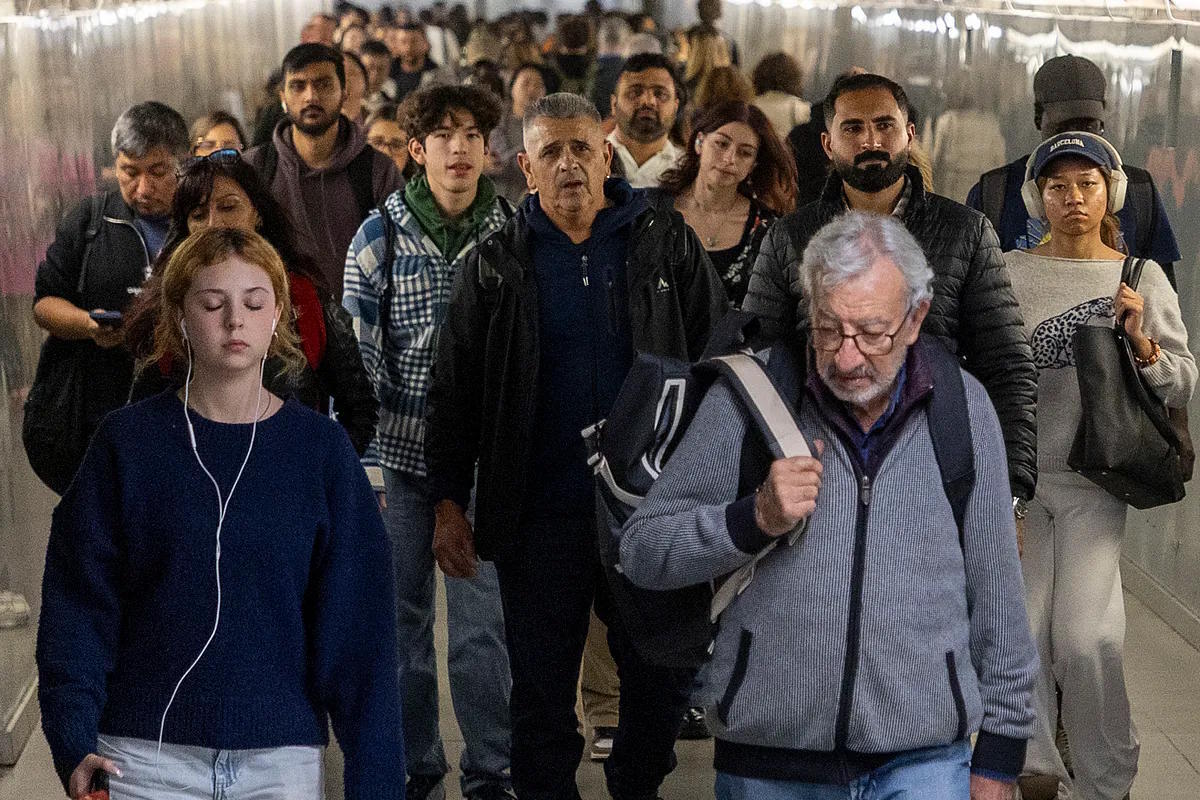
The international projection of Barcelona has shifted in a few years from being dominated by the independence process, with the large demonstrations of the Diada or the images of the 1-O referendum, to presenting demographic figures that align it with the great European multicultural capitals. Two decades ago, it would have been almost impossible to predict data like the ones the city currently exhibits, with a higher percentage of foreign population than Spanish in the 25 to 39 age group. The total number of immigrants has gone from representing only 5% in the year 2000 to over 31%, meaning practically one in every three Barcelona residents.
The ancient Barcino, founded two millennia ago by the Roman Empire, now grapples with its growing cosmopolitan reality and the nationalist discourse that does not recognize itself in the city's appearance. An antagonism that echoes old dichotomies like those of the eighties when the Catalan capital, governed by Pasqual Maragall, with the 1992 Olympics in mind, was viewed with suspicion by the convergent Generalitat of Jordi Pujol. So much so that CiU wiped out the Metropolitan Corporation of Barcelona presided over by the socialist mayor, seeing it as a counterpower.
The contrast between a global city and essentialist identity will be one of the main themes of the upcoming 2027 municipal elections, where Aliança Catalana aims to gather the necessary support to break into the City Council, as it did a year and a half ago in the regional elections. A sentiment of seeing the city as separate from Catalonia, which was recently defined as "the Brusselization of Barcelona" by political scientist Albert Cerrillo, spokesperson for Junts in the Eixample district during the previous term. With this term, he referred to "the loss of Barcelona and Catalan identity" with "the replacement of local and popular expressions by global formats often dictated by economic and political interests external to the city." A debate that connects with the protection of Catalan and has recently led to incidents such as the targeting on social media of some catering establishments with foreign staff for not serving or having menus in this language.
ERC has also announced its goal of "reclaiming the identity" of Barcelona. Its general secretary and leader in the City Council, Elisenda Alamany, calls for support for local commerce and a reduction in souvenir shops and 24-hour supermarkets. In fact, the Republicans promoted the increase in the tourist tax approved by the Council two weeks ago, which, pending validation by the Parliament, will double the surcharge on stays in tourist establishments in Barcelona to eight euros per person per night by 2029.
With 1.7 million inhabitants, Barcelona has reached its highest population index in the last four decades. From 1.9 million in 1979, the demographic trend began to decline until the turn of the millennium broke the downward trend with the gradual arrival of immigrants. A report by the Observatory of Migrations and Refuge highlights that in 2019, the number of registered persons not born in Barcelona exceeded, for the first time, those born in the city. A sustained trend that has led to natives now accounting for less than half of the population (45%).
Shrimp chupe and Latin American ajiaco, Filipino sinigang, or Moroccan harira were some of the international broths that could be tasted at the World Soup Festival held at the end of October in Barcelona by various entities in the popular district of Nou Barris. A gastronomic gathering as a metaphor for contemporary Barcelona, where 182 nationalities coexist, in addition to the Spanish.
The landscape of most streets in the city reflects the demographic changes of the last two decades, with immigration linked to the labor market: fruit shops and mobile phone stores run by Pakistanis mainly from the province of Punjab, bars and beauty centers managed by Chinese, hair salons owned by citizens from Central America, or coworking spaces where the community works with their laptops.
With around 2,500 startups, Barcelona is the fifth city in the European Union with the highest number of emerging companies, after Paris, Berlin, Stockholm, and Amsterdam. The inauguration last week of the new AstraZeneca Global Hub, where the pharmaceutical multinational plans to invest 1.3 billion euros in the next two years for research in advanced therapies and precision medicine, is another example of the attempt, through technology, to regain a prominent position internationally, similar to what the Latin American literary boom did in the 60s and 70s, making it the world capital of Spanish-language publishing, with figures like agent Carmen Balcells or editor Carlos Barral (Seix Barral).
However, the presence of Barcelona citizens of foreign nationality is lower than average in sectors with better working conditions, such as industry, professional services, or public administration. On the contrary, 47% of employees in the hospitality sector are immigrants, as well as 60.5% of domestic and care workers, a sector with high precariousness and mostly occupied by women.
The data from the latest municipal register published by the City Council show that there are 612,500 people registered in Barcelona who were born abroad. More than half of them are from America (329,200), with Argentina leading (50,000). The other most numerous countries of origin are, in order, Colombia, Peru, Venezuela, Pakistan, Morocco, Ecuador, Italy, Honduras, and China. However, Italians are the largest nationality (53,400 people), due to dual citizenship agreements with countries like Argentina. 33% of those from the South American country have Spanish nationality, and 38% have European nationality (mostly Italian).
Excluding dual nationalities, the number of foreign residents registered is close to 460,000, 26.4% of the total population. After Italians, the next two most numerous passports are Colombian and Pakistani.
The estimate of foreigners in an irregular situation has decreased from 14% of the total registered non-EU citizens (about 35,500) in 2020, a peak when the pandemic impacted permit regularization and asylum granting, to the current 5.2%.
The foreign population is relatively young compared to the Spanish, with an average age of 36 years, compared to 47 for the native population. In the age groups of 25 to 29, 30 to 34, and 35 to 39 years, foreign-born individuals are the majority compared to those born in Spain (56.4%, 59.7%, and 54.8% respectively).
In the reverse of migration flows, the predominant profile of those leaving Barcelona corresponds to young Spanish nationals moving to other parts of Catalonia (67.4%) or the rest of Spain (24.1%). Housing appears as the primary reason for this diaspora, which some sectors have used to blame expats, an abbreviation of the English term "expatriates," referring to those who temporarily move to the city mainly for work reasons and whose purchasing power is above the local average.
The 2025 register reflects that out of the 680,000 households in Barcelona, those with foreign residents continue to rise, both those where all members are foreigners (13.4%) and those where Spaniards and people of other nationalities live together (14.2%).
The municipal report prepared by the Metropolis Institute emphasizes "the impact of the housing market on the impoverishment of migrant people." "There is a transfer of income from foreign tenants to the housing market because rents are very high, and most of them are tenants," explains Albert Sales, director of the study and head of Social Rights and Public Policies at the organization. "Families of foreign origin allocate 41.6% of their income to cover housing expenses, while natives, mostly homeowners, allocate 18.5%," he adds.
The international projection of Barcelona has shifted in a few years from being dominated by the independence process, with the large demonstrations of the Diada or the images of the 1-O referendum, to presenting demographic figures that align it with the great European multicultural capitals. Two decades ago, it would have been almost impossible to predict data like the ones the city currently exhibits, with a higher percentage of foreign population than Spanish in the 25 to 39 age group. The total number of immigrants has gone from representing only 5% in the year 2000 to over 31%, meaning practically one in every three Barcelona residents.
The ancient Barcino, founded two millennia ago by the Roman Empire, now grapples with its growing cosmopolitan reality and the nationalist discourse that does not recognize itself in the city's appearance. An antagonism that echoes old dichotomies like those of the eighties when the Catalan capital, governed by Pasqual Maragall, with the 1992 Olympics in mind, was viewed with suspicion by the convergent Generalitat of Jordi Pujol. So much so that CiU wiped out the Metropolitan Corporation of Barcelona presided over by the socialist mayor, seeing it as a counterpower.
The contrast between a global city and essentialist identity will be one of the main themes of the upcoming 2027 municipal elections, where Aliança Catalana aims to gather the necessary support to break into the City Council, as it did a year and a half ago in the regional elections. A sentiment of seeing the city as separate from Catalonia, which was recently defined as "the Brusselization of Barcelona" by political scientist Albert Cerrillo, spokesperson for Junts in the Eixample district during the previous term. With this term, he referred to "the loss of Barcelona and Catalan identity" with "the replacement of local and popular expressions by global formats often dictated by economic and political interests external to the city." A debate that connects with the protection of Catalan and has recently led to incidents such as the targeting on social media of some catering establishments with foreign staff for not serving or having menus in this language.
ERC has also announced its goal of "reclaiming the identity" of Barcelona. Its general secretary and leader in the City Council, Elisenda Alamany, calls for support for local commerce and a reduction in souvenir shops and 24-hour supermarkets. In fact, the Republicans promoted the increase in the tourist tax approved by the Council two weeks ago, which, pending validation by the Parliament, will double the surcharge on stays in tourist establishments in Barcelona to eight euros per person per night by 2029.
With 1.7 million inhabitants, Barcelona has reached its highest population index in the last four decades. From 1.9 million in 1979, the demographic trend began to decline until the turn of the millennium broke the downward trend with the gradual arrival of immigrants. A report by the Observatory of Migrations and Refuge highlights that in 2019, the number of registered persons not born in Barcelona exceeded, for the first time, those born in the city. A sustained trend that has led to natives now accounting for less than half of the population (45%).
Shrimp chupe and Latin American ajiaco, Filipino sinigang, or Moroccan harira were some of the international broths that could be tasted at the World Soup Festival held at the end of October in Barcelona by various entities in the popular district of Nou Barris. A gastronomic gathering as a metaphor for contemporary Barcelona, where 182 nationalities coexist, in addition to the Spanish.
Participants at the World Soup Festival held in Barcelona. Gorka Loinaz ARABA PRESS
The landscape of most streets in the city reflects the demographic changes of the last two decades, with immigration linked to the labor market: fruit shops and mobile phone stores run by Pakistanis mainly from the province of Punjab, bars and beauty centers managed by Chinese, hair salons owned by citizens from Central America, or coworking spaces where the community works with their laptops.
With around 2,500 startups, Barcelona is the fifth city in the European Union with the highest number of emerging companies, after Paris, Berlin, Stockholm, and Amsterdam. The inauguration last week of the new AstraZeneca Global Hub, where the pharmaceutical multinational plans to invest 1.3 billion euros in the next two years for research in advanced therapies and precision medicine, is another example of the attempt, through technology, to regain a prominent position internationally, similar to what the Latin American literary boom did in the 60s and 70s, making it the world capital of Spanish-language publishing, with figures like agent Carmen Balcells or editor Carlos Barral (Seix Barral).
However, the presence of Barcelona citizens of foreign nationality is lower than average in sectors with better working conditions, such as industry, professional services, or public administration. On the contrary, 47% of employees in the hospitality sector are immigrants, as well as 60.5% of domestic and care workers, a sector with high precariousness and mostly occupied by women.
The data from the latest municipal register published by the City Council show that there are 612,500 people registered in Barcelona who were born abroad. More than half of them are from America (329,200), with Argentina leading (50,000). The other most numerous countries of origin are, in order, Colombia, Peru, Venezuela, Pakistan, Morocco, Ecuador, Italy, Honduras, and China. However, Italians are the largest nationality (53,400 people), due to dual citizenship agreements with countries like Argentina. 33% of those from the South American country have Spanish nationality, and 38% have European nationality (mostly Italian).
Excluding dual nationalities, the number of foreign residents registered is close to 460,000, 26.4% of the total population. After Italians, the next two most numerous passports are Colombian and Pakistani.
The estimate of foreigners in an irregular situation has decreased from 14% of the total registered non-EU citizens (about 35,500) in 2020, a peak when the pandemic impacted permit regularization and asylum granting, to the current 5.2%.
The foreign population is relatively young compared to the Spanish, with an average age of 36 years, compared to 47 for the native population. In the age groups of 25 to 29, 30 to 34, and 35 to 39 years, foreign-born individuals are the majority compared to those born in Spain (56.4%, 59.7%, and 54.8% respectively).
In the reverse of migration flows, the predominant profile of those leaving Barcelona corresponds to young Spanish nationals moving to other parts of Catalonia (67.4%) or the rest of Spain (24.1%). Housing appears as the primary reason for this diaspora, which some sectors have used to blame expats, an abbreviation of the English term "expatriates," referring to those who temporarily move to the city mainly for work reasons and whose purchasing power is above the local average.
The 2025 register reflects that out of the 680,000 households in Barcelona, those with foreign residents continue to rise, both those where all members are foreigners (13.4%) and those where Spaniards and people of other nationalities live together (14.2%).
The municipal report prepared by the Metropolis Institute emphasizes "the impact of the housing market on the impoverishment of migrant people." "There is a transfer of income from foreign tenants to the housing market because rents are very high, and most of them are tenants," explains Albert Sales, director of the study and head of Social Rights and Public Policies at the organization. "Families of foreign origin allocate 41.6% of their income to cover housing expenses, while natives, mostly homeowners, allocate 18.5%," he adds.