The always guarded Tiananmen Square opens up like a sea of stone in the center of the political capital of the world's second power. There are no trees; only an endless expanse of gray slabs. To the north, with the portrait of Mao Zedong suspended above its entrance, stands the Gate of Heavenly Peace, the main entrance to the Forbidden City, the ancient imperial palace of the Ming and Qing dynasties.
On one side of the square stands the National Museum of China. On the other side, the Great Hall of the People, the Chinese legislative building that also serves as the official reception center for many visits by presidents and heads of State. The center of this square became the lung of the student uprisings of 1989; here they camped for days demanding changes. But their peaceful protests were crushed by tanks, costing the lives of hundreds of young people, an undetermined number, as it is still a taboo in China. In the Western world, it is a symbol of a massacre that on this Wednesday seemed non-existent during the State visit of Kings Felipe VI and Letizia.
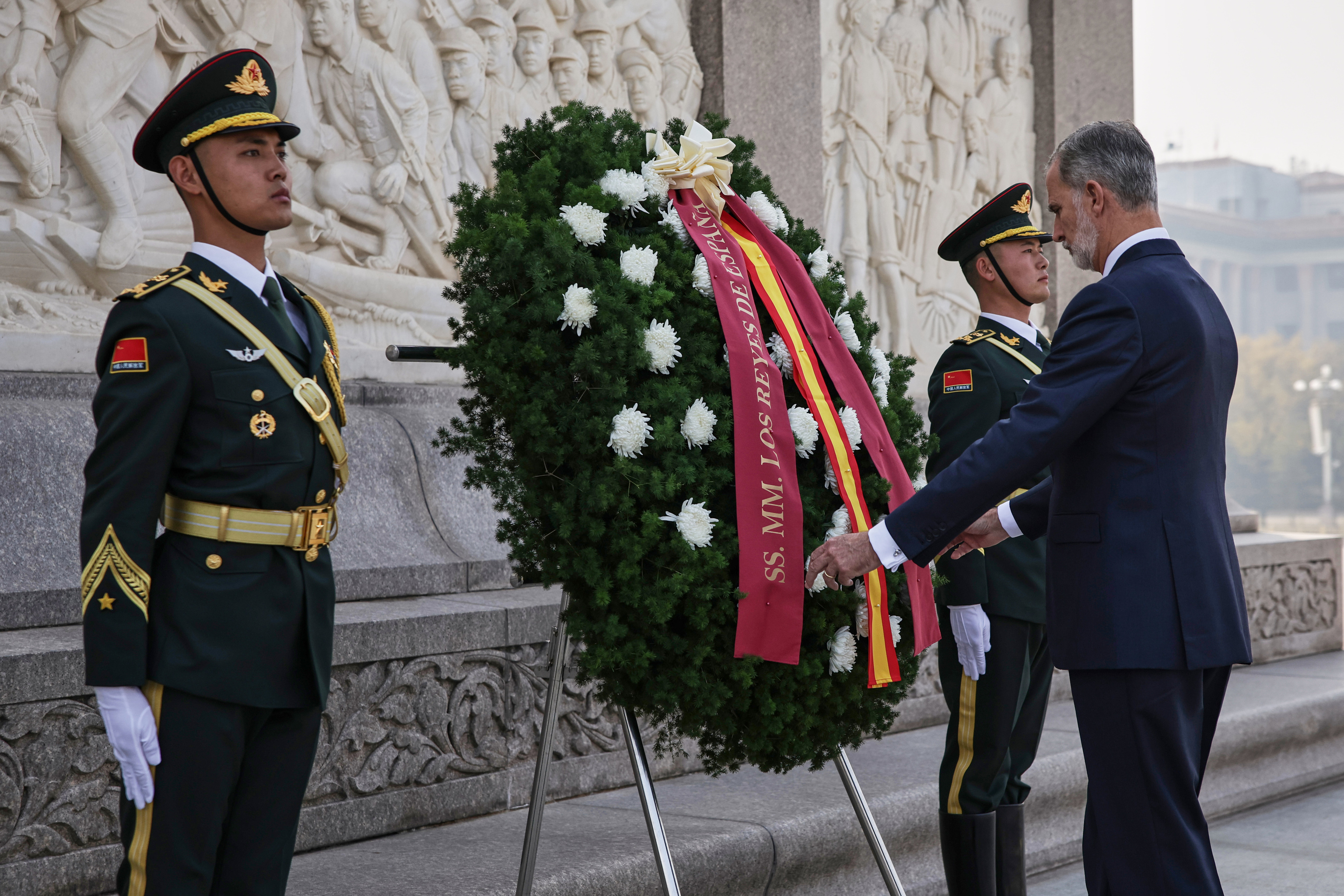
At half past twelve in the morning, the most controversial moment arrived during the visit that the Sánchez Government scheduled with the Chinese authorities for the Kings. In the center of Tiananmen is the Monument to the People's Heroes, a 38-meter-high obelisk honoring "revolutionary martyrs" fallen from the Opium Wars to the founding of the People's Republic of China. Here, Felipe VI and Doña Letizia participated in a solemn floral offering, an image that many heads of State have repeated during their trips to China, but one to which Don Juan Carlos and Doña Sofía did not adhere in 1995 or 2007. Chinese officials explain that it is not a mandatory protocol, but a symbolic gesture reserved for certain high-level State visits. France, Italy, Portugal, and Germany did accept laying the wreath.
During the Tiananmen protests in 1989, the monument became the spiritual epicenter of the student movement demanding democratic reforms. The protesters gathered around it, slept on its steps, and placed flowers or banners with messages dedicated to the "martyrs of democracy." On June 4 of that year, in the vicinity of the square, those protesters were massacred by Chinese troops. The numbers of students killed were never known. Some say it was hundreds. Perhaps thousands. In Beijing, despite more than three decades having passed, this episode remains a taboo. It is one of the most delicate and untouchable topics.
Any reference to what happened in Chinese media or social networks is censored. Any kind of commemoration, or the attempt to lay flowers at the monument in tribute to the victims, is considered a subversive political act. For all these reasons, this corner of Tiananmen embodies a deep tension between official memory and the memory of those who witnessed that bloodbath. Diplomats consulted by EL MUNDO consider this act as a kind of 'toll' for the smooth progress of relations, although they do not fail to show the moral conflict it entails.
The offering was the end of the Kings' daytime agenda, which began in front of the imposing Great Hall of the People. Wrapped in a sort of mist due to pollution, King Felipe and Queen Letizia were welcomed by Xi Jinping and his wife Peng Liyuan. There was the interpretation of anthems and a review of the troops before entering the building and before the Queen and the First Lady went to a technological rehabilitation center for people with disabilities.
Inside, under the Stalinist golden ceilings of the Great Hall of the People, the main auditorium, the Chinese political elite celebrates its annual political conclave, the National People's Congress (NPC). An immense space devoid of adornments and flourishes that was today decorated with Spanish and Chinese flags. The delegations were arranged around a large square table. Xi Jinping highlighted in his opening remarks the "example of friendly coexistence" represented by the 20 years of Strategic Partnership. "China is willing to forge a partnership with greater dynamism," added the President. Felipe VI, for his part, called for building a "solid relationship of mutual trust based on the principles of respect and shared prosperity." They then signed a dozen agreements, including the joint economic cooperation commission.