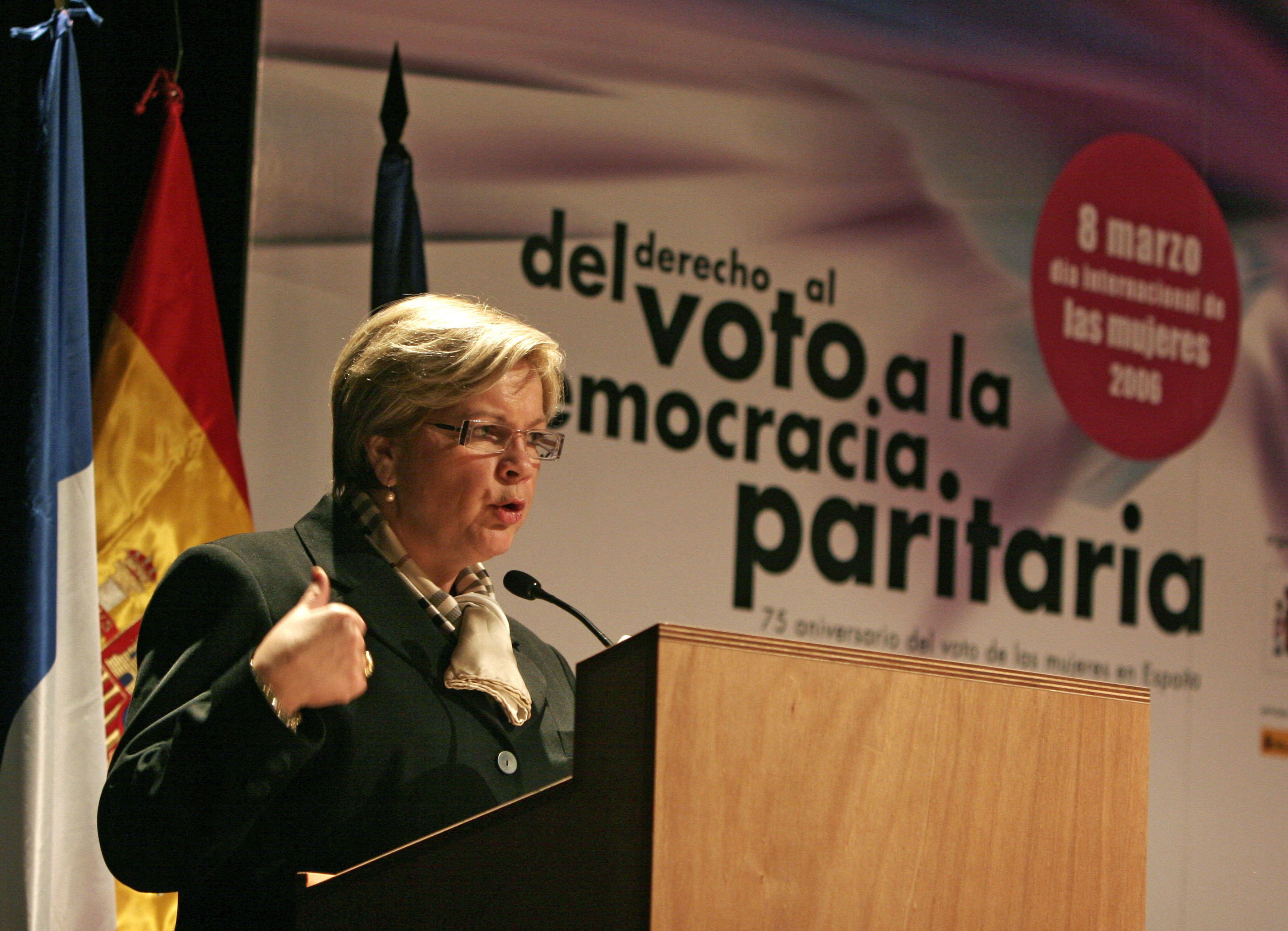
Gaullist by conviction, Catherine Vautrin (Reims, 1960) became just over a month ago the fourth woman to hold the position of Minister of the Armed Forces in France, succeeding the current Prime Minister Sébastien Lecornu at a critical moment in both foreign and domestic politics. Seasoned in the governments of Jacques Chirac and Dominique Villepin, president of Grand Reims and vice president of the National Assembly for a decade, Vautrin has taken on the special mission entrusted by President Macron: to promote French and European rearmament. In this context, she recently visited Spain to discuss with her counterpart Margarita Robles "the most active contribution" to the continent's security, the "future European air combat system," and support for Ukraine "against Russian aggression for as long as necessary."
Question. You recently stated that we are at a "turning point" in Europe. Is there a risk of a broader conflict by 2030? Why does President Macron emphasize "the Russian threat" so much?
Answer. Unfortunately, it is not only France saying this; it is a widely shared assessment. Since February 2022, high-intensity warfare has returned to the European continent, and Russia is conducting hybrid actions to undermine European solidarity. It is not my intention to instill fear, but closing our eyes would be a mistake in this context. I understand that European citizens, in Spain and elsewhere, may think that Ukraine is far away. But our goal is precisely to deter Russia from expanding its aggressive war. To achieve this, we must prepare ourselves; that is, strengthen our collective defense. We have only one objective: peace. And to maintain peace, we must deter adversaries who seek to harm us. To be respected, one must be feared.
Q. France advocates for the concept of "European strategic autonomy." Do you believe the EU is ready for a common defense or do we still depend on NATO?
A. First, we must address a question: what do we want? The era of peace dividends, which corresponded to a period of economic development and peace in Europe, has ended. The world ahead is more unstable, more uncertain, more dangerous. We did not choose it, but we can choose how to face it. The only way forward is for Europeans to assume their responsibilities and contribute more actively to their own security. This naturally involves NATO, particularly by strengthening the European pillar of the Alliance. It also involves everything we can do within the EU, both to support Ukraine and to develop a true European defense industrial and technological base. Lastly, it involves strengthening defense relationships among European nations: what France and Spain are doing together, especially within the framework of the January 2023 Barcelona Treaty, demonstrates this. I was in Romania about 15 days ago and saw, in a NATO exercise, Spanish, French, Romanian, Belgian, and Luxembourgish soldiers defending the Eastern flank together. That is European strategic autonomy: not just words, but actions and concrete results.
Q. In a more integrated defense of the continent, would France be willing to share its nuclear deterrence with other European partners?
A. The President of the Republic has announced that he will address this issue in the coming months. French nuclear deterrence remains the cornerstone of our security and the guarantee of our vital interests. Although the exact definition of these interests remains imprecise, they have always included a European dimension, as emphasized in his 2020 speech. Since then, the President wishes to engage in a strategic dialogue with willing partners on the role of French nuclear deterrence in our collective security. The heightened strategic context should convince us of the imperative of European solidarity. However, I must clarify that Emmanuel Macron never used the word "share": French nuclear deterrence is and will remain sovereign, both in its means and in the decision to employ it. Nuclear deterrence is not "shared."
Q. French Armed Forces spending will reach historic levels in 2026, despite budgetary difficulties. Do you believe other European countries like Spain should follow this example?
A. I have presented to Parliament a proposal for a larger increase than initially planned, with a total budget increase of €6.7 billion in 2026. This was the commitment made by the President of the Republic in July. It is also a budget for sovereignty, in service of a strong and free France. As the President emphasized, this effort is proportionate, credible, and indispensable. Our social model, highly valued by our citizens, can only be preserved if we can respond to threats. I can also say that France is far from the only one making this effort: in Europe, defense spending has nearly doubled since 2015. It is, in fact, the region of the world where defense spending has increased the most in the last decade.
Q. The war in Ukraine has highlighted the importance of artillery, drones, and logistics on the ground. What lessons can European armies draw from this? How to defend against constant drone intrusions?
A. The novelty lies in the intensive use of tactical drones. Today, drones account for about 75% of the battlefield damage. This implies an adaptation in capabilities and doctrine. Regarding drone intrusions, we must differentiate between what happens in the depths of Ukrainian territory with large drones like Shahed and the overflights of airports or infrastructure in major European cities by small quadcopter drones. In Ukraine, the intensive use of drones in depth aims to saturate the air defenses protecting critical infrastructure. In France, our Air Force ensures robust protection of airspace through continuous surveillance and rapid intervention capability. Our priorities are to strengthen detection and interference capabilities and maintain a high operational readiness to protect our airspace.
Q. Modern warfare also takes place in cyberspace. How to defend against disinformation and foreign interference? What role should AI play in national defense?
A. Digital technologies now play a fundamental role in armed conflicts, both on the ground and in cyberspace or intelligence. When disinformation campaigns target the armed forces, it is to discredit their actions. Our adversaries identify and exploit vulnerabilities in our societies. It is evident that disinformation is a weapon used in both wartime and peacetime. In response, France acts through VIGINUM, a highly effective interministerial agency that many of our partners envy. But our primary shield is the awareness of our citizens; that is our top priority. As for AI, its role is essential today for handling increasing data volumes and accelerating decision-making. We have a ministerial agency for defense AI, with 200 experts and 300 by the end of 2027. Defense AI is both a sovereignty and operational challenge. We must sovereignly master the technologies used by our armed forces. In this regard, France has the largest classified computing capacity dedicated to AI in Europe, with the ASGARD supercomputer.
Q. Your recent visit to Spain is related to the differences that have emerged regarding the participation of Spain, Germany, and France in the Future Combat Air System (FCAS) development. Will it ultimately be a joint program or will France act alone?
A. Before building the Future Combat Air System, it is necessary to agree on how to meet military needs and industrial organization. This future combat air system will include not only a main aircraft but also accompanying drones, sensors, connectivity, and a combat cloud. The technical challenges are numerous and significant, but in Europe, we have all the expertise to develop, test, produce, and sustain the FCAS. This is what I emphasized on November 7 during my visit to Spain: advancing the European future combat air system is urgent. The President of the Republic reiterated this at the beginning of October: we want to stay on course. Operational needs are expressed, especially in the areas of air deterrence and carrier landings. From this perspective, we continue exchanges with our partners: Germany and Spain.
Q. In Madrid, you met with Defense Minister Margarita Robles. What can be the contribution of women in a historically male-dominated position?
A. I am not the first woman to hold this position in France, fortunately. Michèle Alliot-Marie, to name just one example, led this ministry. Florence Parly succeeded her shortly after. I believe that it is essential, in the fields of security and defense, to have more women: when making important decisions, drawing on diverse perspectives enriches the debate. My identity is primarily linked to my career as a local elected representative, closely tied to my region, Champagne, and my Gaullist convictions.
Q. You have succeeded Sébastien Lecornu in your position. How do you evaluate the work of your predecessor regarding the war in Ukraine? Have you received any specific instructions from the Prime Minister?
A. I am fully aligned with the continuity of my predecessor, Prime Minister Lecornu, and his work at the Ministry of the Armed Forces for three years. Regarding the war in Ukraine, our determination has not wavered: to restore lasting peace in the European continent, we must continue to support Ukraine, especially its armed forces, and prepare solid security guarantees. Europeans are ready for this. We must continue to support Ukraine in resisting Russian aggression for as long as necessary. It is a challenge for our civilization.
Q. Political instability in France raises concerns among European allies. Do you believe this government will overcome the current difficulties?
A. It is our collective responsibility. Dialogue with Parliament is absolutely essential, and therefore, I meet with parliamentarians every week to discuss Defense challenges, beyond partisan struggles. I am determined to fulfill the mission that falls to me: our armed forces need the budget that will ensure the acceleration of rearmament, commensurate with the threats we must face in the short, medium, and long term.