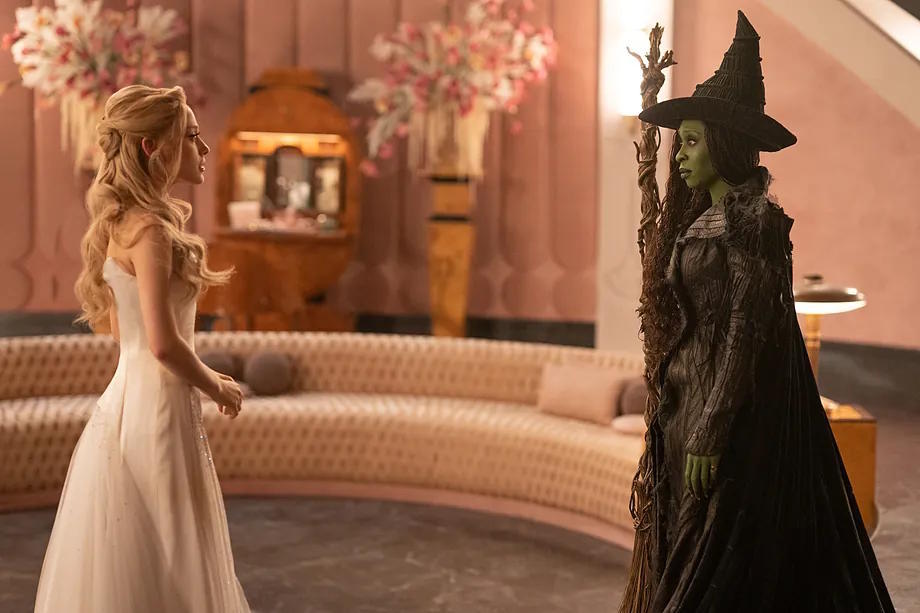
In just about the time it takes a tornado to transport a medium-height teenager with a squeaky voice to a universe of strange colors, Jon M. Chu has gone from being a director with a knack for polishing more or less absurd franchises like Step Up, G.I. Joe, or Now You See Me to becoming the great hope of a Hollywood besieged by fear. Fear of AI, fear of platforms, fear of Trump, fear of fear.
His irresistible and not at all obvious adaptation of the musical Wicked from last year not only grossed 650 million euros worldwide and earned him up to 10 Oscar nominations but has also positioned him at the forefront of a resistance movement against resignation. At 46 years old, this son of immigrants watched from the family restaurant as his parents, born in Taiwan and Sichuan, perfectly fulfilled the American dream in Reagan's United States. And now, he offers others, young and old, the very possibility of dreaming. And doing so over the colors of the rainbow. Corny, but irresistible.
Question. When the first part was released, there was talk of the "curse" of Wicked, the audacity of turning it into two parts, of what was considered a casting mistake... What does revenge taste like?
Answer. Let's break it down. I always knew it would have two parts. I am a big fan of the musical. I saw it even before it hit Broadway. I know I was accused of wanting to capitalize on the production with the two installments, but the story couldn't fit into just one. Besides, the two movies are very different. I was also criticized for hiring Ariana Grande... What can I say? It has been a long journey burdened with the added effort of ignoring everything that was said about us. What I have learned is that if you seek the truth, nothing else matters at all.
Q. What does a musical have that no other genre does?
A. We tend to associate musicals with simple and pure entertainment, with singing and dancing numbers in the most superficial sense. But in reality, a musical allows you to break the principle of reality and gives you permission, for example, to enter a character's mind and hear their thoughts. Then, if the music is well composed and the lyrics are as brilliant and subversive as Stephen Schwartz's, a phrase like "Something has changed in me" sung by Cynthia Erivo takes on a particular meaning. The musical is a tool to get closer to the characters in a much more intimate way than with a close-up shot.
Q. Suddenly, we hear the Wizard of Oz say that the truth no longer matters, that everyone believes what they want to believe. We thought it was a musical and few political statements are as timely and current...
A. That is in the great tradition of musicals like Cabaret, The Sound of Music, or West Side Story. No great musical is solely about singing and dancing. They endure because they speak of an era and are timeless stories. The words spoken by the Wizard of Oz are: "Truth is not a matter of facts or reasons, it resides in what we all believe," and they were written in a different time. But history is cyclical. I remember the movie reached me during the Covid lockdown. And I doubted. I wondered if, after all, the message would be relevant. And so, until the character of Elphaba has to face the dilemma of being herself despite everything and against everyone. She feels alone and people turn her into a villain, but she resists. These are exactly the times we are living in.
Q. When the musical premiered, its plot was related to the tragedy of 9/11, to the invisibility of evil. How do you think that message has been renewed in your film in your project?
A. The Wizard of Oz, the original book, emerged in a time of war over a century ago. And I think that makes it current every time we approach a precipice. I would say it is sad, even, that it is so current. Wicked and The Wizard of Oz seem to me, to some extent, versions of 1984 or Animal Farm. They are warnings.
Q. Your film is a celebration of diversity, respect, the profound and non-trivial meaning of beauty... It seems to be a provocation against the reactionary, or anti-woke, wave that now dominates public conversation...
A. I think that highlighting all of that now is more important than ever. We live inundated with misinformation, with clearly toxic stories that reach us unfiltered. That's why fiction is so important, in general, and a fiction like Wicked, in particular. The stories we tell ourselves are a way to organize reality and give it meaning. Otherwise, we only think of ourselves. That's when apathy arises and we become insensitive. And when this happens, larger and worse forces than us take control.
Q. I think of your biography, of being the son of immigrants, and I want to believe that Wicked also speaks a bit about you, about the struggle for adaptation, about tolerance for the different.
A. Since I filmed Crazy Rich Asians (2018) I made a pact with myself: I would only make movies that I felt only I could make. And I felt that Wicked spoke to me; of having experienced what it feels like to be different, but also to be, as I am, privileged. For me, the heart of this saga is the moment when we look back at our childhood, at what our parents taught us, and question everything. Now, with five children under eight years old, I look at them and think: how do I want them to see the world? I want them to have hope, but I don't want to deceive them and tell them there is a path to follow and a man behind a curtain who will solve everything for them. I want them to have determination. I want them to know they will have to stand up and it will be difficult. But I also want them to believe that there is something beyond the rainbow.