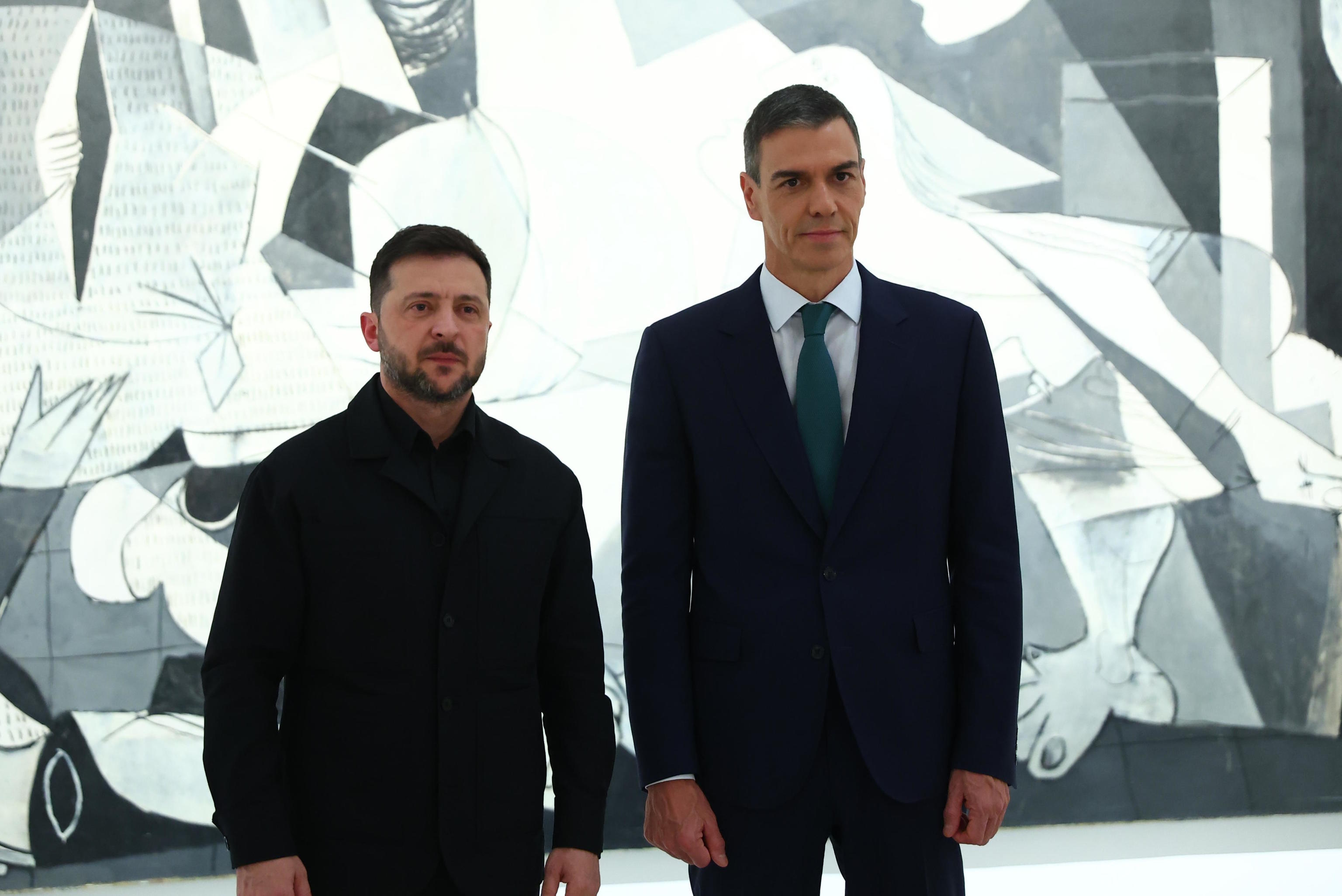
Spain's modest contribution to Ukraine's defense added another 300 million in unspecified "defensive" equipment yesterday, including anti-aircraft missiles to protect Ukrainian cities from Russian missiles and drones. Unfortunately, this ammunition only lasts a few nights of bombardment in this bloody war of attrition.
As part of the PURL initiative (Priority Requirements List for Ukraine), to which Spain was slow to join, our country will add an additional 100 million to the 400 committed by other allies for a total purchase of 500 million from Washington. In military terms, this amount is quite limited and would only be enough to buy, for example, a Patriot battery with a basic radar and six launchers, which seems to be the destination of the funds.
The government of Pedro Sánchez, who seems to have a good personal rapport with Volodymyr Zelensky (addressing each other informally as "friend"), has remained at the bottom of the list of Ukraine's allies in sending military aid. Spain's bilateral military aid, limited compared to Germany, the UK, Poland, or Nordic countries, places it at the lower end of European efforts, especially when measured as a percentage of GDP. While more committed partners have provided air defense systems, artillery, and large multi-year packages, Spain has opted for a discreet profile by participating in joint programs funded by the European budget rather than the national budget, thus diluting its statistical footprint.
Spain has mainly sent military equipment that was out of service or close to it. A prime example is the 29 Leopard 2A4 tanks that were rusting in a warehouse in Zaragoza and needed extensive refurbishment. The same can be said for the M113 armored vehicles, widely used in the Vietnam War and by Spain for decades, now completely obsolete. Spain has also delivered several Hawk anti-aircraft batteries that entered service in 1962.
In terms of weapons and equipment, Spain lags behind major European powers, contributing a total of 2.820 billion euros according to Moncloa (compared to Germany's 12.600 billion, the UK's 10.000 billion, France's 5.900 billion, or Italy's 1.400 billion) and also behind medium-sized countries like Sweden or Denmark. Beyond Europe, the contrast with Canada and Australia is even more striking. Canada, despite having a smaller economy than Spain, has become one of the most committed donors globally. Australia, despite its geographical distance from the conflict, has matched Spain's efforts in absolute terms.
Where Spain has excelled is in significant efforts in hosting refugees compared to the rest of the continent (around 236,570 people with temporary protection), in addition to providing medical assistance to treat and recover Ukrainian soldiers injured in combat. While there is no single official figure encompassing all treated and rehabilitated individuals, various partial data indicate the magnitude, such as a recent scientific study on the General Defense Hospital in Zaragoza mentioning "over 100 Ukrainian war patients" admitted since May 2022.
This balance between Pedro Sánchez's clear political support and limited military involvement reflects an approach heavily influenced by budgetary constraints, internal struggles with government partners more critical of Israel than Russia, and industrial limitations of certain Spanish companies engaged in failed or outdated projects like the Dragón vehicle.
The war is two months away from surpassing the duration of the Great Patriotic War, i.e., World War II for the Russians. This conflict, where the invader has yet to achieve any of its objectives, will prolong further because its instigator, Vladimir Putin, shows no intention of stopping. Spain must decide whether to remain in the background or take a more fitting role according to its political position.