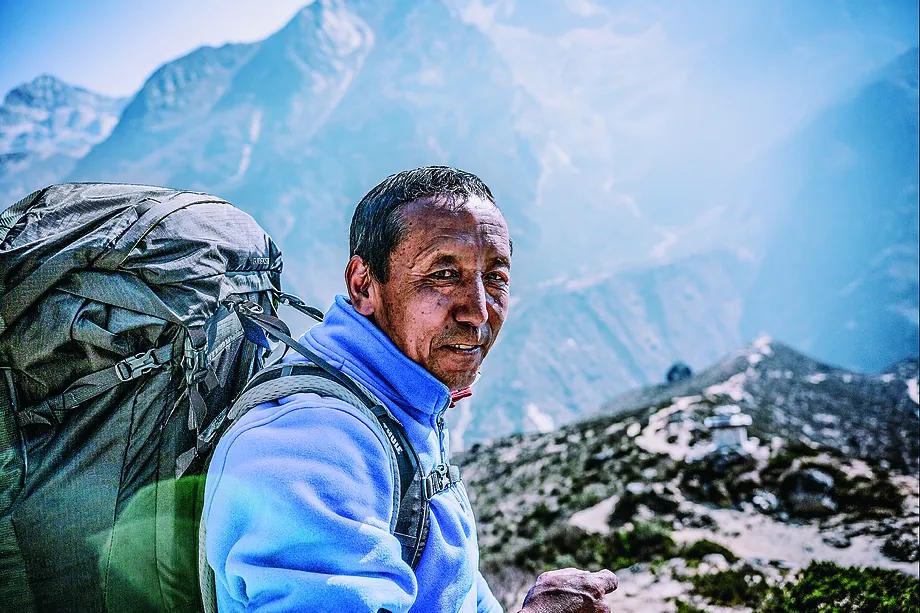
"I have climbed Everest 21 times and it's something I wouldn't wish on anyone." The paradox sounds curious coming from Lhakpa Tenzing, known as Apa Sherpa, because this slight Nepalese man was, until 2018, the person who had ascended the world's highest mountain the most times until his friend Kami Ritta surpassed him, reaching 31 this year. "It wasn't for a record or for adventure, I did it out of necessity, to help my family," he says to EL MUNDO at the presentation of his Thule product line.
Question. Did you not enjoy those ascents?
Answer. No, it was work.
Lhakpa is named that because the tradition among the Sherpa is to name children according to the day of the week. And he, who was born on January 20, 1960, in Thame, was born on a Wednesday. Lhakpa means in Tibetan "belonging to the gods." In his case, his strongest connection is with Miyolangsangma or Mother Goddess, the name his people give to the protector of Everest, the point on planet Earth closest to heaven. "We have to respect her, and that's why we always perform the Puja ceremony before ascending," he explains about the religious sentiment towards this peak in Nepal.
This Sherpa mountaineer owes much to the Mother Goddess, including his life and his nickname, "the most beloved." When he was just a few months old, he was thrown out of the basket his mother was carrying him in after an avalanche. She found him shortly after, unharmed and under an ice cornice. So she took him to the lama (Buddhist priest), who gave him the nickname Apa. "I have a very strong connection with the mountains," the porter points out with laughter.
A smile is a constant gesture on his face, as reflected in the parade where Thule showcased its outdoor products. He also maintained it at the subsequent party, among 1,000 people, sitting alone on a bench with a plate of ramen in hand while the world moved at a different pace. His life changed at the age of 12 when his father passed away, making him the only one capable of supporting his mother and siblings and giving up his dream of becoming a doctor. "I dreamed of saving lives as a doctor, but I had to provide for my family as a porter. In the end, I ended up doing it through my work in the mountains," explains the Sherpa who has never lost a life on an expedition.
He almost lost his own life in the tragic adventure led by Rob Hall in 1996, immortalized in the film Everest (2015). Eight people died, including the famous New Zealand mountaineer whom Apa introduced to Everest in 1989. But once again, God and this time his wife saved his life. "She told me not to go because I had to build a house, it's as if she were a goddess," he explains.
Apa Sherpa was one of the most renowned porters in ascents to any mountain in the Himalayas due to his agility and endurance. Hence, he is nicknamed the Super Sherpa, the Michael Jordan of mountaineering, or the Tiger of the Himalayas. "I am very proud of my nicknames," he appreciates with laughter. But his true virtue is his safety, whether ascending Everest, Dhaulagiri, or Annapurna, the mountain where he had the toughest time and thought he wouldn't make it back after being caught in several avalanches. "Climbing in the Himalayas is very risky; when we leave home, we never know if we will return," he says.
"Climbing in the Himalayas is very risky; when we leave home, we never know if we will return."
Apa cannot remember all the ascents he has made in his life, but he does not forget the only time he ascended Everest from the Chinese side. He had to save the lives of two mountaineers, one Japanese and one Ukrainian, after both experienced health problems. "I carried them on my back: the Japanese was easy, but the Ukrainian was so tall that he was dragging his feet during the journey," he recalls.
What is most striking is that Apa Sherpa accomplished all these feats many times with borrowed and low-quality equipment, far from the technology used in such adventures today. His skill came from his genes and training. "We prepared by climbing," he jovially recounts his routines to stay in shape and confirms that his genetic predisposition also plays a role.
However, 30 sherpas have died while performing their work in this century, 110 in total throughout history, according to the Himalayan Database, with data up to December 2024. It is the toll of a dangerous job, sometimes encountering the stubbornness of some clients who seek to reach summits at all costs. "When they have a problem, I always tell them that the mountain is not going anywhere, that life is more important," the Sherpa reveals.
Social Work
Speaking of fame, aside from Rob Hall, Apa Sherpa has worked on several occasions with Peter Hillary, son of Edmund, the first European to climb Everest. In fact, his first ascent of that mountain was with Peter in 1990. While in 2010, he was one of the members of the expedition that took part of the father's ashes to the summit in tribute to his feat. "The Hillary name means a lot in Nepal; it's not just about climbing, they have also helped a lot by building hospitals and schools," he explains.
Apa continues that progress with his Apa Sherpa Foundation, collaborating in the education of children in Nepal who, like him, walk three hours a day to school. "I was always tired and hungry," he recalls. Thule has wanted to join that project with a product line where part of the proceeds goes to the foundation. It is about providing alternatives to young people so they do not have to risk their lives as porters. "Giving back to the mountain everything it gave me," he confesses.
His children have never taken such risks. They had a very different life as they grew up in the United States after Apa moved there with his family in 2006. Since then, he has not returned to climb in the Himalayas. Nor does he want to, confessing to this newspaper that he would only allow his children to do it once "to experience it."
Q. Beach or mountains?
A. Now, beach (laughs). I've been to the mountains... many times.