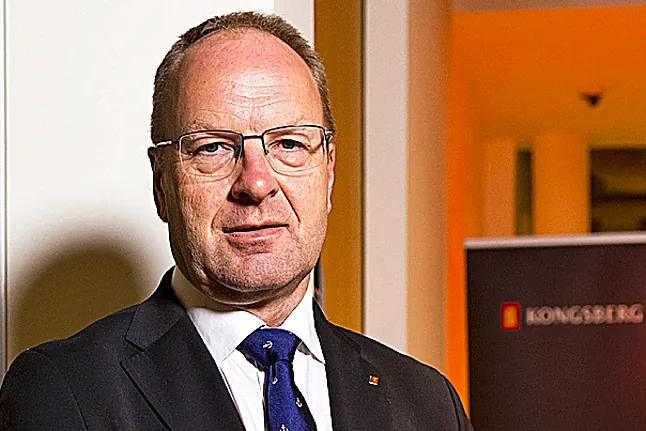
Kongsberg has been selling weapons in Europe for over 200 years, but had never had a military branch office in Spain until now. The Norwegian defense giant has set foot in our country after selling its Nasams anti-aircraft systems, the same ones used to defend the White House, and the NSM naval missile in recent years. With 400 employees in Spain in its other business lines, the company has hired former Navantia executive José Luis Laso to lead the growth of its military business
Its executive vice president, Øyvind Kolset, stated in an interview with EL MUNDO that they aim to also help grow the national industry and recognize two major challenges in the sector: governments buying faster and companies being able to produce everything they purchase.
Why does Kongsberg bet on Spain?
We have won several contracts in the country and believe it is necessary to be here. This is typically what we do at Kongsberg. First, we secure the contract and then start with a small office that grows. This is clearly our intention.
What kind of military projects do they want to expand into?
The focus is currently on the military industry. We are currently looking for suppliers for components of our missiles. This process usually takes time due to certification requirements. Our plan is to identify these good suppliers and incorporate them into our supply chain, not only for our programs in Spain but for everything we do.
What programs are they developing in Spain?
We have three major projects in Spain. These include the Penguin missiles that Spain purchased in the early 70s and we continue to maintain. In 2003, we sold the first Nasams systems (anti-aircraft defense) and are currently modernizing them and seeking for Spain to purchase more systems for its defense. Additionally, the NSM missile (anti-ship) was also acquired. The Spanish government's priority is for quick delivery, so we are working with our supply chain. Simultaneously, we are seeking new partners.
In what other segments do they see opportunities?
We have many divisions, so we see numerous opportunities in Spain right now. We currently offer premium products such as missiles, air defense, and autonomous underwater vehicles. Our innovation division, Kongsberg Discovery, was already present in Spain with 200 employees in Alicante, mainly for civilian purposes, but now they are also pursuing military contracts and programs.
Do they consider acquisitions to grow in Spain?
It is an option. We do look at companies that could fit with us. We do not engage in too many operations, but we strive for quality.
Drones and unmanned vehicles are a hot topic. How do they view this segment?
We believe that unmanned platforms are the new trend in defense. We already have offerings in this area. We are involved in the U.S. Nmesis program to shoot down unmanned vehicles with missiles. We are also researching how to develop unmanned ships and aircraft. We already produce unmanned submarines. Currently, they are not armed, but arming them is a possible evolution.
Regarding Europe, are they satisfied with the pace of European rearmament or were they expecting it to be faster?
Many governments face this challenge. The acquisition process takes too long. There are efforts to accelerate the purchasing process underway. The Spanish missile selection process was very quick. They had their candidates and quickly chose the NSM.
For companies, is the challenge in production?
We anticipated that the demand for missiles would increase around 2020. Therefore, we prepared to increase our capacity starting in 2010 to be ready when the time came. The Board approved the construction of a new factory before the start of the Ukraine crisis. This put us in a very good position, but the war led to even greater growth than anticipated. We are also striving to maintain production pace, but at least we made decisions in 2021 that positioned us well with a new factory in Kongsberg [the company is named after the city where it was founded].
What other challenges do they face?
Currently, the challenge is that everyone is using the same suppliers. It is difficult to increase production. Most of the industry in Europe is not vertically integrated, and we rely on the same companies for supplies. Another challenge is finding workers. There is a competition for personnel and engineers.
You mentioned Ukraine, has this conflict changed how they view their product portfolio?
We are very proud of how the Nasams have performed. They have had over a thousand confirmed collisions against Russian missiles, saving thousands of lives. We are extremely proud. We have also realized that it is not only necessary to have top-level weapons but also affordable weapons containing civilian components, and we want to play a role in this segment.
They have also opened a factory in the United States.
Yes, with the Nasams, we are opening two new factories. One in the United States and another in Australia. The United States has ambitious plans in anti-aircraft defense, and we aim to be part of it. Our Nasams are already present in the United States. One of our systems defends the White House.
It seems that national governments aim to award contracts to their local champions. How does this affect a multinational like yours?
For us, forming partnerships is a central element of how we conduct business. Many countries have regulations, and to sell them missiles, we have to collaborate with the local industry. Others do not have regulations but expect us to do so, especially in support and maintenance. We are proud to do this, not only because it is good for business. Defense programs last around 30 years, and many clients want local support for this. Standardization is crucial, but we can achieve it by involving local partners.