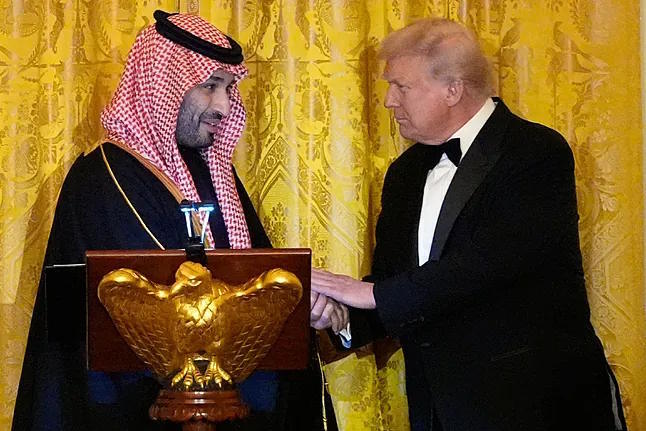
On Tuesday, the U.S. President, Donald Trump, referred to the late Jamal Khashoggi as "extremely controversial" and added: "A lot of people didn't like that gentleman they're talking about; whether they liked him or not, things happened, but he (the prince) knew nothing about it."
The "prince" he was referring to was the Saudi Mohammed bin Salman, known as MBS, who was sitting next to him smiling in the Oval Office at that moment. The "things happened" I understand is a reference to the strangulation and dismemberment of the "controversial" Khashoggi. The "knew nothing" (the "prince" regarding "about it," which is the "things happened" or rather things that happen) was a denial by Trump to his intelligence services, who in 2021 determined that everything indicated that MBS had ordered Khashoggi's assassination.
In this meeting of infamy, where the culprit almost apologized and the host denied there was a culprit, MBS described the dissident's murder as a "huge mistake" and "very painful." We all make mistakes, his highness almost said. But Trump knew who was wrong. He made it clear when a reporter at the event asked a compromising question to the prince, accusing her of putting his guest in "an embarrassing situation."
Contact with Martin Baron, former director of the Washington Post, the newspaper where Khashoggi wrote, to know his opinion on what happened in the White House. He kindly allows me to quote him:
"It is shameful what Trump has said. He showed no respect for human life, no consideration for a man murdered by Saudi agents simply for expressing his opinions," says Baron. "He even suggested that Khashoggi perhaps deserved his death because he was controversial and some people didn't like him. The person who liked Jamal Khashoggi the least was Mohammed bin Salman. That's why he ordered his killing. His body was dismembered in the Saudi consulate in Istanbul. Furthermore, the Saudi government lied about what happened." And he finally adds: "Trump's words are the cruelest, most reprehensible, and immoral I have ever heard from a president."
I have had the opportunity to interview Baron, 71, on a couple of occasions, and he has always been generous with me. He knows very well what it is like to deal with those in power, but he had never seen anything like this in his country. Baron has been the most influential newspaper director of his generation, and under his leadership, his newspapers have won 17 Pulitzer Prizes. Before the Post, he led the Miami Herald during the diplomatic crisis of the Cuban boy Elián González and the Boston Globe, where he led the Spotlight investigative team, which uncovered the decades-long cover-up by the Catholic Church of sexual abuse cases in Massachusetts. The film adaptation of the case, titled Spotlight, won the Oscar for Best Picture in 2015.
In our last meeting in Madrid, he told me what it was like to deal with Trump when he was upset about a specific story his newspaper published, recalling a particular phone call.
"You can only listen because he talks all the time. He doesn't listen. He started by telling me how badly we had treated him, how we had portrayed him as if he were a child. Then he said a series of words that you never expect to hear from a U.S. President. It surprised me, and he continued talking about a meeting he had with the Indian Prime Minister Modi, how great he was, how he had defeated the Clintons, how he had beaten the Bush family, how the economy was doing well because he was president, and many more imaginary achievements. When he finished, I thanked him for calling and sharing his point of view with me. That's how the conversation ended."
Trump's disdain for journalists is not new, the problem is not the animosity itself, something tolerable even acceptable in any democratic country, but the irresponsibility it entails. Baron had already anticipated on page 290 of his excellent memoirs during his time at the Post (Against Power, Ed. La Esfera de los Libros, 2024) the consequences of this attitude.
"Jamal Khashoggi's murder was surely inevitable after Trump showed total indifference to the safety of U.S. journalists. Even worse, in reality. Trump's rhetoric had incited his followers to go against journalists for several years."
He wrote this in relation to his first term. What is to come could be much worse.