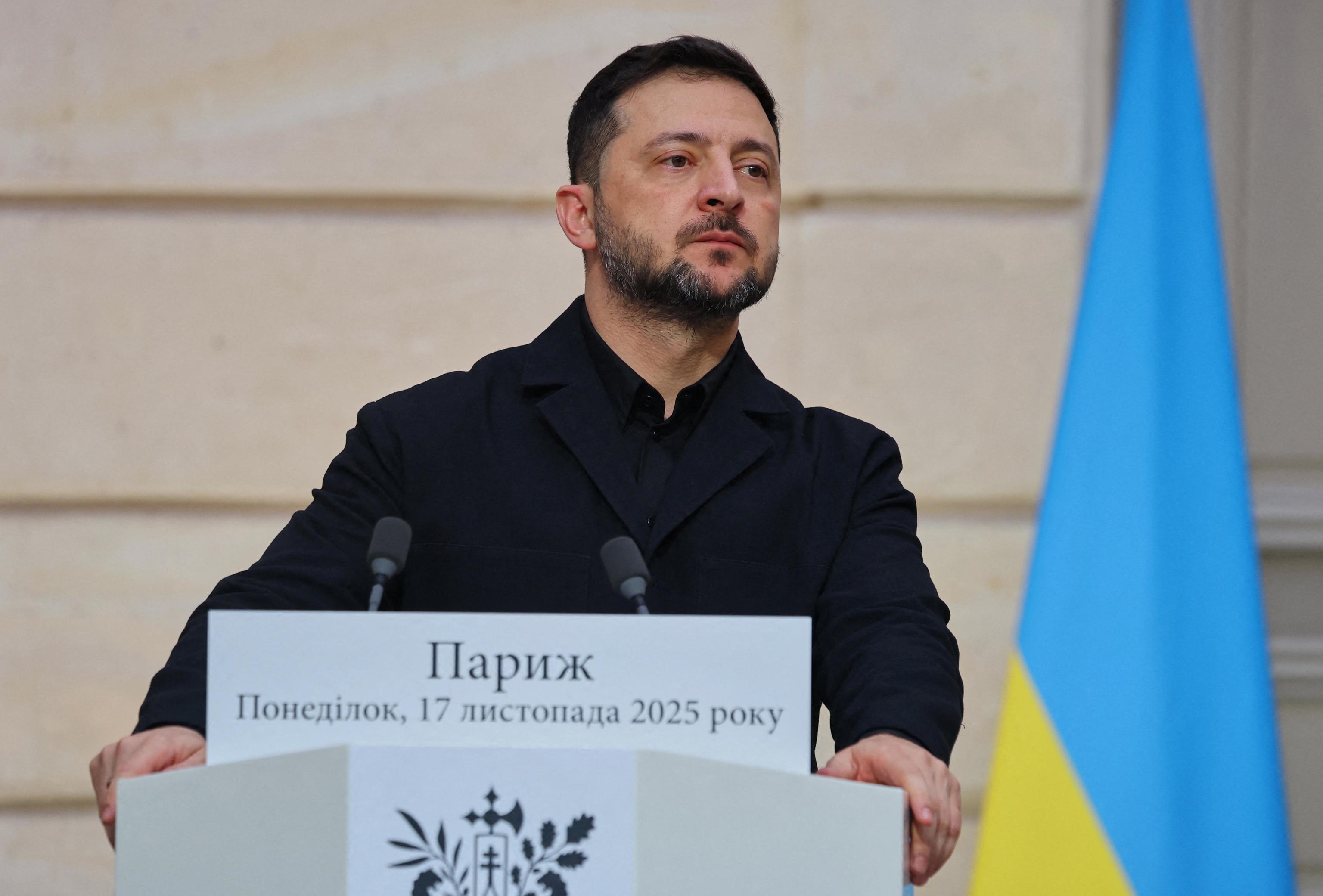
Volodimir Zelenskyy is experiencing his most difficult moments since the Russian invasion began almost four years ago. Several issues besiege the Ukrainian leader, the image of fierce resistance against Russian occupation, but also questioned with a circle of collaborators determined to complicate his Presidency which is becoming volcanic.
The corruption scandal shaking his inner circle revolves around a mega-investigation of bribes totaling over $100 million involving the state energy sector of Ukraine, specifically the nuclear company Energoatom, and a group of individuals who were close to the president.
Among the main implicated is Timur Mindich, Zelenskiyy's partner and co-founder of his production company, who allegedly orchestrated a scheme where contractors had to pay between 10% and 15% in commissions to secure contracts, hidden through shell companies.
The magnitude of the case has created a severe crisis of trust: some ministers were removed, lawmakers from the ruling party even called for a national unity government, and Western allies began to doubt their support unless a thorough cleanup was demonstrated.
Zelenski has stated that he is not personally involved and that may be true, but the wear and tear are real, and a significant part of his own party, Servant of the People, is urging him to take drastic measures. The president has promised deep reforms and audits in the sector companies, but they seem insufficient. The Rada demands the resignation of the shadow prime minister, who is none other than Andrii Yermak, his former producer and now Chief of Staff since he transitioned from comedian to candidate. Zelenski wants to withstand the pressure. For now.
If presidential advisor Mijailo Podolyak is Zelenskiyy's strategist, the executor is Yermak. No one has amassed as much power as him, and there is no negotiation, internal or external, that does not go through his hands. Many people outside of politics consider him the true architect of these power circles that have ended up corrupting.
Several Ukrainian parliamentarians are threatening President Zelenskyy that if he does not dismiss Andrii Yermak, they will reject the 2026 budget, forcing the country to operate with the 2025 budget.
Meanwhile, the opposition, voiced by former President Petro Poroshenko, demands that he overthrow his own government and form another executive, this time a national unity government, similar to Winston Churchill's during his tenure in World War II.
In a way, the pursuit of corruption is a positive development for Ukraine, even if it wears it down along the way. Checks and balances are working, and kickbacks are being pursued. In today's Russia, a country with higher corruption rates, such a judicial process is unthinkable.
Like the UK in 1940, Ukraine is facing terrible Russian bombings and savage destruction today. Moscow has intensified its attacks on the country's energy sources, inflicting punishment on Ukrainian civilians. In the midst of winter, 16-hour power outages, sometimes even longer, have become a constant for the resilient Ukrainian people. Without electricity, there is no water either, and the bombings of thermal power plants also affect heating, essential for any family. Many have embarked on two types of exiles: either returning to the European Union for those who can afford it or a return to the countryside, where old traditional cottages are heated by wood stoves and fireplaces.
Meanwhile, the situation on the front is far from calm. Although for now Ukraine holds the cities of Pokrovsk and Mirnograd, almost besieged by the Russian army for months, Kiev continues to face significant challenges in maintaining its defensive positions due to a lack of infantry. This is what is happening on the front between the regions of Dnipro and Zaporiyia, where the absence of large cities to entrench in allows the Russian army to advance with fewer casualties than in urban contexts, where they are forced to first destroy all buildings before attempting to surround the population and then take it over. The next target in this advance is Huliaipole, in Zaporiyia, a city that the Russians failed to occupy in 2022 and will now try to conquer.
Currently, Ukraine's only hope for an end to the war in 2026 is for the Russian economy to deteriorate to the point where Moscow is unable to sustain the current military effort. That is why they attack every night, with drones and missiles, their oil and gas industry with some success.