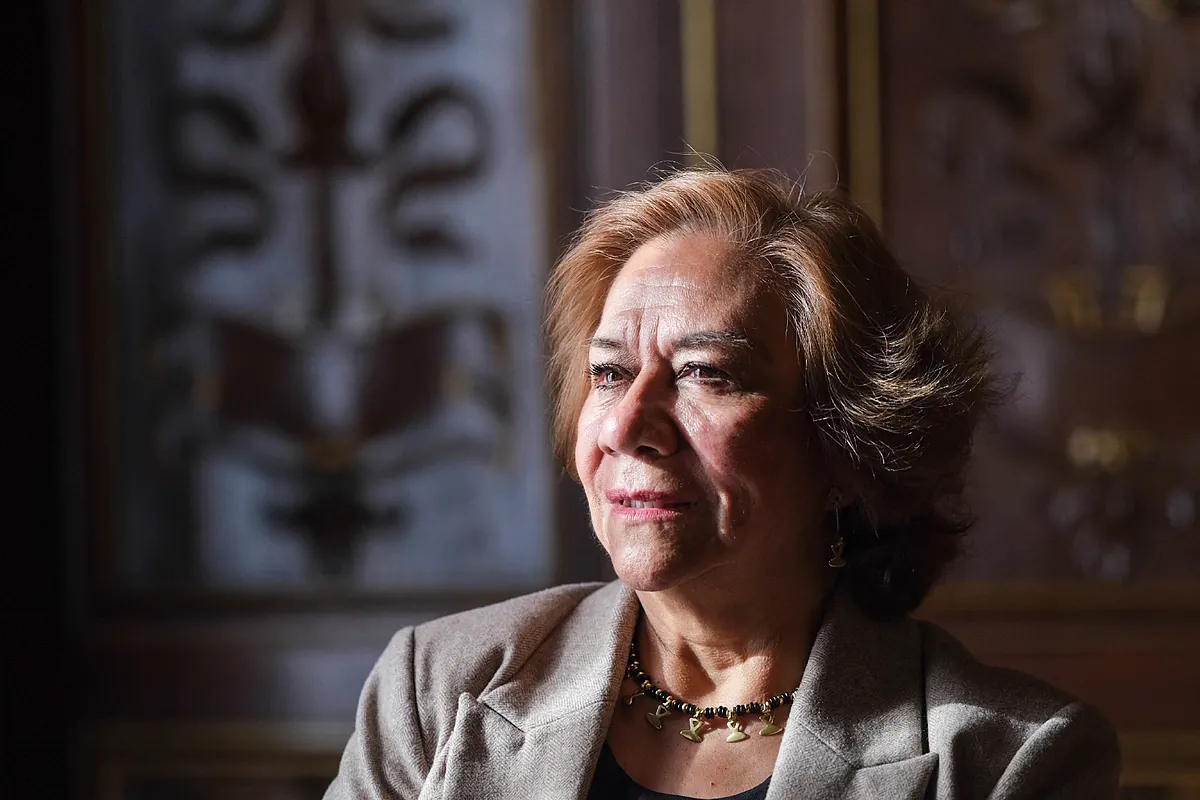
Talking about Colombia means talking about Venezuela. Two nations currently under the spotlight of the U.S. Colombian Foreign Minister, Rosa Yolanda Villavicencio Mapy, who was the first Latin American woman to hold a seat in the Madrid Assembly and has been the fourth chancellor under Gustavo Petro since July, discusses in an interview at Casa de América the current situation in the region, the clashes of her president with Donald Trump, and the relationship with Spain. During her visit to our country, where she has come to present the results of her government in the fight against drug trafficking, she states that "Colombia is a victim of punishment by the United States for not accepting unilateral decisions."
Question. What is the current state of relations between Spain and Colombia?Answer. The current moment of relations between Colombia and Spain is very special. They are very strengthened. We have an identification in the progressive project.
Q. Pedro Sánchez attended the CELAC (Community of Latin American and Caribbean States) summit in Santa Marta. Is that support he gave to Petro a sign of that good relationship?
A. Yes. It is the consideration that we are strategic partners and allies.
Q. Lula da Silva also accompanied Petro along with a few European leaders. There were significant absences. Do you think the summit failed due to Trump's shadow?
A. No, the summit took place despite Trump and was successful. Because in both regions, both in Latin America and the European Union, there is a feeling and a need to diversify relationships, not only political but also economic, and seek other partners. To strengthen friendships that were already there but need to enhance these relationships, precisely to avoid depending so much on a country that is not respecting the established rules to reach agreements, but rather trying to impose. To seek other types of relationships that show that we are not alone.
Q. Referring to that last statement, there is a wave of right-wing movements in the region. Could Petro and the 'progressive' bloc end up more isolated?
A. In Latin America, democratic values have taken root. Some principles have been consolidated, and this makes countries in CELAC mature enough to understand that we are different but need to be united.
Q. The biggest problem in Latin America is the Venezuelan crisis, which directly affects Colombia. How is the country experiencing the militarization of the Caribbean?
A. In Colombia, Ecuador, and Venezuela, the populations are very resilient. There is concern, there is fear, but people continue to do what they have to do. In other words, society does not stop because we think there might be a bombing tomorrow. However, a possible attack would cause significant trauma. In humanitarian terms, it would mean a massive exodus of Venezuelan population, and in economic terms. Faced with that, there are measures in place. But there would not be all the resources needed to address such a situation. It is also suggested in dialogue with the United States that it is not appropriate, that it should be addressed by the United Nations, which has already stated not to violate international humanitarian law. Such a unilateral attitude can cause a lot of harm.
Q. Do you fear that just as the U.S. could attack Venezuela, it could do the same to Colombia?
A. We do not have oil, for better or for worse. Venezuela has oil, and that is the real reason why it is being targeted, under the argument of not collaborating in the fight against drug trafficking, that its government has not been legitimate. We believe that it is up to the Venezuelans themselves to find a way out of these problems or, if there is an opposition that wants to engage in dialogue and seeks mediation, both Brazil and many countries, including Colombia, offer their help. If not, they will have to go through an electoral process.
Q. Going deeper into what you mentioned about that mediation, in the ultimatum that Trump issued that ends on November 24, he also stated that there could be discussions with Maduro. Do you believe in his word?
A. What we see is that Venezuela has sought mediations to facilitate dialogue with the U.S., and it would be best if disputes were resolved through political means. We hope that Trump reconsiders.
Q. More than thirty former presidents have signed a Declaration calling for Edmundo González to be recognized as the legitimate president. Do you think Colombia should do so?
A. What we have said is that we demand the election records where Maduro was elected to be presented. But the records do not exist for either side.
Q. The opposition did show those records, even presenting them to international organizations. Do you not believe in them?
A. No, because they have an entity, the Electoral Council, that should function. And they also did not have the legitimacy of that entity.
Q. If the U.S. were to intervene, would Colombia militarily support Venezuela?
A. No, we do not have the military capacity to confront the United States, nor is it the intention. However, any covert action, any aggression, will have a very negative impact. We will defend our borders internally, but we will not intervene in any other country. In other words, if the United States invades part of Venezuela, we will not be able to do anything other than denounce it.
Q. The U.S. and Colombia have experienced several clashes. How is the diplomatic relationship proceeding after the latest one in which Trump accused Petro of being "a drug trafficking leader"?
A. What we think and want is to de-escalate that situation. Therefore, all we ask for is a return to dialogue. We want him to be aware of all the reports and actions in the fight against drug trafficking that Colombia carries out, which are quite significant and with achievements like no government has had before.
Q. Regarding drug trafficking, the United States intends to designate the Cartel of the Suns as a Foreign Terrorist Organization. However, Petro said it does not exist....
A. There are tools, protocols, and intelligence services that have never provided evidence of the existence of the Cartel of the Suns. No one would dare to deny that there may be elements, individuals, or corrupt officials involved. But the Cartel of the Suns as such is not identified by security forces or intelligence agencies of any country. In the region, groups like the ELN, dissidents, and the Gulf Clan are identified as illegal groups engaged in various illegal activities and criminal groups, but the Cartel of the Suns is not identified.
Q. Looking at internal politics, Petro has changed cabinets several times. Specifically, you are the fourth chancellor. It seems that the government is in constant crisis. Does this affect the Historic Pact and the Government?
A. What happens is that the government won with the support of different forces and political groups that shared to some extent the entire ideology and government plan that was proposed. Right now, some have withdrawn, others have been replaced, but precisely because they are preparing for the new electoral campaign and have aspirations. However, there have been changes based on those who have not been able to carry out all the necessary actions in the development plan, have not made the required changes, have not produced the results, and the Executive has considered that they needed to be replaced.
Q. Focusing on 2026, do you think there are factors that will harm the Government in the upcoming elections, such as the relationship with the United States or the fact that the president and his relatives are on the Clinton List?
R. No, I don't think so, because the population is seeing it. It's like being a victim, because in reality, we are victims of the punishment from the United States for not accepting unilateral decisions, for maintaining the values and principles of the United Nations Charter, for being against the genocide in Gaza... I believe that, on the contrary, those things have made him gain acceptance of values in Colombian society and a certain admiration, not as much as he has abroad, because it is true that abroad the admiration of the people we visit and the authorities is truly incredible.
P. There are more and more Colombians in Spain or in other countries, who emigrate and do not return. Do you think this is a result of the instability in the Government, but also in the region due to Colombia's approach towards Venezuela?
R. No. If you look at the numbers, last year in Spain there were 42,000 asylum applications from Colombians and this year maybe it won't reach 20,000. There is still a permanent flow of Colombians to Spain. But comparatively, it is less than what there could have been last year. We are telling Colombians abroad that it is important to have safe and orderly migration. We would like the country to offer opportunities so that people don't have to leave.