At the school in Kherson, posters similar to those found in any institution in Western Europe can be seen. One informs about the increase in "allergies" at the end of this autumn. There is another one that warns of a possible "tick infestation." But next to those posters, there is another one that reflects the alien reality that the more than 60,000 residents who still live in this town have to face daily, especially the children.
"Attention: the enemy is remotely mining the territory of Kherson", reads the sign. They are "mini petals", it adds. "If you see a mine, stop immediately. Go back the way you came. Stay calm; if you panic, you may not see other mines," the text continues. The final part is addressed to parents: "Due to their unusual size and appearance, children often mistake them for a toy."
It is not the only unusual warning that welcomes the children who usually frequent the facilities. There are also signs that advise on how to act in the face of a drone attack (UAS, in English). "Remember: every object in the air should be considered hostile," the writing indicates.
Irina Kortinuk admits that the educational institutions for the youngest should focus on teaching mathematics or history, but in the institution she manages, weekly lessons have been added for the kids instructing them about the threat posed by the "petal mines" and the continuous attacks carried out by Russian drones in this town in southern Ukraine.
"We invite police officers and specialists. They are told that if they hear the noise of drones, they should hide under a tree. Yes, our children cannot go out for a walk on the streets and breathe fresh air. It's not normal, but it's the life we have to live," adds the 48-year-old activist.
Olesa Martinova, the mother of Arseni, 13, has no doubt that these teachings contributed to her son not suffering a greater setback after his bicycle ran over one of the deadly petals on September 1. He remained composed and was able to seek refuge at his grandmother's house, avoiding the dozen devices that the police later found on the same street.
"The bicycle saddle absorbed most of the shrapnel. He was injured in the arms and legs, but he stopped the bleeding from the wounds by applying pressure until the ambulance arrived," she explains.
The incident Arseni experienced in September is part of the increasing number of similar incidents recorded in Kherson in recent months, where Russian drones seem to have added a new variant to the so-called human safaris they have been carrying out since last year: mining the streets and access to vital facilities.
Under the constant harassment of Russian UAS, any meeting with local authorities requires secrecy reminiscent of a movie script. Appointments are made at the last minute and always in unexpected places.
The military governor of Kherson, Oleksandr Prokudin, suddenly appears in the meeting room, which only opens for the conversation with the journalist.
Prokudin explains that the mining of the city has left three dead - including a child - since the beginning of the year and at least 67 injured. "And an uncountable number of destroyed vehicles," he adds.
"It has become a recurring tactic this year. It is part of their human safaris. The goal is the same as the grenades they throw with drones: to terrorize the population," he opines.
Since the reporter's last visit to the town in October, the authorities have expanded the areas covered with anti-drone nets. Dozens of these devices continue to harass the urban core every day. "The average is 2,500 attacks per month," Prokudin adds, before disappearing as abruptly as he arrived.
Kherson is a constant state of alarm. Cars drive at breakneck speed. Those parked always seek refuge under trees or roofs. Pedestrians follow the same dynamic. They walk seeking the shelter of branches or the proximity of the countless cement shelters installed along the streets.
Burned car chassis seen on some avenues are evidence that haste does not ensure survival. Drones are always faster.
The atypical reality that the city has endured for several years is not only reflected in the urban landscape. This past Thursday, lawyer and documentary director Oleksiy Sandakov organized an exhibition of drawings commissioned to nearly 200 children out of the almost 4,000 still residing in the metropolis.
When the children placed their creations on the table, the images they reflected were far from the kittens, flowers, or bucolic landscapes that their counterparts in Spain would have painted. Here, the visions of the children are almost always the same: drones, tanks, and rockets attacking homes; or burning houses.
"They have drawn what they see. A horror movie. With drones flying over them all day, fear is always there. It's like [the dystopian series] Black Mirror," Sandakov points out.
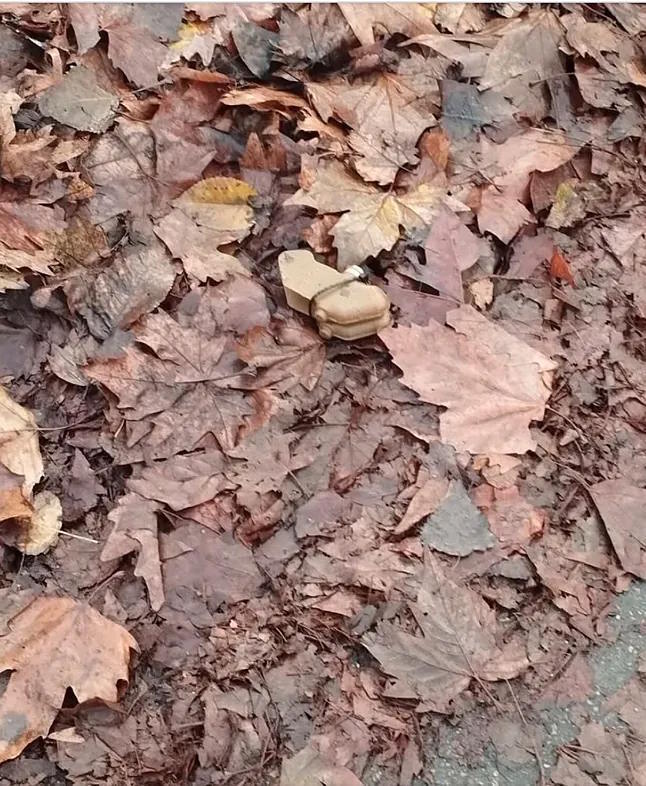
Autumn has filled the streets with leaves, accentuating the threat posed by the "petal mines," plastic devices less than 13 centimeters in size and with a shape and color very similar to those that have fallen by the thousands from the trees.
Coinciding with this time of year, the Russians have increased the launch of PFM-1 (its technical designation) in Kherson, despite its prohibition by the 1997 Ottawa Convention, leading organizations like Amnesty International to demand that these actions be considered a new war crime to add to Moscow's long list.
The latest incident of this kind occurred on the 13th, when Moscow's drones once again "seeded" the streets of PFM-1, causing several accidents that left a police officer with an amputated foot and ambulances affected by the explosions.
"During the day, we usually avoid areas with many leaves precisely because of the mine threat. But that happened at three in the morning. We were transporting a patient to the hospital. We saw a flash of light and heard an explosion. The mine blew out the tire. We were unharmed," explains Ludmila Nemchenko, the paramedic driving the ambulance.
Ludmila and her team were lucky. When they got out of the ambulance, they did not stumble upon the rest of the explosive devices that had been scattered throughout the area. Something that another team of paramedics failed to avoid, whose car also triggered a PFM-1 explosion two hours later.
"They had launched them on the only street leading to the hospital. They do it on purpose. They used to use the petals outside the city, but now they are mining our streets," comments the 68-year-old veteran.
She is not the only one claiming that the Russians are launching the "petals" near local hospitals. Ina Kholoniak, director of the Children's Hospital of Kherson, states that the workers at her facility have found numerous lepstok (the local name) scattered right at the entrance of the compound "on several occasions, the last one just a month ago." "We always find them in the morning when people usually come to work," she points out.
The open spaces connecting the various departments of Luchanskyi Hospital have also been covered with nets. The head of the surgery department, Vitaly Khomunkha, believes that the deployment of this drone protection system has contributed to the decrease in the number of injuries caused by explosives launched by these UAVs. "We used to have 40 injured per month, and now it's between 10 and 20. I think the nets are effective," he says.
Since the beginning of the year, Vitaly has had to operate on a dozen patients affected by the infamous lepstok. Only one of them managed to save their foot. "A couple of them had hand amputations while grabbing the mine," he recounts. "They were all civilians, regular people who were out shopping or working."
Vitaly also had to amputate the right foot of Olena Semenikhina at the end of last year. The 46-year-old woman is the mayor of Sadove, a village located 22 kilometers from Kherson.
Since that November 13th, Olena has not been able to return to her village. After 7 months of recovery and obtaining a prosthesis, the 46-year-old official now spends her time managing the assistance center that distributes humanitarian aid to the hundreds of displaced people from the village who have had to flee to the urban center of Kherson due to the constant harassment by enemy drones. "Before the invasion, the population of Sadove was 1,500 inhabitants. Now there are 21," warns Olena, who limps and is sometimes assisted by a pair of crutches.
She was one of the first victims of the pétalo. It happened when she was trying to save a municipal employee who had been injured by a grenade launched by a UAV. "I was trying to find a wheelbarrow to get him out of there. There was a drone flying around. I hid under a tree. When it left, I got up and took a few steps. I heard the explosion and felt immense pain. I looked at myself and had no fingers. Not even the new boot I had bought. I rolled on the ground, screaming and crying. I was lucky because later I was told there were three more mines very close by. But I didn't touch them," she recalls.
If the use of drones to mine Kherson with FPM-1 has not yet become widespread, in Sadove it has been a constant since last summer. Olena says they even found a local resident dead in the cemetery, bleeding and surrounded by pétalos. "We couldn't confirm if it was a mine because it was so dangerous to evacuate the body that we left it there. The animals ate it," she explains.
Since being injured, she has not been able to return to Sadove, but she stays in daily contact with the stubborn residents who refuse to leave. People like Dimitri (who does not want to give his last name), 42, who has reluctantly become an "expert" in dismantling the chilling devices, even with a highly questionable method.
"I cover it with clothes. I pour gasoline and set it on fire. That makes them explode," he explains while communicating through the connection initiated by Olena. "The Russians drop the mines at the entrance of the village, preventing aid from reaching us. I do it to clear a path. You hear them flying every night and hear the sound of the mines they drop," he asserts.
Like every morning, the municipal employees under Oleg Franasink, 44, climb the escalators to clean the anti-drone nets deployed on the local avenues.
It's not just about cleaning. It's not uncommon for officials to find explosives and even drones trapped in the mesh. Oleg shows the latest devices they found a few days ago. They are not pétalo, but some kind of improvised grenade. "They usually don't throw lepstok on the streets protected by nets, but in open places," he points out.
A short distance away, the basement of the institution where Irina Kortinuk works currently hosts nearly a dozen women who, despite the explosions on the surface, have decided to attend a new yoga session.
The instructor speaks softly, accompanied by calm music. "Arch your back [cat pose]. Now exhale." The tranquility of the gathering contrasts with the regular blasts on the surface. Irina explains that a drone crashed nearby a few hours earlier, destroying the communications, hence the lack of internet connection.
The facility manager says they have only canceled the classes attended by about 45 people once: last June, when the Russians bombed the local administration headquarters with several hundreds of kilos of bombs. "The shrapnel reached here," she adds.
For her, yoga and explosions may not be an ordinary combination, but neither is the daily routine faced by the residents of Kherson. "It's about mimicking a normal life in the face of a very abnormal reality. We have to maintain our sanity," she concludes.