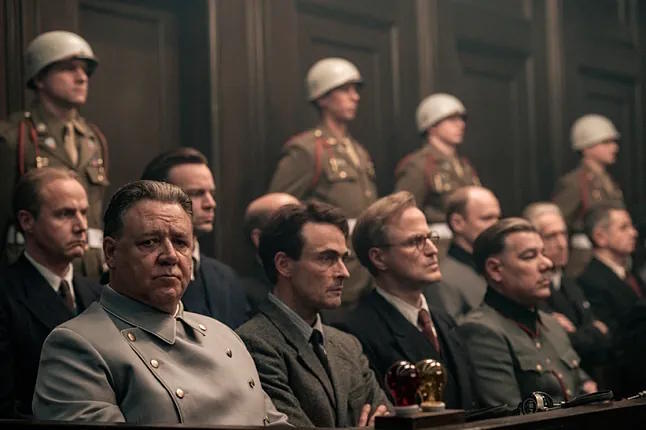
On the banks of the Pegnitz River, with some of the most emblematic and charming bridges in Germany, Nuremberg could pass for the epitome of a perfect city, perfectly Bavarian. And yet, it was there where the Nazi leaders were judged for their crimes in a process that inaugurated international criminal law and where cinema became evidence for the first time. The film about what remained of the horror of the extermination camps shocked the world 80 years ago and probably determined each of the 13 death sentences (plus three life imprisonments). Perhaps that is why, due to the contradiction that always accompanies any great discovery, few cities represent in their unchanging beauty the horror in its rawest form. The new film by James Vanderbilt, Nuremberg, talks about all of this. It recreates the most famous and decisive trial in recent history, but does so very attentive to each of its paradoxes. And only the adopted starting point surprises: the protagonist, played by Rami Malek, is the psychiatrist in charge of determining if Hermann Göring (played by Russell Crowe with an exaggerated gesture) was in his right mind to do and allow what he did and allowed.
"My first interest arose not so much from History, with a capital H, but from the point of view to tell it," reasons the director about the book by Jack El-Hai on which the film is based. And he continues: "It is important not to overlook that it is a true story. Dr. Douglas Kelley was tasked with determining if the accused were fit to stand trial. It was important to know whether there was individual responsibility, if they were aware of their actions even though they could always claim the defense of following orders... But what is really interesting is that the material allowed us to delve into the deepest depths of the beast. Such an approach has never been used to address World War II or the subsequent years."
In fact, the film is presented as a psychological duel between the psychiatrist and the former commander-in-chief of the Luftwaffe. The idea is to trace the exact limit at which madness turns into evil, and vice versa. In his own way, the director is an expert in the subject. It is worth noting that he wrote the script for probably the best film of recent times dedicated to unraveling the dark mechanisms that operate in the mind of the greatest and most enigmatic of killers. Zodiac, by David Fincher, bears his signature. "We tend to think that society learns from its mistakes, that in some way the atrocities of the past are not repeatable today. And yet, the limit of what we are capable of seems not to vary over time. In certain situations, human beings are capable of repeatedly committing the most ruthless actions. The human condition, it seems, remains the same," reflects Vanderbilt in order to connect the past, present, and perhaps the immediate future.
The Nuremberg trials were significant for many reasons. The most obvious of all has to do with the birth of international criminal law. But beyond legal technicalities, many of them not without controversy (the charges against the accused were only defined as "crimes" after they were committed, for example), the fundamental aspect according to the director and his film has to do with, precisely, our present days. "We are talking," he says, "about nations that would soon become enemies. The United States and Russia were at the beginning of the Cold War, and yet all of them decided to choose justice over revenge. The story of prosecutor Robert Jackson, portrayed by Michael Shannon, is incredible. In the United States, it is a footnote, but he was a man in the Supreme Court who stood up to the military, which wanted to execute all the Nazi leaders. He stood his ground and said, "We cannot turn the elimination of a surrendered army into an act of war." The military argued that judging men for following orders was a terrible idea, but he insisted. He even took a leave of absence from the Supreme Court, risking his career, to be the lead prosecutor. Ultimately, he insisted on putting justice before revenge, which is the truly heroic aspect of this whole story and concerns all of us right now."
But not only that. For the first time, cinema was used as evidence, and, to the horrified gaze of the world, the only possible images of the extermination camps were shown: those of the piled bodies. "That is why," he continues, "we decided to use the real images in our film. Even the narration heard is the same as in the trial. There is no recreation. I remember that in Judgment at Nuremberg, Stanley Kramer's 1961 film on the same subject, the prosecutor narrates about the images. I wanted, in a way, to pay tribute to cinema itself, to its decisive and moral function. We show only six minutes, in the trial it was almost an hour of film."
Vanderbilt argues that the wounds of the past are the same as those of the present and, without daring to draw more parallels than the fair and timely ones, he cannot help but issue a final warning, which is also a caution. "It is frightening how we have shortened our attention span. We spend more time looking at our phones than at the sky. We want everything fast and easy. And in this perfect storm we have entered, historical memory loses the same value as the concept of truth itself. The discrediting of journalism, the success of lies on social media, extreme right-wing revisionism, and the neglect of our history are all part of the same illness. It is essential to look back. My father and grandfather talked to me about World War II. For younger generations, Nazism is as distant as the Middle Ages. And that cannot be," he concludes.
Nuremberg, an ideal city, a trial of the darkest of times, and now, a very dark film on its way to the very bright Oscars. So contradictory everything.