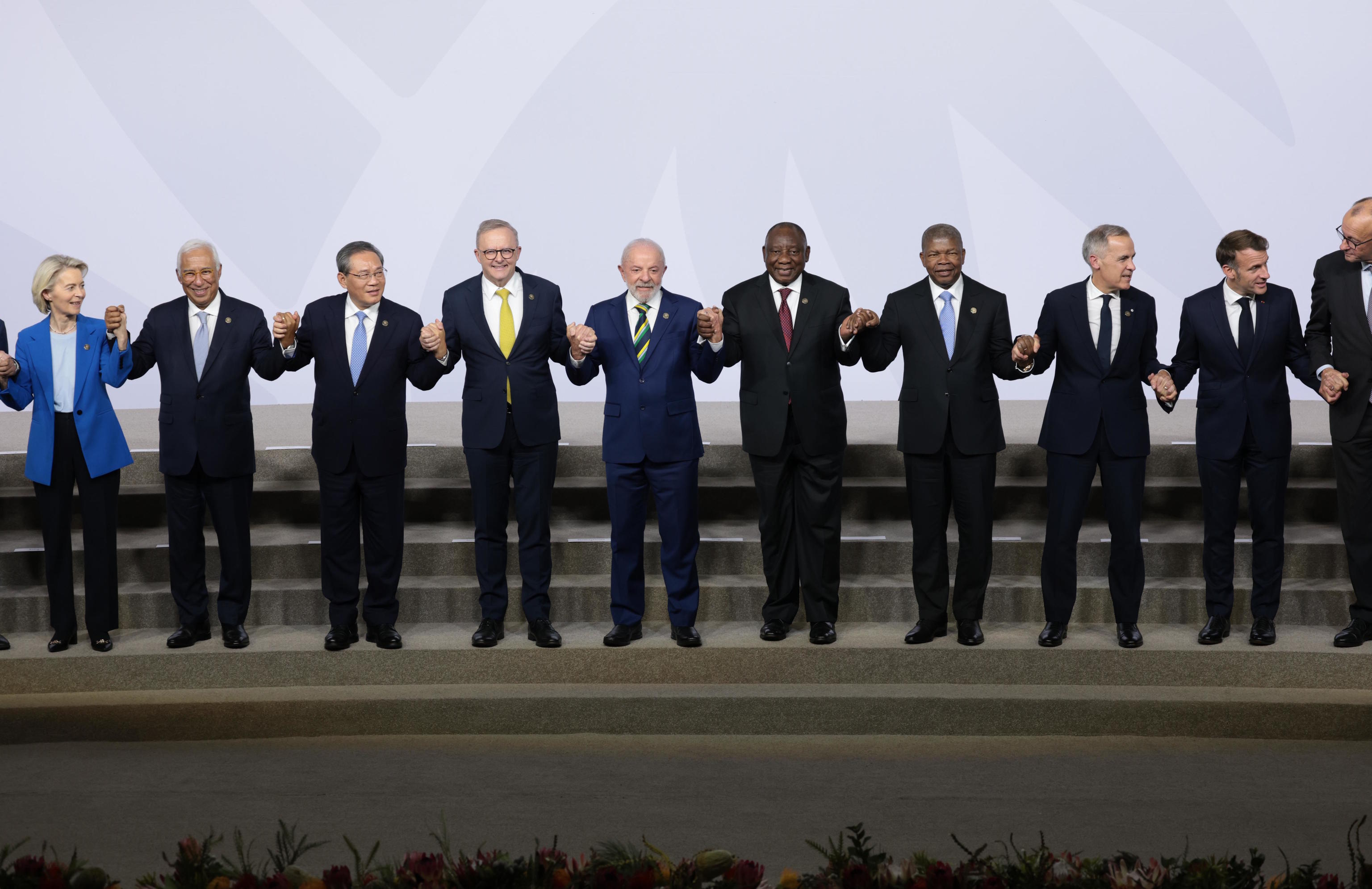
The NASREC Exhibition Center is the venue hosting the G-20 summit in Johannesburg, the first one held in Africa. Today, the location is filled with rows of tables, chairs, cables... but during apartheid, it was an exceptional bridge connecting South Johannesburg, where Soweto was located, with North Johannesburg, then reserved for white citizens under the Group Areas Act. Now, it has served as a bridge to connect Zelenski's allies with his defense of Ukraine's territorial integrity and sovereignty. The peace plan for this country, sponsored by Donald Trump, became the central axis of the summit. It highlighted the international effort to explore alternatives to the White House's approach.
While leaders tried to prevent the summit from failing by seeking common ground, Ukraine's allies, driven by European representatives, with António Costa, President of the European Council, at the forefront, promoted diplomatic relations to show alternatives to Trump's plan and open a door for Zelenski. "Intense diplomatic efforts are being made regarding the peace plan for Ukraine outside the G20 meeting", European sources stated yesterday. The work culminated in a meeting of a dozen countries, sponsored by Costa, in which Spain also participated, intending to avoid a direct clash with Trump, welcoming Washington's peace efforts, but also rejecting a move: they reject that the borders of a country, in this case Ukraine, "be modified by force".
Trump's peace plan for Ukraine contains 28 points, among which are a series of proposals that represent red lines drawn by Zelenski, such as Ukraine conceding regions in the west of the country to Russia, including areas that have not been invaded by Kremlin forces until now.
Specifically, point 21 of this peace plan sponsored by the White House and backed by Russia establishes that Crimea, Lugansk, and Donetsk will be recognized de facto as Russian, even by the United States.
France, Germany, United Kingdom, Italy, Canada, Japan, Norway, Finland, Ireland, Netherlands, and Spain, among others, expressed their "concern" about the proposed limitations for the Ukrainian Armed Forces in that plan endorsed by the United States and Russia, as they would "leave the country vulnerable to future attacks." The proposal includes reducing the Ukrainian army to a maximum of 600,000 troops. Brussels considers these points of the agreement "unacceptable." In contrast, Hungarian Prime Minister, Viktor Orban, yesterday requested in a letter to the President of the European Commission, Ursula von der Leyen, to support the plan.
They believe that Washington's proposal has "important elements that will be essential for a just and lasting peace," but they also distance themselves, albeit in a measured tone to avoid confrontation. "We welcome the ongoing efforts of the United States to bring peace to Ukraine," they say with an open hand, but at the same time, they insist that they will continue to coordinate "closely with Ukraine and the United States in the coming days."
Before this conclave, French President, Emmanuel Macron, German Chancellor, Friedrich Merz, and British Prime Minister, Keir Starmer, held an initial meeting to discuss the matter, before the already expanded meeting sponsored by Costa.
The Spanish government has always advocated for the need for a "just and lasting peace" and that this "cannot be achieved behind the backs of the EU and Ukrainians." Spanish Foreign Minister, José Manuel Albares, spoke yesterday with his Ukrainian counterpart, Andrii Sybiha, to reiterate "firm support for Ukraine," and Pedro Sánchez, in his intervention in the first session of the summit, defended the principles of the United Nations Charter: "Everyone, everywhere, at all times. Whether in Ukraine or in Palestine, this means defending sovereignty, independence, and territorial integrity, and ensuring strict compliance with international humanitarian law in all conflicts."
While contacts between the teams of Zelenski's allied leaders intensified, exchanging impressions, something was also happening in the G20 itself. Despite defeatist expectations, a consensual declaration was achieved without the United States, the major absentee from the meeting - they did not send any representatives - in which they spoke out against the use of force to annex territories of other countries. An issue Argentina distanced itself from - they wanted to discuss the "conflict in the Middle East" instead of "occupied Palestinian territories" -, but it had the approval of Russia and Saudi Arabia. For Argentina, "it is essential to preserve the rule of consensus as the foundation of the legitimacy of decisions taken within the framework of the G-20," as expressed by its government in a statement, expressing its displeasure at not considering the United States.
The fifth point of the declaration refers to the United Nations Charter and warns against the use of "threat" or "force to obtain territorial conquests at the expense of territorial integrity and sovereignty or political independence of any State." It adds that States "must develop friendly relations among nations, among other things by promoting and encouraging respect for human rights and fundamental freedoms for all, without distinction of race, sex, language, or religion."
This took place yesterday in South Africa, but today, the U.S. Secretary of State, Marco Rubio, and Trump's diplomatic envoy, Steve Witkoff, will travel to Geneva to discuss the president's plan with Ukrainian representatives, as confirmed by a U.S. official to AFP.