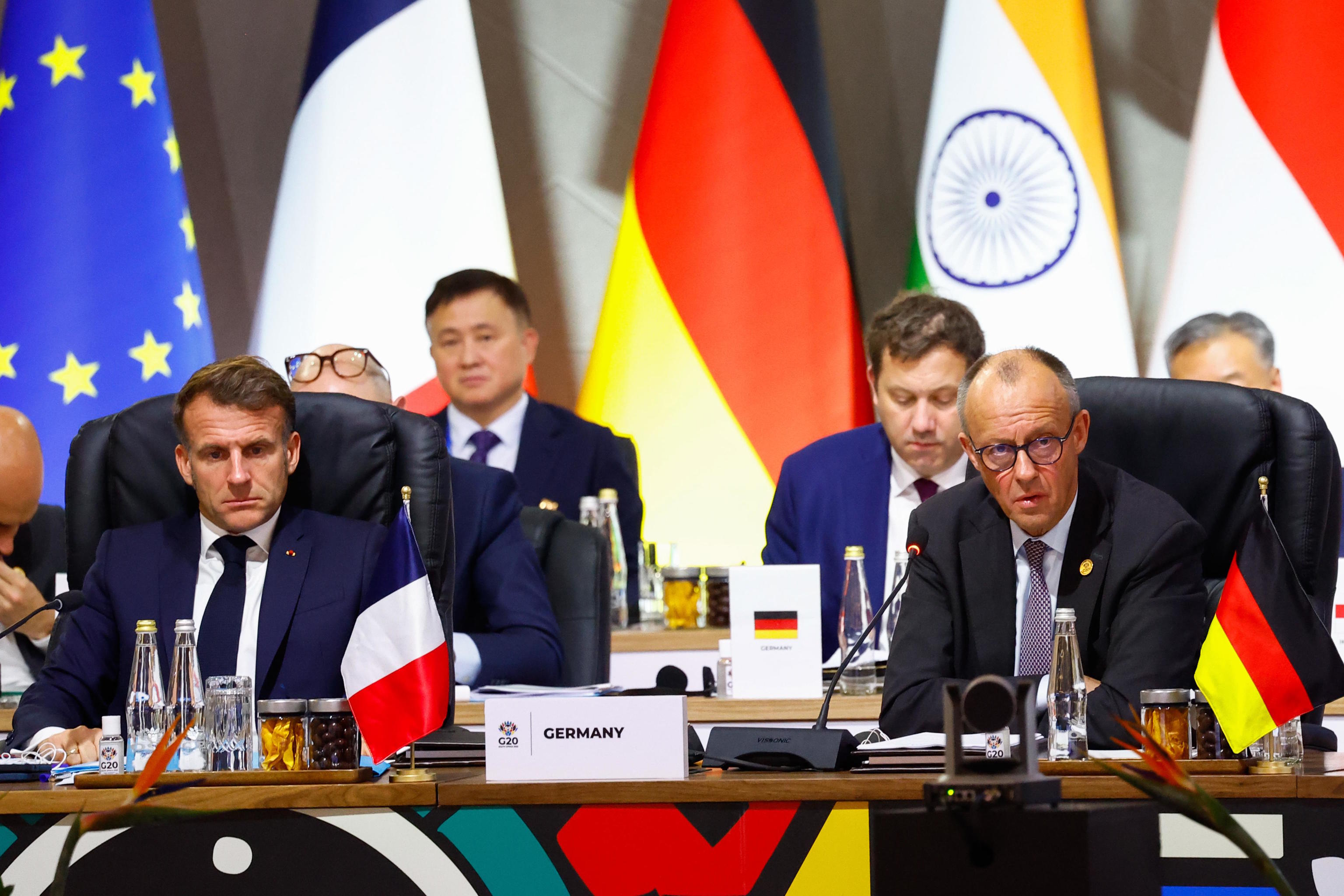
Hope was fading. The conversations were difficult, uphill. But the door was slightly ajar. The South African government never gave up on the fact that the first G20 meeting held in Africa would end, for the first time, without a joint declaration. The US's no-show, which did not send any representatives, along with the absences of leaders like Xi Jinping (China) or Vladimir Putin (Russia), who did send delegations, shook the meeting. But in the end, in a last-minute twist, the attendees have signed a consensus declaration that, among other points, warns against the use of force to annex territories of other countries.
"The adoption of the summit declaration sends an important signal to the world that multilateralism can yield results and indeed it does," said South Africa's President Cyril Ramaphosa at the G20 opening. "We thank all delegations that have worked with us in good faith to produce a final G20 document worthy of this historic leaders' meeting. It sends a message of hope and solidarity. It tells the world that, as G20 leaders, we will fulfill our solemn commitment not to leave any person, community, or country behind."
The declaration consists of 30 pages and 122 points. The spokesperson for the South African president, Vincent Magwenya, explained while leaders spoke in the plenary that it is "a unanimous adoption of the declaration by all present countries," a fact he wanted to "emphasize." In this regard, Argentina's representative, Foreign Minister Pablo Quirno (President Javier Milei did not attend), expressed reservations about two points in the declaration, stating that it should reflect the lack of consensus due to the absence of the US and that they wanted to discuss the "conflict in the Middle East" rather than "occupied Palestinian territories."
The seventh point of the declaration speaks of "working for a just, comprehensive, and lasting peace in Sudan, the Democratic Republic of Congo, the occupied Palestinian territories, Ukraine, as well as ending other conflicts and wars worldwide."
Indeed, the US did not attend the summit, but Russia was present through Vladimir Putin's advisor, Maxim Oreshkin. Diplomatic sources indicate that the declaration had the approval of Russia and Saudi Arabia.
The fifth point of the declaration refers to the United Nations Charter and warns against using "threat" or "force to obtain territorial conquests at the expense of the territorial integrity and sovereignty or political independence of any State." It adds that States "must develop friendly relations among nations, promoting and encouraging respect for human rights and fundamental freedoms for all, without distinction of race, sex, language, or religion."
This point is adopted amid controversy over the peace plan for Ukraine promoted by Donald Trump, which contains 28 points, including proposals that represent red lines drawn by Zelenski, such as Ukraine conceding regions in the west of the country to Russia, including areas not yet invaded by Kremlin forces, and reducing the Ukrainian Army to a maximum of 600,000 personnel. The text is rejected by the Ukrainian president and Zelenski's allies, who are meeting during the G20 to promote an alternative.
Specifically, point 21 of this peace plan sponsored by the White House and backed by Russia states that Crimea, Lugansk, and Donetsk will be de facto recognized as Russian territories, even by the United States. Kherson and Zaporizhia will be frozen on the contact line, implying a de facto recognition of that contact line. Ukrainian forces will withdraw from the part of Donetsk oblast they currently control, which will later be used to create a buffer zone.
Furthermore, point 22 states that once these annexations are established, neither Russia nor Ukraine could reverse the situation "by force."
In the context of the G20, the President of the European Council, Antonio Costa, has convened a meeting of Zelenski's allies present at the meeting, attended by Pedro Sánchez, lasting an hour, to discuss Trump's peace plan for Ukraine.
Another point with significant background in the G20's public declaration is number 33, which refers to critical minerals. "We support further exploration of critical minerals, especially in developing countries; promoting the diversification of mineral sources, routes, markets, processing locations, and value chains."
And that point adds: "We seek to ensure that the critical minerals value chain can better withstand disruptions, whether due to geopolitical tensions, unilateral trade measures incompatible with WTO rules, pandemics, or natural disasters, and that more producing countries can participate in and benefit from value chains."
In May, the US and Ukraine reached an agreement allowing Washington to have a significant financial stake in the country's mining production and privileged access to its coveted rare minerals.
Kiev, pressured at the highest level (more like blackmailed, as lamented by European governments), accepted without achieving the security guarantees it desired in exchange for yielding its resources, having to settle for the idea, advocated throughout by the White House, that a business presence in the country would be the best deterrent against Russia.