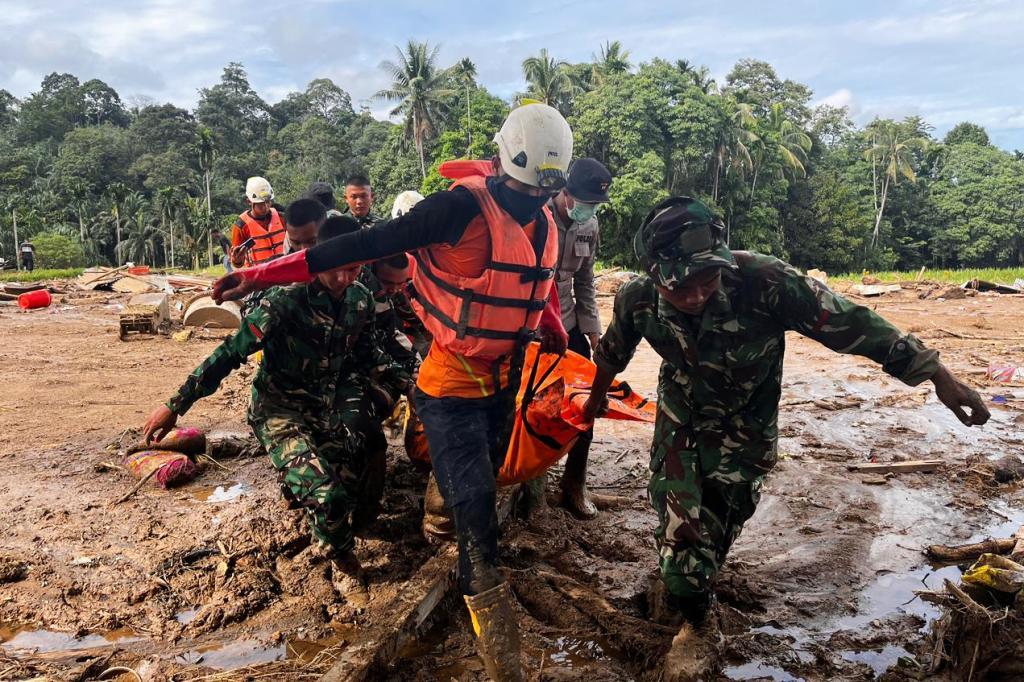
In Sumatra Island, in Indonesia, some communities were literally wiped off the map by the floods; dirt roads turned into mud pits, isolated villages, mud pools where homes once stood. In southern Thailand, images taken from helicopters show children clinging to their parents on rooftops waiting to be rescued while the water had swept away everything around them. The same scenes were repeated in the low-lying areas of Colombo, the capital of Sri Lanka.
A wave of torrential rains, tropical cyclones, and landslides has mercilessly hit vast areas of South Asia and Southeast Asia. The outcome marks one of the worst natural disasters in the region in decades: according to official figures, around a thousand people have died. There are hundreds missing and millions displaced. Sri Lanka and Indonesia have deployed military personnel this Monday to assist the victims.
Sumatra Island bears the brunt of the disaster due to Cyclone Senyar, an exceptionally violent tropical storm. Indonesian authorities confirmed at least 442 deaths and over 400 people missing in the hardest-hit areas. Thousands more remain trapped in isolated communities without water, electricity, or access to accessible roads. It is the natural tragedy with the highest number of fatalities in this country since the 2018 earthquake and subsequent tsunami that killed over 2,000 people.
Indonesian authorities reported that in some areas, landslides buried entire villages; bridges, roads, and infrastructure were destroyed. There are over 80,000 displaced people in three provinces. Temporary shelters have been set up, and thousands of rescue teams deployed.
The government sent on Monday three warships with aid and two hospital ships to some of the hardest-hit areas. One of the images in Sumatra showed how one of the region's characteristic endangered elephants lay buried in a thick layer of mud and debris near the damaged buildings in the city of Meureudu, while rescuers searched for survivors.
In southern Thailand, over a million and a half homes have been affected by historic floods, with water levels reaching three meters in the province of Songkhla. At least 162 deaths have been reported in this country. The magnitude of the disaster became evident when a local hospital had to use refrigerated trucks to store bodies because its morgue was overwhelmed. "Many neighborhoods are submerged under water," survivors said.
Emergency teams rescuing a body from the mud in Sumatra.Ade YuandhaAP
Meteorologists have said that the extreme weather in Southeast Asia may have been caused by the interaction of Typhoon Koto, which crossed the Philippines and is now heading towards Vietnam, where it has already caused three deaths, and Cyclone Senyar, formed in the Strait of Malacca. There have also been reports of severe flooding and at least a couple of deaths in Malaysia.
Over 330 dead in Sri Lanka
Across the Bay of Bengal, Sri Lanka saw Cyclone Ditwah bring intense rains, landslides, and river flooding: the result is the worst natural disaster on the island since the devastating 2004 tsunami that killed around 31,000 people. The official death toll is 334, and over 400 people are still missing. The government declared a state of emergency over the weekend and has requested international aid.
"We are facing the largest and most challenging natural disaster in our history," President Anura Kumara Dissanayake said in a speech on Sunday, promising to "rebuild a nation better than the one that existed before" with international support.
Over 20,000 houses have been destroyed in this country, and 108,000 people were relocated to state-managed temporary shelters. "Some neighborhoods are completely buried under mud," said the Disaster Management Center. Authorities are deploying military helicopters to reach trapped individuals.
In recent weeks, a chain of floods and storms has spread like never before from the Philippines to Sri Lanka. An accumulation of extreme phenomena that, according to experts, is the result of a convergence of unusual meteorological systems (multiple cyclones at the same time) and the amplifying effect of climate change.
The storms have coincided with a climatic pattern that enhances intense rains: a persistent La Niña phase in the Pacific combined with a negative dipole in the Indian Ocean, a rare situation where warmer waters near Indonesia increase evaporation, providing abundant moisture to Southeast Asia.
This excess moisture, acting as fuel for the rains, led to excessive precipitation, saturated soil, overflowing rivers, and dozens of landslides. Additionally, global warming contributes to the strength of the storms.
For example, Vietnam has already experienced the unusual number of 14 typhoons this year, and the Philippines over twenty of these destructive storms. Regions like Sumatra, southern Thailand, or Sri Lanka were already facing significant challenges: deforestation, rapid urbanization, housing in high-risk areas, and inadequate drainage systems. All of this, combined with natural phenomena exacerbated by the climate, leads to increasingly stronger storms that particularly affect rural communities, coastal areas, and marginalized neighborhoods.