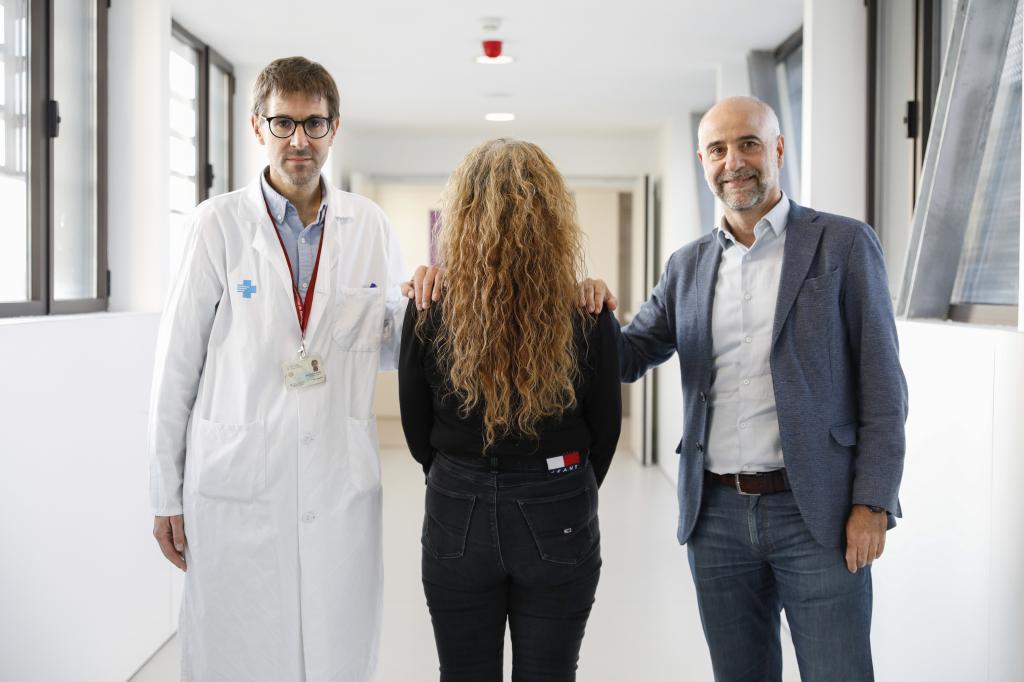
Among the more than 40 million people living with HIV in the world, there are a handful of cases with a superpower. Unlike the rest, these individuals are able to confront the AIDS virus on their own, managing to control it naturally without the help of any treatment.
Maria, a 61-year-old Catalan woman, is one of these exceptional cases known in medical jargon as "exceptional elite controllers". She has been taming HIV for 42 years. Over four decades facing the same virus that showed no mercy to thousands of people who, like her, were infected in the early 80s.
She never imagined that more than 40 years after finding out she was HIV positive, not only would she still be alive without taking any medication, but that her extraordinary case would be helping science in the search for a cure for HIV.
"I was diagnosed in '83, at the Purpan Hospital in Toulouse, France. At that time, that diagnosis only meant one thing: death. Certain death. My oldest daughter was one year old then, and all I could think of was preparing her to live without her mother," she recalls, emotionally looking back.
"What else could I think?" she continues. "Everyone was dying." And her eyes well up as she recites some names that come to mind. Fermín passed away, Eli passed away, Tonín passed away... "I remember a photo from that time. We were a very large group of people. But because of HIV, only I remain. Only me," she murmurs.
Johanna Mercier on HIV: "With current resources, we are facing a real opportunity to eradicate the infection"
New advance against HIV: one annual injection against the infection
Many friends passed away in the early 80s, while Maria was trying to break free from heroin and leave a very complicated life behind. "Some died very quickly, like my brothers-in-law at that time, who passed away in less than five years."
She is convinced that it was with that couple that she got infected. "They were the ones who injected me for the first time, with the syringe they used. Because at first, you never inject yourself. You offer your arm to be injected by others. Then, of course, you get used to it and lose count of how many times you've done it," she says, as she rolls up her sweater sleeves to show arms marked by years of addiction.
Like many at that time, this Catalan fell into heroin without knowing the consequences it carried, when she was still just a teenager. "I am the youngest of five siblings, and I was put to work at a hotel right away. There I met who would be my partner, who was 17 years older than me and turned out to be a drug dealer. Before I knew it, I was going to Amsterdam to bring heroin."
And from trafficking to consumption, she assures, there was only a small step. When she started, she had not yet turned 18.
"If you live with drugs, eventually you end up using them," she laments. "At first, it seems wonderful, it makes you feel good and escape, but it's a deception. Before you know it, you are completely hooked. It destroys you."
After the birth of her daughter, Maria convinced herself that this was not the life she wanted to live and entered a detox center.
But while she tried to hold on to life, death was always around her. And over her head, a constant sword of Damocles.
"I knew it would be my turn, that at some point it would be my turn. I joined a support group for HIV-positive individuals and saw many people die. Many. Also many children." She sighs as she remembers a little boy who was born just 20 days after her daughter. "I remember his birthday was on August 28. But he didn't make it to 8 years old because he passed away on the 21st. I will never forget that," she says with a trembling voice.
"Cases like Maria's are the closest thing we have to an HIV cure. Studying them can provide us with many clues"
The first time they suggested that her case was special was in 1990 when, seeing her progress, a doctor wanted to run more tests. "She even doubted that I was positive and repeated the tests, but she was convinced when she saw the results again, showing antibodies against the virus."
It wasn't until many years later that she heard the term "exceptional elite controller" for the first time and the explanation of why she has remained unscathed against the virus all these years.
"Cases like yours are truly extraordinary," Javier Martínez-Picado, ICREA research professor at IrsiCaixa in Barcelona and one of the world leaders in the study of elite controllers, repeats to her today, on a sunny November morning in Barcelona.
"We call elite controllers those people who have been infected with HIV but have not developed the disease, have not lost immunity, and do not show virus replication in the absence of antiretroviral therapy," explains Martínez-Picado, who recalls that this occurs in less than 1% of all infections. In most cases, these patients lose that natural protection against the virus over time, after a few years. But within that group, there is an even more extraordinary subgroup - exceptional elite controllers like Maria - who manage to maintain that superpower against HIV for decades or even for life. They represent less than 0.1% of the total.
"Studying these cases is very important because they can provide us with clues to one day cure HIV," emphasizes the researcher, who a few months ago published an article reviewing all the evidence obtained through the study of nine cases published in the scientific literature. "Maria was not among them, but if we included her, she would be the longest-standing case," he emphasizes. "It is truly exceptional."
Through her, one can practically trace the entire history of the epidemic. "Her diagnosis was in '83, the year the virus was first identified," and only two years after the first cases of what would later be called AIDS were described.
Over these more than four decades, Maria has managed to escape death and the terrible consequences left by the first drugs developed against the infection. But she has experienced firsthand the stigma and discrimination surrounding AIDS. She claims that she still feels it today - "It's unbelievable, in the 21st century!" she exclaims indignantly. That's why she does not want her face and real name to appear in this report.
"I don't mind showing my face anymore, but I don't want to do it because I know it could affect my daughters. Rejection, believe it or not, is still there," she asserts. And she mentions the case of her youngest daughter's paternal family, who is 23 years old. "They have no idea. But I know they would reject her if they found out, even if we proved that neither of my daughters is infected," she laments.
"The stigma is still very present, and today it can be a significant barrier to diagnosing people who may be living with HIV and are unaware of it," confirms Arkaitz Imaz, a doctor at the HIV Unit of the Bellvitge University Hospital in Hospitalet de Llobregat (Barcelona).
Throughout his career, this specialist has come across some elite controller cases, although it has been a while since he identified new patients due to treatment protocols. "Unlike years ago, medical guidelines now recommend starting antiretroviral therapy as soon as the infection is diagnosed because it is associated with a better prognosis," he explains. This immediacy, which improves the quality of life for those affected, in turn masks potential exceptional cases like Maria's.
The only time this Catalan woman took antiretrovirals was during her second pregnancy, and she did so with the sole purpose of minimizing the chances of transmission. The rest of the time, these treatments are not prescribed to her because the virus in her blood is undetectable. Additionally, her immune system also does not show the usual footprint left by the pathogen in the absence of treatment.
"What is so special about me that I have achieved this?" asks María, who knows that Javier Martínez-Picado can give her some answers about her exceptional case.
The first thing the researcher explains is that there is no single reason. "Cases like yours are always multifunctional," he points out.
When they come into contact with the virus, elite controllers manage to put so much pressure on the pathogen that they manage to subdue it and isolate it in dead ends. But there may be multiple reasons behind this ability, Martínez-Picado explains.
Some of them have to do with genetics. For example, some patients have a special mark on the CCR5 molecule, which is essential for the cell doors to open for the virus. "Having a mutation in both alleles of this gene is associated with a higher probability of being an elite controller," explains the researcher. It is precisely this mutation that has made it possible to eradicate HIV in several patients who have undergone bone marrow transplants with these characteristics.
"We also know that there are certain types of molecules in the immune system that play a role in the response to infections, known as HLA, which are protective. Specifically, we know that B57, B27, and B87 confer a certain degree of protection against infection." On the other hand, researchers are analyzing the influence of epigenetics, the factors that act as a switch for gene expression, "which we believe play an important role," says Martínez-Picado, who is also exploring the role played by specific cells in the immune system, called natural killer cells, a kind of paramilitary force that, without asking too many questions, eliminates any cell suspected of being infected.
"In most elite controllers, we can still detect viruses, but they are defective viruses that cannot replicate. We think this may be due to a very powerful initial immune response that manages to subdue them," explains the researcher. In some cases, protection also has to do with the fact that the viruses have ended up in places in the genome where they can move around but cannot replicate. "It's like putting a car in a garage where you can't maneuver it. It's there, but it can't go anywhere."
The scientist is particularly intrigued by one characteristic of these patients that he has been pondering for a long time: the fact that elite controllers are mostly women. "Although the population living with HIV in our environment is predominantly male, with around 80% of these people being men, what we see is that among the elite controllers identified, the proportion of women can reach 60%," he points out.
"We believe that this is largely due to the fact that the innate immune system is more powerful in women. For genetic reasons, women have a greater capacity to produce a molecule called interferon, which, as its name suggests, interferes with viruses and gives them an evolutionary advantage over men, helping to ensure offspring," he explains. "We think that in cases like María's, where they were in contact with the virus at a time when they were young and had a very, very powerful immune system, they had a very high immunogenetic capacity for protection, and that was key."
María nods and smiles. She sees herself reflected in that strength. She adds that she is like her car, which she calls Frasquita. "I like to do what the Japanese do, which is to give things a soul. I talk to it and say, 'Don't break down. I've had it for a long time and it's never let me down. And I'm the same, ever since I got off drugs, I've always told myself to keep going."
She says she will always consider herself a drug addict and therefore avoids any substance that could cause her to become addicted. "It scares me a lot. I have prostheses in both knees and was prescribed very strong pain medication, but I didn't want to take it because of everything I've been through. I went without because I wouldn't trade what I have now for anything. No amount of money can pay for the peace of mind I feel when I wake up and can be with my daughters," she says, looking fondly at her youngest daughter, who is with her. "She hasn't had the life I've had. She has her degree and I'm sure she's going to do great things," she says proudly.
"There is a complete lack of money to fund this research."
For those researching HIV, cases like María's "are a real gold mine." Martínez-Picado emphasizes this, and Ezequiel Ruiz-Mateos, a researcher at the Institute of Biomedicine in Seville and a member of the board of directors of GeSIDA, confirms it.
"These people are the closest we have to a cure for HIV," he stresses. "Understanding the mechanisms they have used to corner the virus to the point where it is virtually impossible to replicate can give us many clues as to how to emulate their case in all people with HIV and achieve a cure," says the Andalusian researcher.
They are a perfect model for research, and Spain is in a privileged position to do so, with cutting-edge equipment and identified patient cohorts, Ruiz-Mateos and Martínez-Picado agree. The problem, they add, is that "there is a complete lack of money to fund this research."
"The funding being provided at the public level is laughable, and philanthropy is not contributing to these types of projects either," laments Martínez-Picado, who denounces the fact that lines of research seeking to find a cure for HIV are running dry.
For the researcher, "the current situation, in which the goal is to diagnose and treat people with HIV for life, is undoubtedly much better than what we had at the beginning of the pandemic, but it is still far from ideal. We cannot lose sight of research focused on curing HIV, and to achieve this goal, we need the real and joint involvement of all sectors and organizations, both public and private," continues the scientist, who stresses that "we have the medical and research tools to take important steps in this direction, but we need funding."
In this regard, the scientist points out that progress in achieving a cure for HIV would not only eliminate the disease in millions of people, but also better prepare us for possible future threats.
This family of viruses has been on this planet for 500 million years. Ancestral retroviruses make up 8% of our genome, which means that at various points in mammalian evolution, we have crossed paths with these viruses. This could happen again. Today, tomorrow, or in half a century, but it could happen again. And we must remember that the mortality rate of HIV, without treatment, is 99.99%. Only cases like Maria's prevent this. Therefore, contributing scientific knowledge on how to deal with and cure this type of disease can give us an advantage in the face of future pandemics," he points out.
"The truth is that it is difficult to understand why more money is not being invested in a field that has proven to be essential," agrees Imaz.
María also joins in the call for action. "If more money isn't being invested in this, it's because of vested interests and a lack of political will," she emphasizes, before launching into a plea. "I feel like I've been given many extra years of life. I want to help, and if my blood can be used to find a cure for this epidemic that has caused so many deaths, then let it be used and researched. Here are my veins."