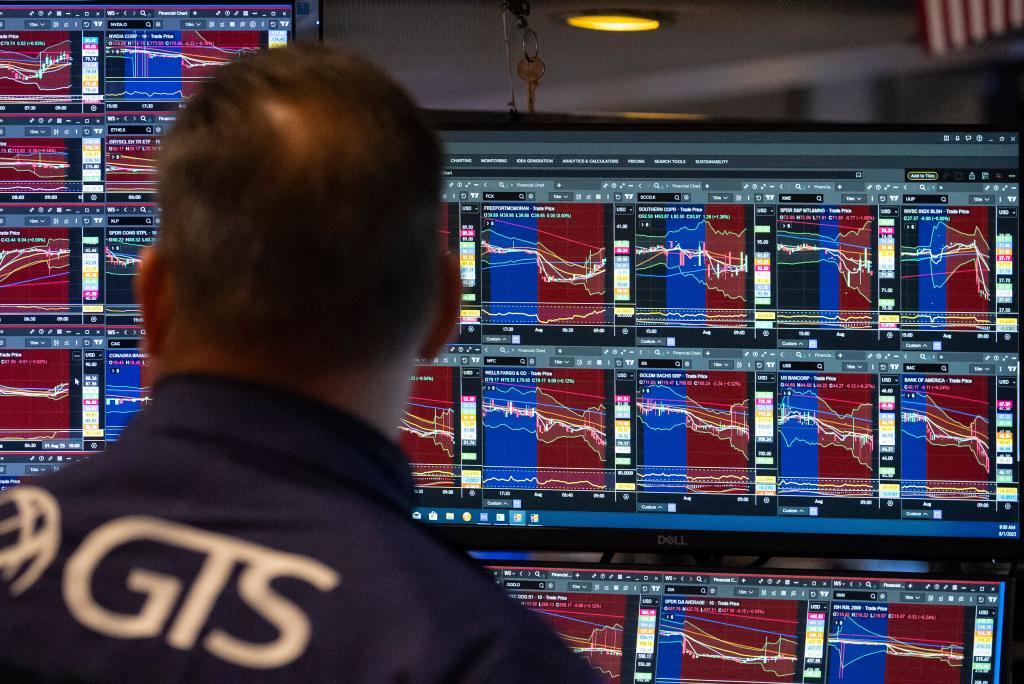
A quarter of a century after the dot-com bubble, there is talk about the upcoming market crash driven once again by technology. It's easy for those monitoring the stock markets to succumb to hyperbole and sensationalism in the face of increasingly frequent warnings of a possible collapse of the giants monopolizing artificial intelligence globally. The question is whether the fear is about the bursting of a bubble due to the sky-high valuations reached by a handful of firms or if it's simply vertigo from plummeting from a skyscraper that keeps building floors at an unprecedented speed. In other words, does the market fear a bubble in AI or is it the fear of something as old as "too big to fail," as seen in the 2008 US subprime crisis?
Let's start with the numbers. The five largest US tech companies - Nvidia, Apple, Alphabet, Microsoft, and Amazon - collectively have a market capitalization of 15.7 trillion euros, equivalent to the valuation of all companies on the major European stock exchanges. The EuroStoxx 50 index, which includes the 50 most important firms in the eurozone, doesn't even reach 5 trillion euros in market capitalization among the fifty companies, while Nvidia alone is valued at 3.8 trillion. For another example, the Ibex 35 still doesn't surpass a trillion in market capitalization among the major companies in our market, with Inditex, Banco Santander, Iberdrola, and BBVA above 100 billion euros.
Is it justified for a single company to be worth nearly 4 trillion euros? According to experts, yes, given the record-breaking results it presents and the level of monopoly in its business. A separate question arises as to whether a single company should be valued the same as the 50 largest European companies due to the systemic risks it poses. As of the third quarter of the year (its fiscal year 2026), Nvidia reported revenues of 147.811 billion dollars and an accumulated net profit of 77.101 billion, a 52% increase from the previous year, with operating margins that are unbeatable for almost anyone, close to 60%, the highest in the sector by far thanks to its "chip pricing power," as noted by Edmond de Rothschild's private banking. On average, tech companies are at 37% with Nvidia included, where Microsoft and Meta stand below 40%, and Alphabet and Apple above 25%-30%.
With the Nasdaq trading at earnings multiples of 30 times, it is still far from the P/E ratios seen at the beginning of the century, around 45 times during the dot-com bubble. Although some show extreme valuations. Take Palantir, a company based on big data and AI, created in the aftermath of the 9/11 attacks with funding from the CIA, trading at multiples of 386 times, implying that it would take almost 400 years to recover the investment through profits, although this would decrease rapidly if it continues to grow at the current pace, considering that it wasn't until 2023 when it started to become profitable. Its main clients are intelligence services and government defense departments of allied states. This year, it aims to double its revenues to nearly 4.4 billion dollars. It has a market capitalization of around 335 billion after rising 150% in the last year and dropping 22% in November alone. This is a cause for concern in the market given the magnitude and impact its fall could have, no matter how minimal. "Financial indicators do not show signs of exuberance, and valuations reflect fundamentals clearly superior to the rest of the market. However, it is true that expectations are high, and volatility within the sector could be higher than in others in the face of any disappointment, however minimal," emphasize Banca March.
Their completely oligopolistic business has also been favored by years in which money was printed hastily at central banks worldwide to boost economies. And that money, a large part of it, is still there, seeking where to invest in the most profitable way possible. It should not be forgotten that the new era of interest rates in the last three years was preceded by nearly a decade of glaciation in which money yielded nothing, with rates at 0% and even negative.
CONCERN 1: THEY ARE ALL THE SAME
AI is poised to change everything. Not only will it make industries more productive, but it will also enhance human capabilities, make military and defense technology more precise... and could even cure diseases if all goes well. The issue is that there are so many possibilities that never before has so much money been invested in a technology that has not yet demonstrated a profitable business model to justify a trillion-dollar bill in investments. "It has even surprised its creators. The world must digest something that has progressed very rapidly," says Álvaro Ortiz, Big Data Analysis Manager at BBVA Research. "There are already surveys indicating that 70% of the US population uses AI" in their daily lives, a fact about a gap in expectations and unfinished realities.
The few specific figures available point to an impact on annual productivity of between 0.1 and 1.5 percentage points in the US over the next decade, with a per capita GDP expected to rise from $85,000 in 2024 to $105,000 in 2034, according to the non-profit organization RAND (Research ANd Development) focused on research and development, while reducing debt and, theoretically, the cost of living because, on paper, it is assumed that workers will be more efficient and have more leisure time for spending, boosting economies while pushing down prices for movie tickets, concerts, or streaming platforms.
It is widely assumed that AI will transform our lives in ways that are still unimaginable. It is so disruptive that it is not even comparable to the arrival of the Internet, which was merely consultative in nature, experts say, compared to AI, which goes much, much further. What is unknown is how far it will go. In this ethical AI realm, the company Anthropic emerged, founded by key former employees of OpenAI and owner of the cloud Claude. Microsoft (which controls 27% of OpenAI after the latest restructuring) and Nvidia have announced a $15 billion investment in it. In turn, Anthropic provides servers to Alphabet and services to Amazon, who also invest in the company. And this is just one example. In this network woven by all the major American tech companies, services, software and hardware sales, direct investments, or in startups at the venture capital level are intertwined... and it is almost more likely that everyone works, in one way or another, with everyone else. Oracle spends billions on purchasing Nvidia chips, for example, but has also announced a $300 billion alliance with OpenAI for cloud development. "For some, this is a problem. For me, not so much because it is a unique control mechanism. Everyone participates with everyone else because no one is sure who will be the winner," says Francisco Rodríguez, senior economist at Funcas.
Overall, it is expected that, excluding Nvidia, the four major tech giants, Meta, Alphabet, Amazon, and Microsoft, will end 2025 with a capex of $300 billion and even higher in 2026, reaching $400 billion.
CONCERN 2: FINANCING
American investors have also started losing sleep over the massive financing needs of AI, which seem never-ending. And this is something that has changed. Until this year, tech companies, with overflowing cash reserves, have undertaken their multi-billion-dollar investments on their own, using their liquidity. But in 2025, they began seeking financing, involving the financial system... and if something bad were to happen - it's an old story - it would pose a stability risk for the entire economies.
So far this year, the five largest tech companies, Amazon, Alphabet, Microsoft, Meta, and Oracle, have raised a record $108 billion in financing, debt that triples all the capital raised over the past decade. For example, Google's parent company issued $5 billion in bonds last week, with a dozen banks participating in the placement, including Santander and BBVA, with a significant presence in the US. It received requests that were five times the offer, with the offered rate at 5.55% for the longest-term bond, 40 years out.
In a recent report by consulting firm Bain & Co, tech companies will jointly need to allocate around $2 trillion per year to finance computer capacity needs by 2030. The problem is that, with current forecasts, they will fall short by about $800 billion considering that they are prioritizing growing at an unprecedented pace rather than monetizing investments. All to avoid losing the race to be one of the winners in AI. "These are historic financing needs. Some of these hyperscalers are transitioning from generating massive cash flows to burning money in 2026," says RAND.
One of the largest anticipated expenses continues to be concentrated in the creation of data centers, which remain heavily concentrated in the US, and more specifically in three states: Virginia, Texas, and California, which account for one-third of the 3,664 data centers that exist. "Clear evidence of the current need for data centers is that, despite the huge investment—$356 billion, a fifth of Spain's GDP—most of the projects under construction already have assigned workflows and are leased, indicating that no excess capacity is being generated," notes Banca March. In Europe, where there are also data centers, Frankfurt stands out as the largest in terms of size, with 200 MW of installed capacity that is 74% leased. Below these figures, Milan and Paris reach 100% and 87% occupancy, respectively.
WHAT IF THE BUBBLE BURSTS?
It is true that half of international fund managers believe there is a bubble in AI valuations, according to Bank of America. But it is also true that no one is very clear about the implications it could have if it burst on the real economy. In general, experts understand that if one of its protagonists were to fail tomorrow—which is something that will happen, as in any revolution—it would not necessarily have an impact on citizens' pockets. That impact, they argue, would be contained in the stock market, and there, indeed, we should watch out for the correction that is coming.
At the moment, AI is more aspirational than real, although, for example, half of European banks acknowledge that they use it for their internal affairs and only 9% for external affairs with customers, according to a recent report by S&P. What is being looked at more closely is the impact on employment. "In all industrial revolutions, there has been job destruction, which is replaced by new jobs. The problem with AI is that it is not very clear that this will happen," Rodríguez analyzes. The surprise for many is that it is not already happening, and the explanation is simple: "For every 1,000 cases, you find errors in 50, and this is a very high ratio. The refinement for the replacement [of workers] has not yet arrived," but it will.