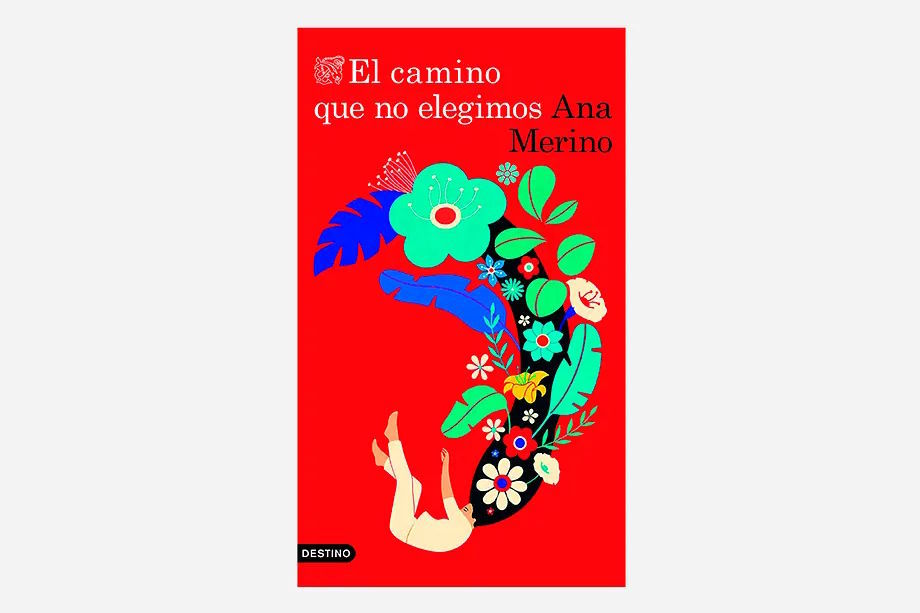
One late April day like any other, Juana Cepeda, a Spanish Literature professor at a prestigious college in New England, is suddenly abandoned by her husband, Connor, a renowned Biology professor, after two decades of marriage. This stark and bewildering scene sets off El camino que no elegimos (Destiny), the new work by the poet and playwright Ana Merino (Madrid, 1971), an absorbing and emotional novel that reflects, through a diverse group of characters, on all the facets and depths of love and on the incomprehensible and unexpected turns our lives can take.
"Suddenly, I vividly saw that specific, harsh image, and I began to think about what sustains a marriage, what happens to love over time, how it changes, what transforms it...," recalls the writer. "That led me to consider the security in which we live, that false comfort, because many times life takes us to unexpected places that surprise us. Then, I simply started pulling the thread, and the characters began to appear on their own to illustrate the need to redefine love and explore how it affects us, how we face it, that path with so many forks that can never be traveled alone. Love has always been the emotion that gives meaning to human life. But it is also an emotion that always depends on the other, thanks to which a single individual can make us happy or unhappy. That is where its power lies."
A very true reflection in Juana's case, who, after turning 50, must abruptly rethink her life. "A decision made for her completely shatters her world, in which she believed everything was fine, orderly, harmonious. Suddenly life drags her along, and it is fascinating to explore how when something like this happens, we always have the need to find answers but also to look forward," Merino opines.
On the other side, with Connor, the writer delves into aspects such as existential dissatisfaction, addictions, and a lovelessness that does not always have a specific cause. "I am not interested in writing a novel of good and bad characters, but of decisions, of those more or less radical decisions that mark our lives and encompass everything, from pain to the possibility of redemption," the author points out. "Connor may be unlikable to the reader, but in his journey, he redeems himself and seeks to define another life. And even though he causes a lot of harm to the person he was with for so long, I believe that making a difficult decision is always the right choice, as one must seek their truth. I think betrayal would be living a big lie, not facing reality, even if it is cruel and painful."
"I am not interested in writing a novel of good and bad characters, but of those decisions that mark our lives"
Rich, varied, and ensemble, as we say, the intelligent and multifaceted look at that supreme emotion presented in The Path We Did Not Choose does not end solely with Juana and Connor's story, but encompasses many other aspects of love, such as the fear of surrendering or prejudices towards others, which Merino articulates in the passionate relationship between Cécile, a French teacher and Juana's friend, and Marco, a police officer and former military of Italian and African-American descent.
"I wanted a plot that reflected the doubts that arise around how we perceive the other person and the world they represent", Merino points out. "Many times in love, we are the ones who create obstacles that, more than personal, have to do with social constructions and perceptions, with everything around us and with prejudices towards certain worlds that are not our own or that reflect opposing values. However, the amorous impulse, the passion, is above all that."
Through these teachers, there are constant nods to 19th-century love through Galdós, Pardo Bazán, and Stendhal -"love never changes, what changes is society, but we continue to love each other the same way," Merino opines. And even in this rich mix, there is room for the infinite intricacies of family and friendship relationships. "These types of affections are fundamental in shaping who we are, and I am fascinated by exploring how their relationship with others determines each character."
About a year and a half ago, Merino left her position at the University of Iowa, where she founded and directed a Spanish writing master's program for years, and definitively returned to Spain, which she had left in 1995 to cross the pond. Therefore, if The Map of Affections (2020 Nadal Prize) was a love letter to the United States and a nostalgic homage to our country - while also solidifying a literary voice marked by ensemble storytelling, exploration of feelings, and reflection on chance - this new novel is, as she explains: "My farewell to everything I experienced in the U.S., a tribute to the places I passed through in these almost three decades, especially New England and Dartmouth College in Hanover, between Vermont and New Hampshire, where I was very happy," she points out.
This society is brilliantly recreated in the book, using a small university town as a microcosm representing an entire country. "It is a fascinating and complex place, very different from Europe in many ways, so at first, there are many social issues to learn. The way people understand life and the challenges they face are different. Here, I wanted to reflect a paradox that has always caught my attention: how it is a profoundly individualistic country, where people are isolated, but at the same time, there is a strong sense of community, and everyone is hyperconnected with those around them," explains Merino. "That contrast can be seen in a small town that, moreover, is the real soul of the country more than the big cities."
"Love never changes, it is today the same as it was in the 19th century, what changes is society"
However, the portrait that Merino paints, set between 2016 and 2018, is not without criticisms and issues. The book naturally touches on everyday themes in the United States: latent racism, the danger of mass shootings, the dramatic experiences and lives of veterans, illegal immigration... And especially, the social shock and political radicalization that came with Trump's first presidential campaign. "Violence, for example, is much more present there. Although we suffer from a different type here, terrorism, the ease of access to weapons there, their everyday use, generate other social dynamics, like prevention workshops, training. Things that I experienced in college and learned to normalize."
Regarding this decade marked by Trumpism, the writer believes that many of the problems in the United States stem from what she calls the empire syndrome. "That hegemonic vision affects society at all levels because that imperial policy is bellicose and destructive, full of wars that destroy the youth, attracted by adventure and not by ideology. Spain suffered from it in the 17th century, when even Cervantes was a soldier, and France in the 19th century," Merino argues.
"However, I believe that American society is very resilient and full of resources, so even though today's politics are what they are, I am optimistic and believe that better times will come when all those negative values will fade in favor of greater ideals. That is what I want to believe."
An inevitable dystopia?
Besides this novel, spending half her life in the United States has brought Merino another gift. Alongside the publication of this novel, she is about to premiere a theatrical production of her play, *La redención* (The Redemption), published in 2016. "Upon returning, I decided I wanted to go back to the theater. I had already staged my play *Amor muy frágil* (Very Fragile Love) in Switzerland, but in Spain it's not so easy; there isn't as strong a network of alternative theater as there, or the opportunities found in the United States," confesses the author, who has registered as a theater producer and invested all her savings, 25,000 euros, in this piece, plus another 10,000 euros she received as an advance on this latest book.
"We are being swept along by the inertia of a slow apocalypse that we are promoting with our selfishness."
"It's true that this entrepreneurial spirit is very American, so you could say that the US gave me the opportunity to bring the kind of theater I want to Spain. Those years allowed me to take the plunge and stage this play." A piece that, although written a decade ago, is entirely relevant today, as it is a dystopia set in a highly toxic waste plant where Merino explores human relationships.
"We are being swept along by the inertia of a slow apocalypse that we are promoting with our selfishness. Consumption seems to give meaning to our existence, and, confident in this, we generate waste that will take thousands of years to disappear," the author reflects on this play, which premieres at the Torrejón Theater on February 22nd. "And I hope to be able to announce tours throughout Spain soon," she concludes enthusiastically.