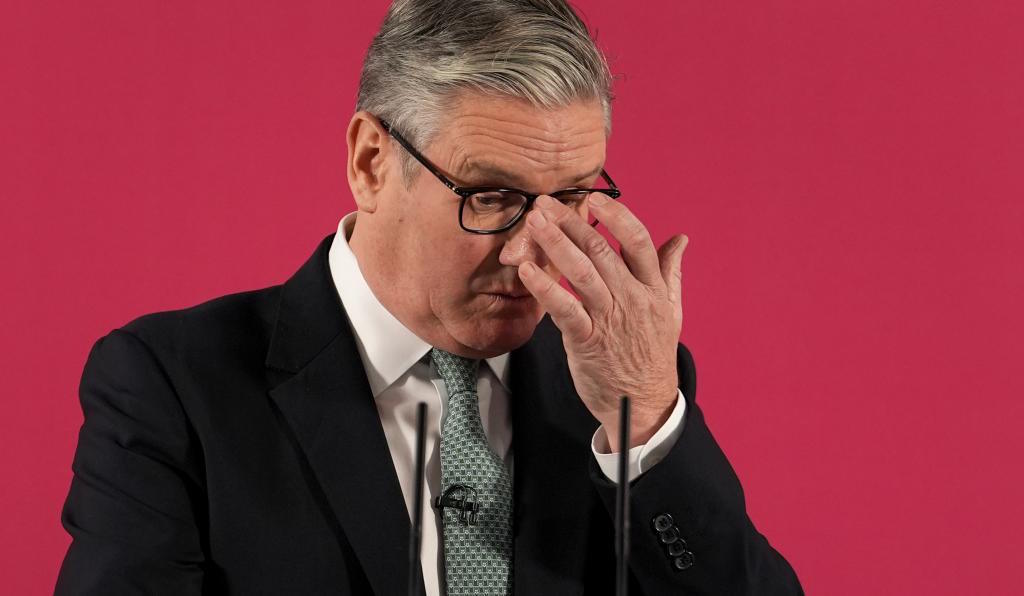
British Prime Minister, Keir Starmer, has today defended his Finance Minister, Rachel Reeves, against accusations of manipulating data from the Office for Budget Responsibility (OBR) to justify tax increases in the 2026 Budget. According to Starmer, "there was no deception" on Reeves' part, who used worse fiscal outlooks than those provided by the OBR to support her revenue and spending program, an organization independent of the Government. The Prime Minister, therefore, remains committed to fiscal adjustment, despite angering part of the left wing of his own Labour Party.
Starmer used his defense of Reeves to announce his desire for a closer relationship between the UK and the European Union. "The [final] Brexit agreement has significantly harmed our economy," said the Prime Minister, emphasizing the importance of "reducing frictions" between the UK and the Twenty-Seven. Starmer made a call to "accept that we need to get closer to the EU", and "behave like adults," which "will involve concessions." For the Labour Government, a close relationship with the EU could be the key to opening up the British economy to greater growth.
Achieving more growth is the 'number one' goal of the British Government, and one of the keys on which the Labour Party has staked its (judging by the polls, currently impossible) victory in the general elections scheduled for 2029. However, restrictive budgets and a reduction in the Welfare State, which are the Government's short-term strategies, mean less growth. Trade and investment with the EU could be the factor that helps square that circle. Additionally, Starmer knows that a return to the EU is popular among the British. The problem is that no one wants to compromise on anything to achieve it.
And this is reflected in the relationship between London and Brussels. The agreement signed last May between the UK and the EU for the normalization of phytosanitary rules is progressing at a snail's pace, and the negotiation for London's entry into the EU's rearmament financing mechanism (SAFE) hangs by a thread. The EU has not hidden its displeasure in recent weeks with the attitude of the Labour Government, whose pro-European rhetoric, according to some, falters when it comes to translating into practical actions.
But Starmer wants more, even though London and Brussels have not yet tackled the biggest negotiating issue, which is the free movement of young people from the EU to the UK and vice versa.