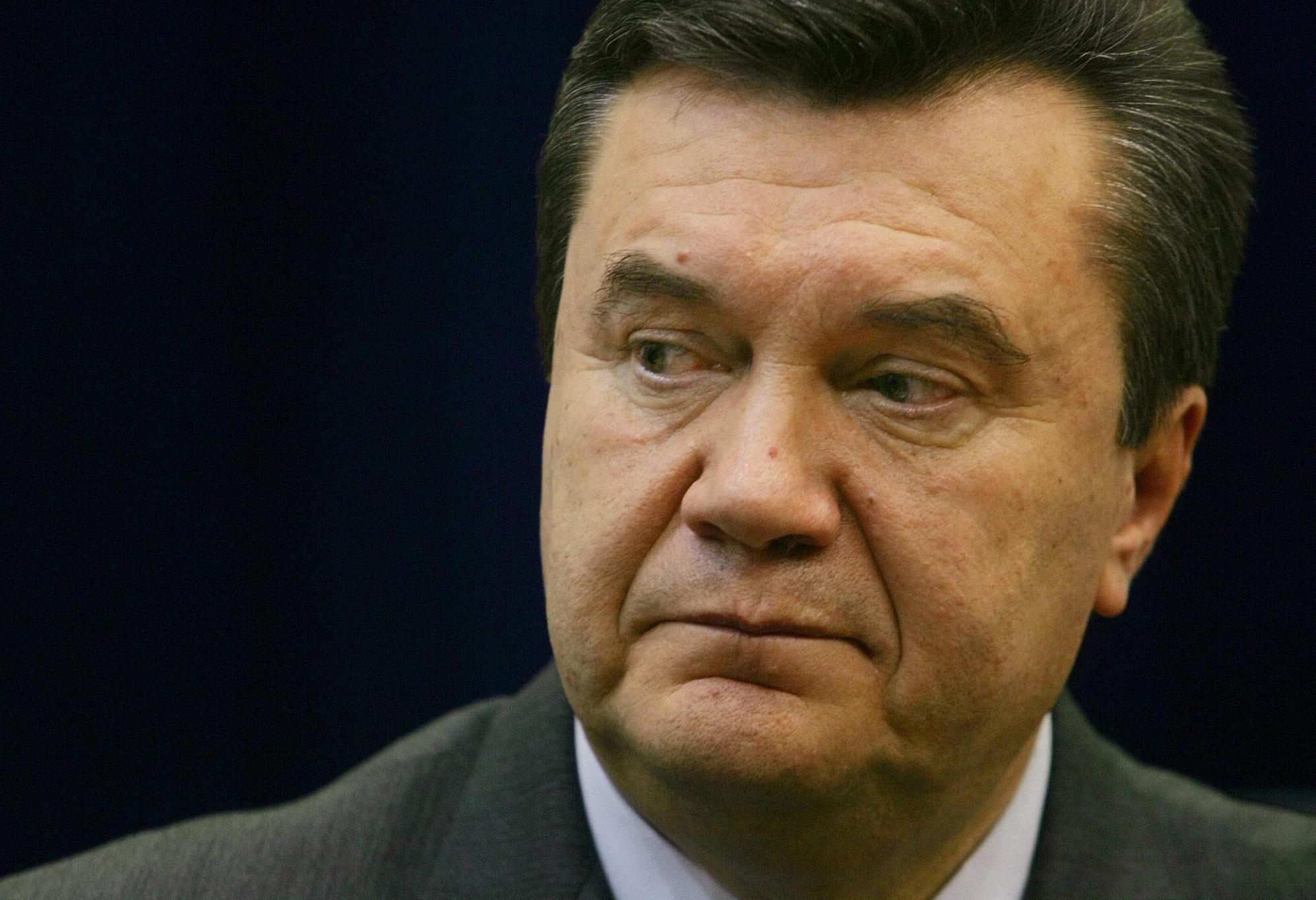
In front of the former residence of Viktor Yanukovich, Valdyslav Kondratyuk, a 29-year-old former soldier, is torn between the insulting opulence of the complex once occupied by the former Ukrainian president and the news about the scandal rocking the current Head of State's Administration, Volodimir Zelenskyy.
Kondratyuk decided to visit this weekend the vast estate where Yanukovich resided - between 2002, when he became the country's prime minister, and February 21, 2014, when he was forced to flee the country amidst a popular uprising. He did so after learning about the so-called Midas case, a misappropriation scheme involving several close associates of Zelenski, which on Friday led to the resignation of his closest assistant, Andrii Yermak. "I wanted to see how a person who stole from Ukraine lives," he explains in front of the former president's residence.
For a former prisoner of Russian jails - he was only released on May 23 after spending 26 months incarcerated - what is happening can only be described with one word: "disgusting." "I feel completely betrayed. To see someone enriching themselves with the blood of Ukrainians, when there are thousands dead in the war, is repugnant," he points out.
The former soldier was one of the dozens of people who visited the so-called Mezhyhiria Residence this weekend, located on the outskirts of Kiev and occupying an area of 140 hectares.
Dubbed the Corruption Museum, the estate - former headquarters of a Cossack-era monastery, which Yanukovich appropriated - includes a zoo, golf course, vintage car museum, helicopter pad, a huge spa, and even a restaurant shaped like a Spanish galleon, installed on the banks of the Dnipro River that flows alongside the former presidential residence. Experts estimated that the cost of these infrastructures - dotted with artificial lakes and statues of Greek and Roman classicism - amounted to around 1,000 million dollars.
"Think that all of this was paid for with your money," explains the guide leading the group of Ukrainians entering Yanukovich's former residence.
The 3,000-square-meter, 76-room palace is a perpetual excess. From the Italian marble used for the floors of the first two floors, to the 30 types of exotic woods used for the parquet-covered areas, the armors imported from Spain worth 10,000 euros each, the several-meter-long caiman skin adorning the dining table, or the perpetual gold color with which all faucets, knobs, and handles were painted.
The leader took great care in choosing objects based on their rarity. Or directly for their outrageous price. He drank Armenian brandy from a barrel made of Ivory Coast wood. He played billiards with balls made of elephant ivory. And both the piano in his living room - which cost 225,000 dollars - and the Swiss music box in the billiard room - priced at 456,000 euros - were limited editions.
"Only 25 pianos and 25 boxes of this type were made. We know this because the invoices were recovered when Yanukovich fled the country and the residence was occupied by activists," explains the Ukrainian accompanying the visitors.
The living room alone occupies over 200 square meters and is adorned with chandeliers totaling over 30 million euros. "This Italian carpet cost 280,000 euros," points out the guide. The most incredible thing is that the colossal residence was only occupied by Yanukovich, his partner, and her daughter.
The president would travel to the spa through a 100-meter underground tunnel connecting it to his house to avoid going outside. There, he could enjoy the comforts of these chambers - including a salt cave - but also a bowling alley, a boxing ring, gym, and a tennis court.
Denys Tarakhkotelyk was one of the first Ukrainians to enter Mezhyhiria on February 22, 2014, just hours after Yanukovich left.
The activist, along with a group of friends, managed to save the residence from looting but also decided to stay on site for over a decade. "I did it to preserve it, so that all that (the excessive luxury) would serve to educate the new generations. Yanukovich's palace served as a model for Ukrainian politicians, but in the wrong sense. Everyone wants to have the same," he argues.
The Corruption Museum is just the pinnacle of a scourge that has accompanied Ukraine since its independence in 1991 and has now sparked social outrage once again with the Midas case.
Archive image of President Zelenski with his until Friday Chief of Staff, Andriy Yermak.AFP
The departure of Andrii Yermak from power - considered the gray eminence of this Administration - has not put an end to the criticisms now directed at Zelenski himself. Last week, Alexander Rodnyansky, an economist teaching at the University of Cambridge and who until last year served as an advisor on these matters to the Ukrainian president, lashed out at the leader and the system he has created in a column in The Economist.
"The taboo question now is not whether corruption is widespread, but whether the current leadership remains part of the solution or has become part of the problem," the expert inquired after accusing Zelenski of being primarily responsible for an Administration based on "loyalty rather than competence" and where efficiency is measured by the ability to overcome scandals "rather than prevent them."
President's plummeting popularity
For the columnist of the Ukrainian newspaper Pravda, Angela Skrylyeva-Popova, the investigation has been a huge blow to Zelenski's public approval, which she estimates to be between 20 and 45%.
"Society perceives the scandal as a betrayal", she recently wrote in that publication, but in the same text, the psychologist explained the limited popular mobilization on the issue by arguing that "fear" of "protests" affecting the country's priority - the war to stop the Russian invasion - weighs more.
"It is logical that the fear of chaos.. of a collapse on the front line is greater than the anger at corruption," she opined.
Denis Tarakhkotelyk, who took part in the popular uprising of 2014, also shares that apprehension and "appreciates" the National Anti-Corruption Bureau for "not revealing all the information." "The priority is to save the country. And we couldn't do it with another revolution like the one in 2014," he adds.
Skrylyeva-Popova's hypothesis aligns with the scant twenty people who gathered this Saturday to protest against the Midas case. Maria Barabash, an anti-corruption activist, has never managed to gather more than a few hundred people since she began calling for demonstrations several weeks ago.
"We have been accused of being pro-Russian, of being American agents.. Corruption is a huge problem because it is based on the impunity of those who commit it. And it is spreading throughout society. People see that our leaders accept bribes and do not receive any punishment, and they decide to imitate them," she states.