In 1970, before becoming globally controversial with his theory of the clash of civilizations that was so popular in the nineties and after 9/11, Samuel Huntington founded, with his friend, investment banker and diplomat Warren Manshel, a magazine that was "serious, but not academic, entertaining but not frivolous." Thus was born Foreign Policy, a medium that is the provocative and up-to-date alternative to the always serious (and sometimes pompous) Foreign Affairs.
Foreign Policy was purchased in 1978 by the Carnegie Endowment for International Peace think tank, which 30 years later sold it to the Washington Post. The Graham family, owners of the newspaper, retained control of the magazine when they sold the Post to Amazon's founder and principal shareholder, Jeff Bezos, in 2013.
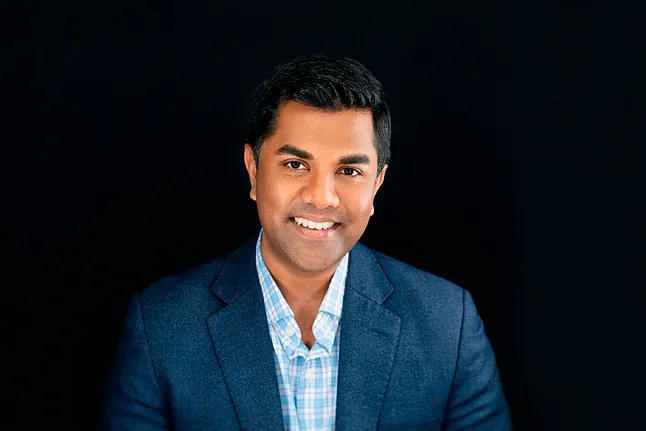
The first director of the magazine was the future U.S. ambassador to the UN and right-hand man of Hillary Clinton at the State Department, Richard Holbrooke. For the past five years, Ravi Agrawal has held that position, and he granted this interview to EL MUNDO during the Halifax Security Forum, held every November in that Canadian city.
What options does Europe have with Donald Trump's peace plan for Ukraine?
The question is what actions Europe can take and how many resources it can contribute to Ukraine. And that is a matter of internal policy for each European country. Because each country has a very different perception of national threats: for Spain, the threat is in the South; for Finland, in the East. Each European country has its own assessment of what it can do, and that will be what decides the long-term future of the war... and of Ukraine.
Will Europe be able to support Ukraine in the long term that you speak of?
I have my doubts that Europe will be able to reorient its economy to spend so much on Defense.
And negotiate more support from the US?
I don't think Europeans have much left to offer Donald Trump. They have agreed to spend much more on Defense. They have agreed to buy weapons from the United States to give to Ukraine...
Why did Donald Trump make this peace proposal? Is it, as many suggest (including the 'Wall Street Journal' over the weekend), for economic benefits for him and his circle (like his son-in-law, Jared Kushner, and his special envoy for Russia, Steve Witkoff)? Because he admires Vladimir Putin? Because he wants the Nobel Peace Prize?
If only we could know what goes through Donald Trump's mind! There are many conjectures about the points you have raised. But what is clear is that Trump has shown privately and publicly that it is important to him that people perceive him as a peacemaker and a successful negotiator.
The question is whether that matters to him enough to sign whatever is put in front of him.
I believe Trump is very frustrated by his inability to end this war, although I reject his claim that he has ended eight wars.
Including wars between Albania and Azerbaijan and Egypt and Ethiopia, which not only did not exist, but also involve countries that do not share a border.
Exactly. Or between India and Pakistan.
In fact, claiming to have ended that war is what caused his rift with his former ally, Indian Prime Minister Narendra Modi.
Yes. I don't know what his motivation is with Ukraine. But it is clear that the perception about him worries him, and that is one of the reasons that explain his changes in attitude. Now it seems that he has returned to the beginning of his Presidency, when he didn't care about what happened to Ukraine.
This new peace plan is like what he advocated back then.
It's going back to square one. It's a plan for the surrender of Ukraine, and I don't think Ukraine will accept it.
Although in this edition of the Halifax Forum there was a debate titled 'Democracies Lead', it doesn't seem to be the case. In international politics, democracies react to what are referred to here as the CRINK [the English acronym for China, Russia, Iran, North Korea]. In domestic politics, democratic parties are on the defensive against those with questionable credentials in defending liberal democracy.
Each democracy has its specific problems, and since Covid-19, they have been engaged in internal debates about the major trends of the last four decades: globalization, immigration, urbanization, and technological change... But I don't think many of the forces you refer to are antidemocratic, because they need the legitimacy that elections provide and can lose power if the electorate does not vote for them. The British Reform UK party is not antidemocratic, but anti-immigrant, radically nationalist, and a manifestation of the cultural wars [debates on gender, race, environment] in that country. And, it also reflects what is happening in the US, where Trumpism is not antidemocratic, but a reaction against many things. Is the United States still a democracy? Or, following the taxonomy of Harvard Spanish political scientist Juan Linz to refer to late Francoism, "a competitive autocracy"? It is a democracy. There are elections. The Republican Party, in power, suffered a cascade of electoral defeats last month. And there is no doubt that the Republican Party is very concerned about its electoral prospects in the 2026 legislative elections.
I believe that democracies are being challenged worldwide, and the US is no exception, but it is a democracy. I prefer to analyze the US as a country that is sliding in the direction of a kleptocracy [literally, "government of thieves"].
"Kleptocracy" is not a very kind term. I am not here to be kind or unkind, but to think about ways to analyze the moment. There are elements of crony capitalism that seem to be very visible in the current US. I am not speaking categorically. I simply estimate that "kleptocracy" provides a better framework for analyzing that country than the dichotomy of "democracy"-"autocracy".