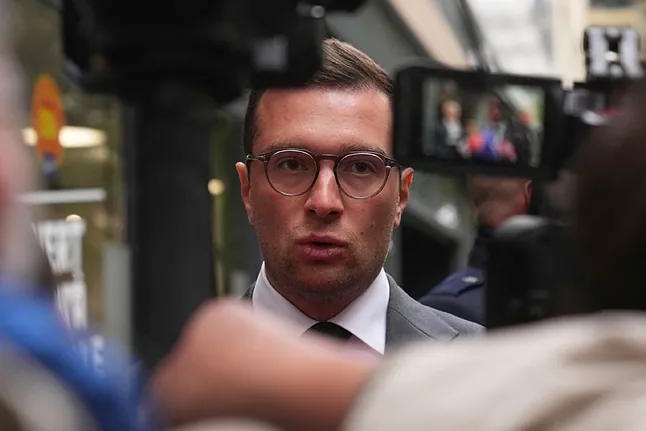
Jordan Bardella, the poster boy of the French far-right, was signing copies of his latest book, What the French Want, when a 74-year-old retiree jumped on him and smashed an egg on his head. The incident didn't escalate further, and the assailant, identified as Jean Paul M., appeared before the French justice system this Tuesday amidst growing social and political tension.
"I am extremely concerned about the increasingly violent climate in our country", acknowledged the National Rally (RN) president, just 30 years old. "Violence often comes from the same side and is always suffered by the same political camp (...) The closer we get to power, the more intolerance and sheer stupidity are unleashed."
The egg incident in Moissac, and the flour attack by a 17-year-old student in Vesoul, have once again put Bardella in the spotlight, just in time for the latest Ifop-Fiducial poll for Le Figaro, confirming him as the top favorite for the presidential elections, with 44% of preferences, even ahead of his political 'godmother', Marine Le Pen (40%).
"Bardella is no longer just Le Pen's substitute or replacement," warns Frédéric Dabi, Ifop's director. "The survey reflects a process of internalization among the French to accept Bardella as the final candidate."
The previously known "Plan B" of the National Rally is starting to look more and more like a "Plan A," with Bardella's clear alternative in case Le Pen fails to overturn the five-year ban on holding public office in January.
The young 'protégé' and MEP has emerged as the star pupil of the far-right leader, with an enviable appeal among young voters and a more moderate profile, aiming to emulate the shift experienced by Giorgia Meloni with Brothers of Italy (while Le Pen remains "linked" with the radical Matteo Salvini and his League).
As a sign, Bardella dedicates just one paragraph to his mentor at the end of What the French Want, compared to the twelve pages of loyalty and gratitude he dedicated in his previous book, What I'm Looking For. Analysts actually interpret his new book as Bardella's declaration of independence and his very personal introduction for the 2027 presidential elections, with constant references to his Italian mother, Luisa, and his tough childhood in Seine-Saint-Denis, the crime and drug-ridden suburb north of Paris.
In his book, he avoids any references to the National Rally and presents himself simply as a politician in search of truth, "beyond the media agenda and the relentless pace of social networks." Written by himself, with his notebook in hand, it is a diary of impressions from his encounters with around twenty ordinary French citizens (from farmers to mayors, bakers to restaurateurs, including a policeman, a taxi driver, an art gallery owner, and a karate teacher).
"The French feel that politics has nothing to do with them and that a gaping chasm separates them," Bardella argues. "Their concerns, difficulties, anxieties, and likewise, their hopes, have disappeared from the agenda of political leaders".
"What would my mother say to the President of the Republic?" Bardella wonders towards the end, as if he already sees himself impeccably dressed in blue at the Élysée Palace. "I would like to tell him to raise the salaries of the lower-ranking public servants, to think of all of us," she replies, as a signature to the creed of "work," "health," "security," and "economy" briefly outlined by the far-right light aspirant, hailed as "our next president" in the presentations as he travels across France.
Bardella's irresistible rise has coincided with internal movements (such as the recent resignation this week of David Rachline as vice president due to his pending legal issues) and with the increasingly noticeable shift of the party towards neoliberal beliefs, as evidenced in the debates on the 2026 budgets in the National Assembly, where the RN has embarked on the definitive conquest of the traditional right-wing space of The Republicans (LR).
LR leader and former Interior Minister, Bruno Retailleau, has, in fact, deflated in the Le Figaro poll, placing him at 25% popular support, even behind the favorite of the moderate left, Raphaël Glucksmann (26%). The only centrist politician capable of overshadowing Bardella today is former Prime Minister and leader of Horizons, Édouard Philippe, who has clearly distanced himself from Emmanuel Macron to position himself for the 2027 presidential elections.