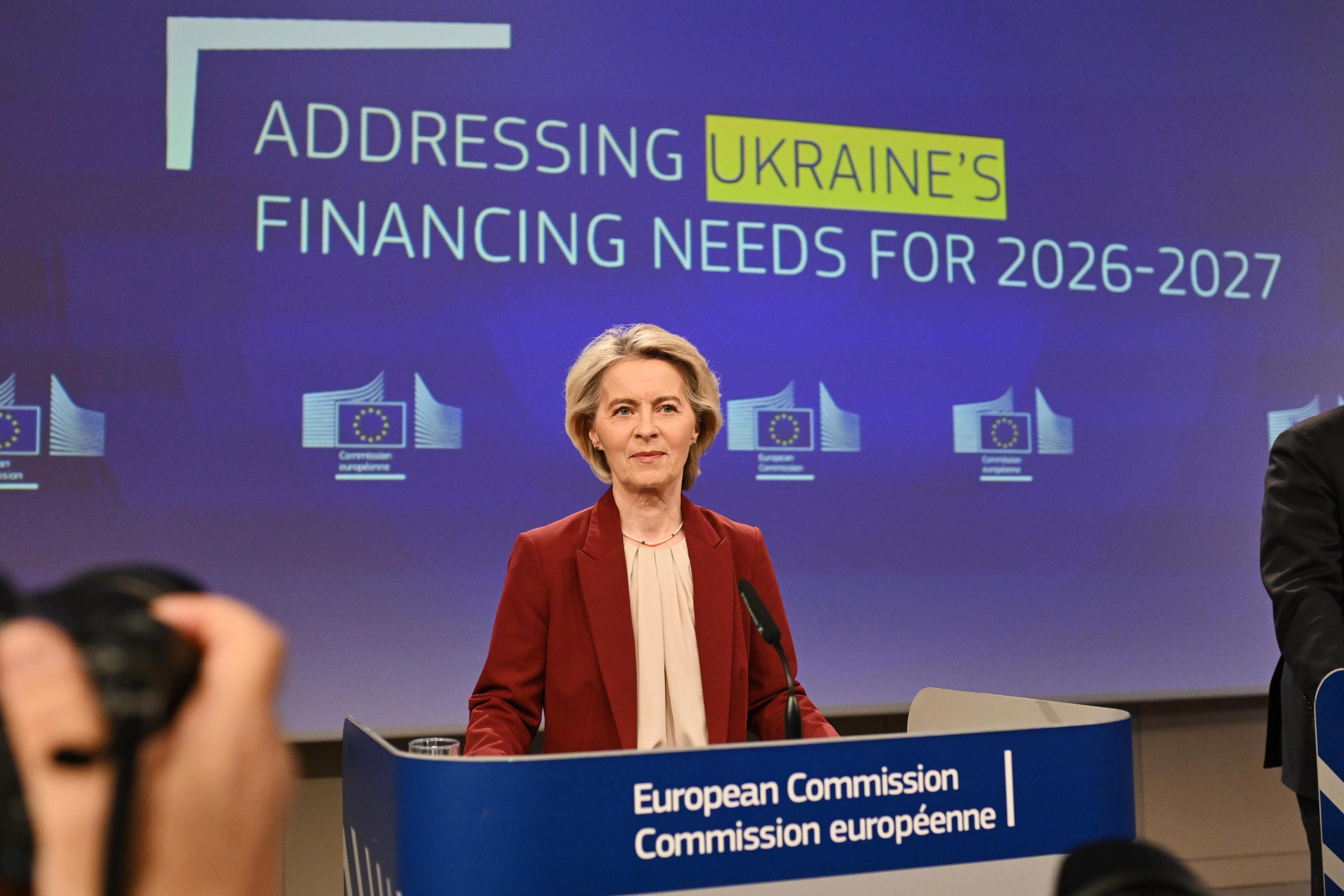
Ursula von der Leyen continues to seek a way to use the immobilized Russian assets, mainly in Belgium, to offer a "reparation loan" to Ukraine. She seems determined to do so despite strong resistance from the Belgian government, and this Wednesday an initiative that will be discussed in mid-December at the Council. That is, by the countries.
In her proposal, the Commission President has decided to include all Russian assets frozen in the EU. Not only those in Euroclear, a company based in Brussels. Furthermore, she has reduced the amount of credit that will be offered to Volodymyr Zelensky, which will be 90,000 million over the next two years, and ensures that the text guarantees that Belgium will not be left alone in case Vladimir Putin attacks the country judicially, economically, or even militarily. But the government led by Bart de Wever continues to resist.
"We have the frustrating feeling of not being heard. Our concerns are being minimized. The texts that the Commission will present today do not address our concerns satisfactorily," Belgian Foreign Minister Maxime Prevot pointed out early in the morning upon arriving at the NATO meeting. He had already seen the documents that Von der Leyen and the Commissioner for Economy, Valdis Dombrovskis, would present hours later, and he did not like them at all.
Both have made efforts to convey the opposite. "We have listened very carefully to Belgium's concerns and have taken almost all of them into account in the proposal we are now putting on the table for the reparations loan," Von der Leyen initially stated. "Our proposals comply with international law, maximize pressure on Russia, and send a clear message that their aggression will not prevail," Dombrovskis echoed. But their statements have not been particularly successful because if Belgium's position was not clear, De Wever himself reiterated it a few minutes later.
"Under the current conditions, a loan for the recovery of Ukraine using the frozen Russian assets in Belgium is not viable. I cannot imagine that the European Commission would dare to confiscate a private company [referring to Euroclear] against the will of a Member State. It's unprecedented," stated the nationalist and far-right leader in comments to the Flemish radio and television VTM reported by EFE.
"Many countries remain silent, and I understand why. All understand that our demands are rational and reasonable. The question is whether they can meet them. So far, they have not been able to," he added. The fight in the mid-December Council meeting will be significant, and it seems highly unlikely that a common ground will be reached at the meeting. Unless a decision is made to move forward without Belgian support and achieve a qualified majority, as required by the plan.
90,000 million and an unwanted Plan B
Returning to the loan conditions, the 90,000 million is below the up to 145,000 million that had been discussed until now. The Commission itself set that figure, although they have now reduced the amounts. The total amount on which this loan will be based has also changed. The EU now points to 210,000 million instead of the previous 185,000, and this difference is because it no longer only considers the frozen assets in Euroclear.
"Russian assets amount to 210,000 million. What do we do? We analyze Ukraine's needs for 2026-2027 as calculated by the IMF: they are 135,000 million. We said we would cover two-thirds of the needs, and that's how we arrived at 90,000 million," explained Dombrovskis himself. None of this convinces Belgium either.
In case of no agreement, or rather to pressure and reach one, Von der Leyen has also proposed a second mechanism to help Ukraine in its war against Russia: issuing debt backed by the EU budget. But this option is not at all to the liking of the northern and more austere countries, and it would also require unanimity. It will not move forward.