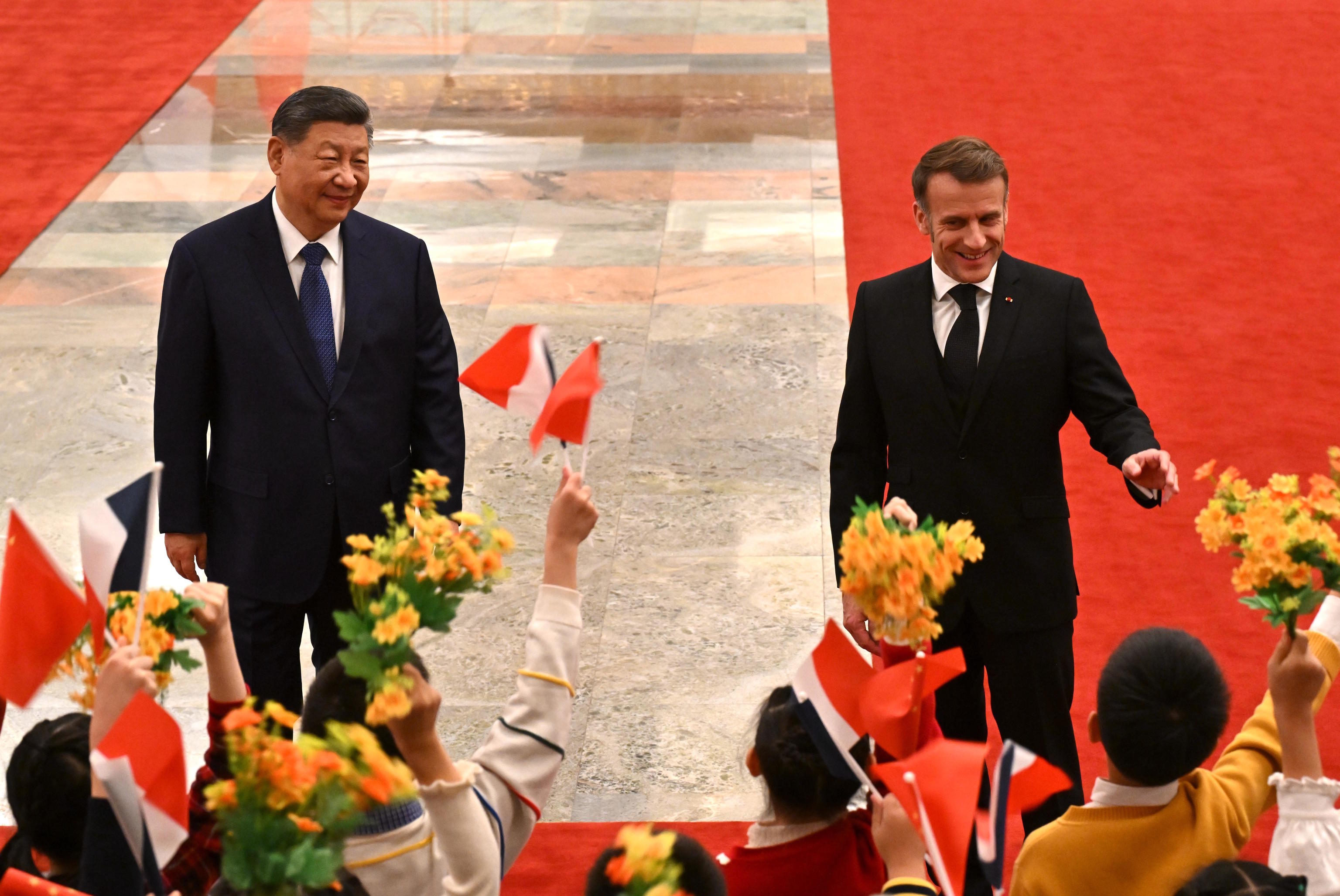
While the official stance of the European Union toughens towards China, the most influential leaders of the bloc are packing their bags to take turns traveling to Beijing and court President Xi Jinping in hopes of balancing increasingly tense trade relations and returning home with favorable investment agreements.
The path was opened by Pedro Sánchez, who has managed to be received by the Asian giant on three occasions in the last two years. This week it is the turn of the French president Emmanuel Macron, and early next year, the visit of the German chancellor, Friedrich Merz, is scheduled. From the United Kingdom, another key player in the European equation, efforts are also being made to organize an official trip to Beijing in January by Prime Minister Keir Starmer.
This Thursday, Xi rolled out the red carpet for Macron's State visit. The Chinese leader will have a significant gesture with the French president that he has not offered to other European leaders or heads of state from other continents: he will accompany him on a trip to the capital of another Chinese province. Xi and Macron will travel to Chengdu in the west of the country, which just a month ago hosted the first stop of the State visit of Kings Felipe VI and Queen Letizia.
Macron landed in Beijing on Wednesday night accompanied by his wife, Brigitte, and a delegation of over 80 people, including several ministers and almost 40 CEOs of large French companies. The composition of the delegation reveals the marked economic nature of the visit. It is not by chance: France's trade deficit with China reached 47 billion euros in 2024.
The French president seeks to attract new investments from Chinese companies and facilitate access for French exports to the vast Asian market. To achieve this, he has signed several agreements with Xi in the energy, food industry, and aviation sectors.
As reported by Chinese state media, Xi told Macron that China and France "should demonstrate their responsibility, defend the banner of multilateralism, and firmly stand on the right side of history." The French president responded by ensuring that, despite the disagreements between Beijing and Paris, both have the responsibility to "find mechanisms of cooperation to resolve differences."
In addition to the economic agenda, Macron took the opportunity to directly address Xi with a message that he had only expressed in front of cameras and at international forums: for China to use its influence over Russia to pressure Vladimir Putin towards a ceasefire in Ukraine and pave the way for credible peace negotiations.
Nearly four years after the Russian invasion, Beijing has not hesitated in its diplomatic and economic support for the Russian military offensive. In addition to buying oil, recent reports - such as the one published at the end of November by the Financial Times - indicate that Xi's government continues to supply drone parts that give Moscow an advantage on the battlefield.
Over the years, Macron has oscillated between more confrontational stances and more conciliatory ones regarding China. Sometimes he presents himself as the toughest European leader against Beijing, denouncing the regime's pressure on global trade, security, and diplomacy. At other times, he adopts a more pragmatic tone, emphasizing that the European Union should not replicate the strategy of permanent confrontation that the United States promotes in its relationship with the second world power.
A day before Macron's meeting with Xi in Beijing, two proposals were presented in Brussels to reduce the risk of their ties with China, from the "trade weapons" they should use to counteract "coercion," to the strategy to end China's dependency on rare earths, whose extraction and processing are dominated by Beijing.
The European Commission also announced that it would resort to stricter economic policies to strengthen the security of the supply of these crucial materials for sectors such as automotive, electronics, and defense. To this end, a strategic fund of almost 3 billion euros was announced to boost projects in mining, refining, and recycling of essential minerals and metals.
In this context, the debate in Europe grows on how to balance the need to protect its strategic autonomy without giving up access to the Chinese market, which remains too essential for many industries. Internal tensions within the EU - between those advocating for a tough line and those preferring a more pragmatic approach, like Spain - add complexity to an already delicate relationship.
For Beijing, visits like Macron's these days, or like the visit of the Spanish Monarchs in November, represent an opportunity to show themselves as a reliable partner amid a volatile international climate, while trying to prevent Europe from sliding into the geopolitical orbit of Washington.