The image of Vladimir Putin paying tribute this Friday to Mahatma Gandhi in New Delhi, at the Rajghat memorial, on the banks of the Yamuna River, encapsulates a difficult paradox to ignore. Gandhi, a universal symbol of nonviolence and peaceful resistance, staunchly advocated that no political goal justifies armed aggression. Beyond the diplomatic protocol typical of State visits, the fact that the person responsible for the invasion of Ukraine - a conflict that has caused thousands of deaths - lays a wreath at the place where the man who dedicated his life to stopping violence was cremated in 1948, evokes significant contradictions.
To end the week in which he issued a new threat saying his country is prepared to go to war with Europe, and rejected any plan to end the current conflict that does not include the occupied Ukrainian territories, Putin bowed before one of the great symbols of peace. "His ideas of freedom, virtue, and nonviolence remain relevant to this day", wrote the Russian president about Gandhi in the visitor's book.
Putin concluded his second and final day of the trip to India with the purpose of signing new trade and arms sales agreements. Throughout, he was courted by Indian Prime Minister Narendra Modi, an international relations tightrope walker who has long been walking a tightrope between Moscow and Washington.
A strategy that began to show cracks after Trump's return to the White House. The U.S. President has accused Modi's government of financing Putin's war machinery through abundant purchases of Russian oil, a flow that surged since the start of the war in 2022 and made Russia a key energy supplier to India.
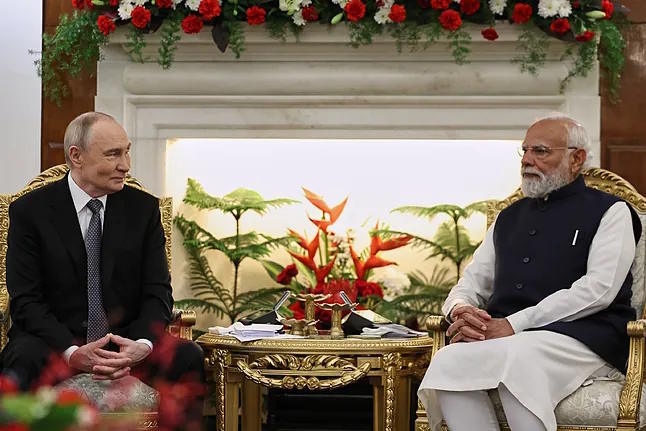
After the symbolic act in front of the Gandhi monument, Modi and Putin held a bilateral summit. "Our relations are deeply rooted in history, but it is not words that matter, but substance, which is profound," said Putin after the meeting began. Modi referred to his Russian counterpart as a "true friend" and a "visionary leader."
Mentioning the war in Ukraine, Modi stated that his country "is not neutral; it stands on the side of peace". Indian media also quoted Putin thanking Modi for his "peace efforts" in the "crisis" in Ukraine.
Putin's trip aimed to boost several contracts through which India would expand its arsenal of Russian weapons with more Su-57 fighter jets and S-400 air defense systems, which were very useful during the military clash last May with neighboring Pakistan.
Military cooperation remains one of the pillars of the bond between Moscow and Delhi: over 60% of India's military inventory is of Russian origin. However, this dependence has decreased compared to a decade ago when it exceeded 70%, due to the increasing diversification towards suppliers like the United States, France, and Israel.
The Friday summit came at a critical moment for both leaders. While the Russian leader rejected the latest peace proposal for Ukraine presented by the U.S., the Indian leader is facing commercial blows from Trump, seeing his alliance with Washington crumble while his major regional rival, China, continues to consolidate its influence in Asia.
Bilateral trade between India and Russia illustrates the new balance. Transactions increased from $10.1 billion before the pandemic to $68.7 billion in the last fiscal year. More than a third of all Indian crude oil imports came from Russia in the last three years, attracted by discounts resulting from Western sanctions. Under the Biden Administration, Washington tolerated these ties considering India an essential partner to counter Chinese advances. However, Trump has opted for a tougher stance: this summer, he doubled tariffs on Indian products from 25% to 50% as a pressure tactic due to continuous purchases of Russian oil.
This fall, the U.S. announced sanctions against any entity doing business with Russian state oil companies Rosneft and Lukoil, leading the Indian conglomerate Reliance Industries to announce it would halt its Russian oil imports. This company accounted for around a third of these imports, so a significant reduction is expected in the coming months.
U.S. officials told the Wall Street Journal that the White House believes reducing Russia's oil revenues is key to pressuring Putin and, given Trump's limited influence over China, the largest buyer of Russian oil, the U.S. has focused on tightening tariffs especially on India, another country that has been functioning as a "money laundering center for the Kremlin".
Trump's pressures on Delhi led to an unexpected shift in Indian diplomacy: Modi approached Beijing, easing border tensions of recent years, and traveled in September to the neighboring country to participate in a regional summit with Chinese leader Xi Jinping and Putin. The three were photographed holding hands and sharing jokes, an image that did not sit well in Washington.
To counter the new U.S. tariffs and demonstrate maneuvering capability, Modi reportedly asked Putin to increase Indian product imports and facilitate the hiring of South Asian country workers in Russian projects.
From the embrace with which Modi welcomed Putin on Thursday night at the airport, two messages emerge: one directed at Trump, reminding him that India has powerful alternatives and partners; and another aimed at the Kremlin itself, emphasizing that New Delhi seeks to strengthen its bond with Moscow to prevent Russia from falling completely into China's orbit.