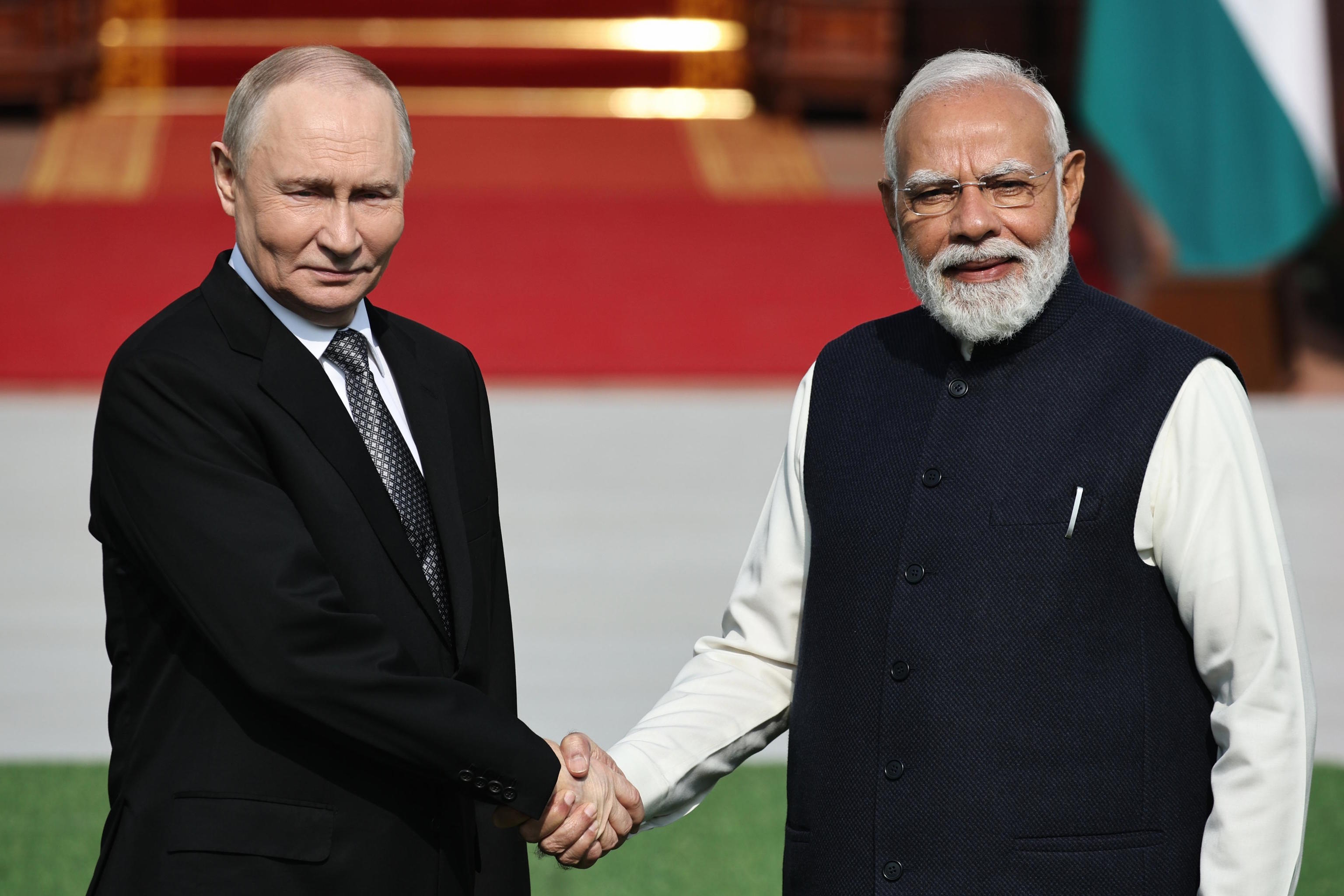
Billboards with joint portraits of Narendra Modi and Vladimir Putin are displayed in many neighborhoods of New Delhi. Indian and Russian flags are everywhere. The Indian capital has been preparing all week to welcome the first visit of the Russian president since his large-scale invasion of Ukraine in 2022. A good opportunity to gauge Prime Minister Modi's complex diplomatic balancing act between his traditional allies in Moscow and Washington.
Putin landed in New Delhi on Thursday to finalize with Modi, who welcomed him at the airport, various commercial agreements and the sale of Russian-made weapons, from fighter jets to air defense missiles.
Another priority in the discussions is how India can bypass U.S. sanctions and tariffs to continue buying Russian oil. Moscow needs this Indian economic support to keep fueling its war machinery while India, the world's most populous country, is always energy-hungry.
Before the war in Ukraine, the Russian regime barely supplied 2% of India's oil imports, compared to the current 35%. "We have to protect our trade from foreign pressure," has been the message conveyed from the Kremlin to New Delhi in recent months.
Before heading to the Indian capital, Putin granted an interview to the English-language channel India Today, addressing the war in Ukraine. "Russia will take control of Donbass, as well as the southern and eastern regions of Ukraine, one way or another," warned the Russian president.
The transfer of the Ukrainian region of Donbass was one of the points in the 28-point plan prepared by Trump's team, which drew criticism from Ukrainian and European officials. "It all comes down to this. Either we liberate these territories by force of arms, or Ukrainian troops withdraw and stop fighting there," Putin stated.
The Russian leader traveled to India accompanied by a broad delegation consisting of nine ministers from his cabinet and several CEOs of state-owned companies. After a warm and colorful welcome and a private dinner with Modi, the significant day is Friday with a formal bilateral summit.
The Russian and Indian leaders will close a new arms purchase agreement by the Modi government, from S-400 anti-aircraft defense systems, fifth-generation Sukhoi-57 fighter jets, and small modular nuclear reactors, safer, cheaper, and more useful to replace coal-fired power plants. New Delhi is by far the largest international buyer of Russian weapons. Putin and Modi are expected to sign multiple commercial and defense agreements on Friday.
Bloomberg reported on Thursday that India had also closed a deal to buy Russian submarines for $2 billion. The Modi government denied the information, stating that it is not a "new agreement" but an existing lease contract signed in 2019, with delivery scheduled for 2028. According to Bloomberg, Indian officials visited a Russian shipyard in November to review the progress of the submarine production plant.
Local media reports that India expects the submarine to be incorporated into its Navy strictly for training purposes and without the possibility of active combat deployment. Delhi had previously returned a Russian nuclear submarine leased for 10 years after its contract ended in 2021.
India has firmly held onto a traditional "non-aligned" stance with any bloc, something it embraced during the Cold War. In other words, it has continued to juggle between Washington and Moscow without leaning more towards either side. This has not pleased U.S. President Donald Trump.
In recent months, the U.S. has been commercially pressuring New Delhi like no other ally. Trump has never hidden the main reason for his resentment: India is heavily buying oil from Russia despite international sanctions against Moscow for the attack on Kiev. In the summer, Washington imposed an additional 25% tariff on New Delhi, adding to the existing 25% on Indian products. "They (India) don't care how many people in Ukraine are being killed by the Russian war machinery," the Republican remarked.
"The Indian Prime Minister is not someone who gives in to pressure," Putin said in India Today when asked if the U.S. was "pressuring" India with tariffs on Russian oil purchases.
In October, Trump claimed that his pressures had worked and that the South Asian giant would stop buying Russian oil. However, Indian officials have reiterated that their country has no intention of halting its crude purchases, arguing that these imports are linked to the energy needs of its over 1.4 billion inhabitants.
The ties between Moscow and Delhi began shortly after India gained independence in 1947. The now-defunct Soviet Union economically supported India in its industrial development and provided diplomatic backing in its disputes with neighboring Pakistan over the Kashmir region. It also helped Indians produce Russian-designed missiles, aircraft, and nuclear-powered submarines.
New Delhi, in turn, has routinely had Moscow's back in the most controversial international affairs. Modi voted against a UN Human Rights Commission resolution condemning Russia's actions in the second Chechen war and abstained from voting on UN resolutions in 2013 and 2016 against the Russian-backed Assad regime in Syria. In 2014, India also refrained from condemning the Russian invasion of Crimea, as it did in 2022 with the attack on Ukraine.