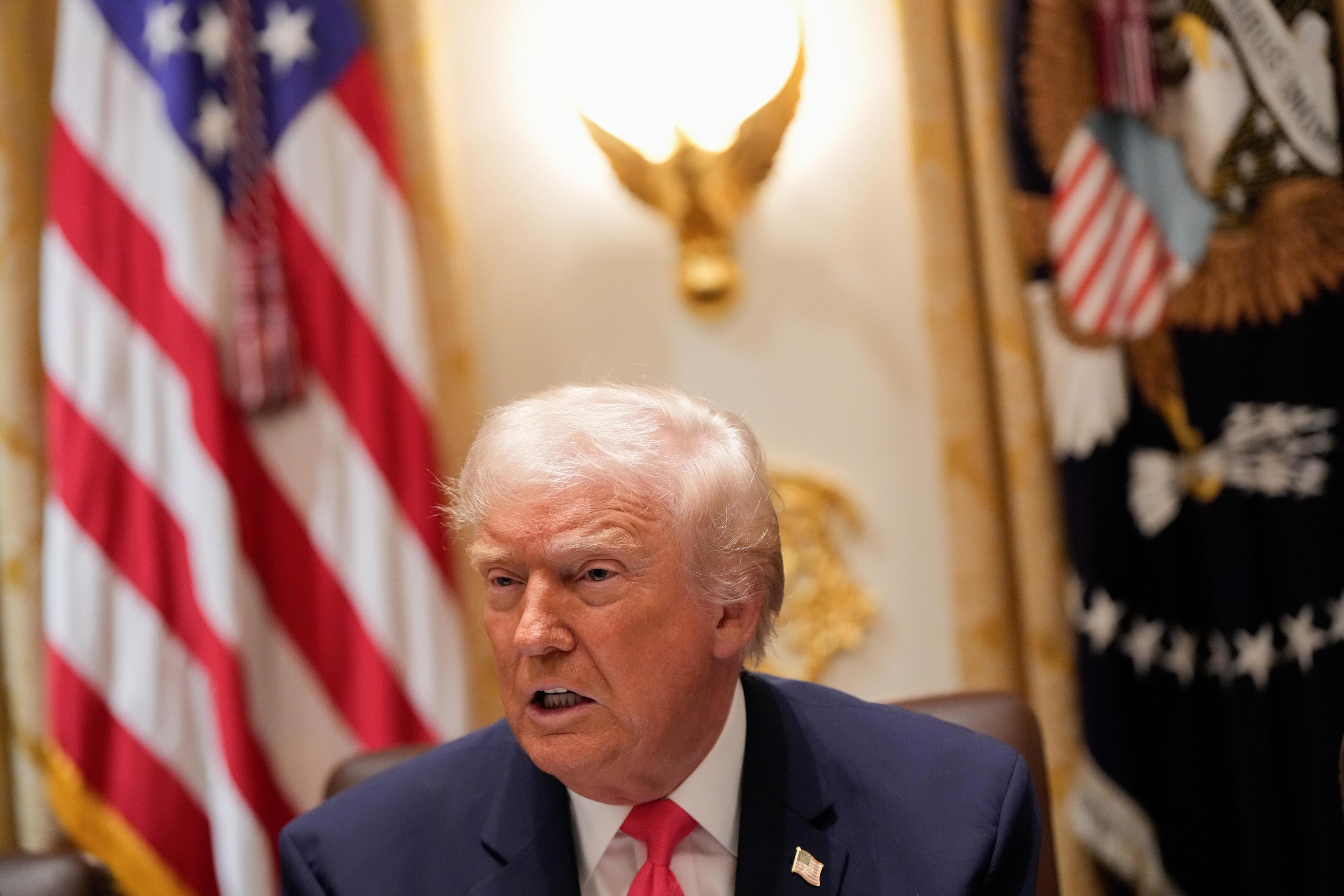
Almost half of Europeans (48%) consider Donald Trump as an "enemy of Europe" against the backdrop of the war in Ukraine, according to a survey conducted in nine countries (including Spain) by the French platform Le Grand Continent. The majority of citizens in the old continent (51%) believe there is a "high" or "very high" risk of an open war with Russia in the coming years.
The survey primarily reveals the sense of "insecurity" that has taken hold in Europe (technologically, militarily, energetically, and in terms of food) and the growing polarization of societies on hot topics such as immigration or climate change.
"We are facing a portrait of an anxious Europe, deeply aware of its vulnerabilities," warns Jean-Yves Dormagen, a professor of Political Science at the University of Montpellier and head of the polling agency Cluster17. "Internal fractures are not secondary but are intensifying at a time when geopolitical tensions threaten collective cohesion."
The perception of Trump as "enemy of Europe" has increased over the past year and is notably higher than average in countries like Belgium (67%) or France (57%). The Euro MP and presidential candidate of the moderate left in France, Raphaël Glucksman, echoed this sentiment this week and urged European leaders not to become "doormats for tyrants and magnates," directly referring to Putin and Trump regarding the Washington plan to end the war in Ukraine.
"The United States has decided to sell Ukraine and European security to Russia," wrote Glucksman on his X account, leader of the Place Publique party (Public Square). "We can postpone the deadline by a few weeks by discussing the surrender plan, but that will not solve the crux of the matter."
In Spain, ranked third, 53% of the population considers Trump as "enemy of Europe." When it comes to dealing politically with the U.S. president, Spaniards are, however, more divided between "opposition" (41%), "engagement" (35%), and "alignment" (24%).
At the European level, and despite the widespread view of Trumpism as a "hostile force," 48% ultimately opt for "engagement" with the EU's administration, compared to 33% in favor of "opposition" and 19% in favor of "alignment."
The fear of war with Russia has also resonated among Europeans: 51% believe there is a "high" or "very high" risk of conflict in the coming years. "A perception like this would have been unthinkable a few years ago and marks the acceptance of the European public opinion of the new geopolitical regime," warns Professor Jean-Yves Dormagen.
Poland is the country where the fear of direct confrontation is most widespread (77%), followed by the Netherlands (59%) and Belgium (58%). Spain is at 49%, just below Germany and France.
Two out of three Europeans also believe that their countries "will not be able to defend themselves" against a Russian aggression. Over 80% of Portuguese and Italians share this opinion, as well as 76% of Spaniards. "The countries that feel less capable are precisely those that least envision a direct confrontation with Russia," points out Dormangen.
A vast majority of Europeans (74%) now stand united on EU membership, with Spain at the forefront (89%) and France at the bottom (61%), alongside a more entrenched sense of national pride. France is also the country where citizens (86%) feel the closest threat of terrorism, which remains among the top concerns of Europeans.
The pressure of immigration is also perceived as a threat in Central Europe, especially in Poland and Belgium, while countries most affected by the arrival of irregular immigrants like Spain and Italy, almost half of the population see it as a "necessity." Internal fractures have also intensified due to climate change: 43% of Europeans agree that the problem has been "exaggerated" or "exploited" for political purposes, while 54% disagree.