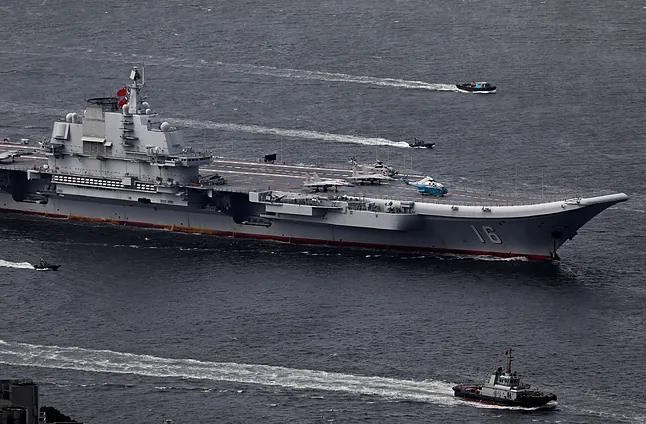
The diplomatic clash between China and Japan intensified again this weekend after a serious military incident near Okinawa, where Tokyo has accused Chinese fighter jets of targeting Japanese aircraft with their fire control radars. This is a dangerous maneuver that, in military terms, is equivalent to preparing for a possible attack.
According to the Japanese Ministry of Defense, the incident occurred southeast of the Okinawa archipelago, in an area of international waters where the Chinese military is conducting naval maneuvers these days. On Monday, the Chinese aircraft carrier Liaoning, along with three guided-missile destroyers, continued to carry out exercises with continuous deployments of combat aircraft, especially J-15 fighters.
Japanese authorities maintain that two of these fighters directed their radar at Japanese Air Self-Defense Force F-15 aircraft on two separate occasions. The use of fire control radar forces its targets to take evasive maneuvers, substantially increasing the risk of accidents.
Japanese Defense Minister Shinjiro Koizumi described the incident as "dangerous and extremely regrettable" and stated that the actions of the Chinese fighters "clearly went beyond what was necessary to ensure flight safety." According to Japanese media, this would be the first time that Tokyo has publicly made such an accusation against Chinese military aircraft.
Regarding this incident, Prime Minister Sanae Takaichi stated that Japan will respond "calmly, but with determination", reaffirming her government's commitment to strengthen maritime and aerial surveillance in the region, as well as closely monitor all Chinese military activities in its vicinity.
On a more diplomatic note, the Chinese ambassador in Tokyo was summoned on Monday to lodge a formal protest, while Beijing described the Japanese version as "completely inconsistent with the facts," claiming that it was the Japanese aircraft that followed and harassed the Liaoning carrier strike group.
A spokesperson for the Chinese Ministry of Defense stated that Japanese aircraft repeatedly intruded into areas designated for Chinese military training, forcing their fighters to "take defensive measures."
This latest friction adds another chapter to one of the most significant diplomatic crises between the Asian neighbors in recent years. The clash began when Takaichi suggested last month that Japan could militarily intervene if China attacked Taiwan. Her statements triggered a strong reaction from Beijing, including economic sanctions (restrictions on the import of Japanese seafood) and increased military pressure around Okinawa and the disputed Senkaku Islands in the East China Sea, whose sovereignty is also claimed by Beijing.
On Sunday, the Financial Times reported that Tokyo had asked its major ally, the United States, to publicly express clearer support for Japan, something that Donald Trump has been avoiding in recent weeks. Specifically, the Japanese ambassador in Washington, Shigeo Yamada, formally requested the White House for a public show of support.