The new National Security Strategy of the Trump Administration, stating that Europe "will not have economies and armies strong enough to remain reliable allies," is shaking the continent. Perhaps not so much for the content, as many of the threats and criticisms are a written confirmation of the attitude and approach that the United States has been applying for a year now, but for the fierceness of the text and the evidence that Europe is falling behind. Far behind in a world that is changing at a dizzying speed for which the EU does not seem prepared.
In diplomatic circles, several points are highlighted. The initial reaction is one of astonishment. "Many of us are quite astonished by the fact that the United States is expressing itself in this way regarding Europe. The problem is not Europe. We are reliable and quite strong. But we need to reprogram ourselves; there are going to be three tough years ahead," explained a country from the north.
After the initial impact, a second nation adds that it is not clear that the new strategy is so new. "It seems like a repetition of many things that the United States has been saying since the beginning of this year and what J.D. Vance said in Munich in February," they point out. This connects with the criticism launched by former Swedish Prime Minister Carl Bildt on Friday.
"The U.S. Security Strategy proclaims, among other notable things, as a policy objective to cultivate resistance to Europe's current trajectory within European nations. That is JD Vance on steroids," noted the former Swedish Foreign Minister on his X social media profile.
Once that is accepted, a second analysis emerges. For example, it highlights that the U.S. statements "emphasize the importance of the EU's defense preparedness agenda for 2030." "Europe needs to quickly be in a position where we can defend ourselves. And it underscores the need to continue the work, both at the European and national levels, on policies that can enable the EU to safeguard its interests in the new geopolitical context. This requires EU member states to reflect on their priorities when discussing Union policies," they continue from a third country.
"And if we are not able to do that, then citizens should prepare for a world where we may have to accept doing what the major players ask of us," this same source concludes. In other words, there is a very real risk not only that Europe will lose its dominant position, something that has already happened, but that it will have to accept being somewhat dominated by China and the United States. This fear has been looming in Brussels for some time, but it seems increasingly close and real.
"I think Trump is doing what he promised: putting the U.S. first. He is putting into writing what we have been seeing in recent months. He does not see us as trustworthy. What concerns me the most is that Europe may not realize that a tsunami is coming," they affirm in a fourth country. And this diagnosis aligns with what has been pointed out so far: it is the acknowledgment of the new reality, and there is a real danger that the EU may not react in time.
Further from this same source: "It is dangerous that this attitude could persist, that it resonates with the public. That the way U.S. citizens see things could resonate, and that even with a possible change of government, this could persist. That is quite unsettling." The portrait and diagnosis from north to south of the EU are very concerning.
Meanwhile, in the European Commission, there have been hardly any official reactions. In the daily press briefing by the spokespersons of the European Commission, the issue of Trump's new Strategy was completely avoided. The President of the Commission, Ursula von der Leyen, has made no reference to this issue and remains focused on trying to convince the Prime Minister of Belgium, Bart de Wever, to allow the EU to use the frozen Russian assets in Euroclear. This company is based in Brussels, and the country's top official has been refusing for months to allow the EU to use those funds to provide a loan to Ukraine.
Months of negotiations for a vital issue, on which not only the future of Ukraine but also that of the EU depends, and which cannot be activated due to the refusal of the ultranationalist Prime Minister who just a few months ago wanted to dismantle the country he now leads. Another example that the rhythms in Europe and the rest of the world are completely different.
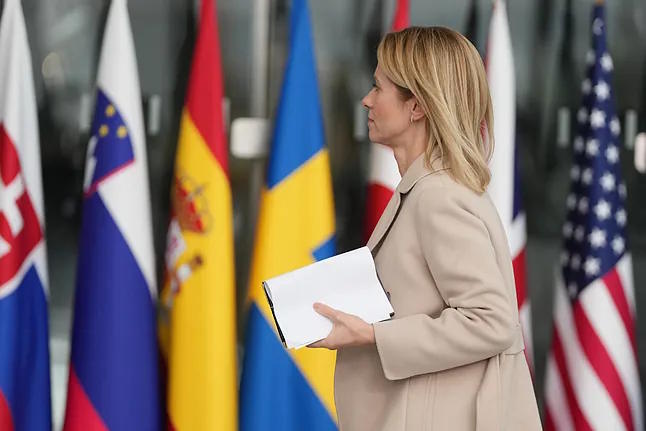
The only official voice that has said something has been the EU's High Representative for Foreign Affairs, Kaja Kallas. "Of course, there are many criticisms, but I believe some of them are also valid," she stated in a debate organized at the Doha Forum held in the capital of Qatar.
"If we look at Europe, for example, it has been underestimating its own power against Russia. I mean, we should have more confidence in ourselves, that is for sure. We want Europe to remain European, to regain its confidence as a civilization, and to abandon its failed focus on regulatory suffocation," she asserted. The analysis seems very accurate. The question now is how to implement it.