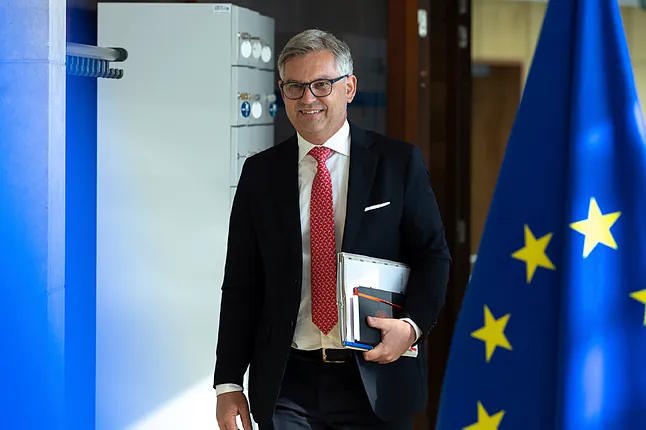
Magnus Brunner (Höchst, Austria, 1972) meets with EL MUNDO, along with a small number of media from different European countries, just a few hours after the European Council approved the advancement of deportation centers for immigrants outside the European Union. In the style, therefore, of those already developed by the Italian Prime Minister, Giorgia Meloni. And along with that action, the new regulation on safe third countries was also processed. All of this will need to be ratified by the Parliament, something that seems very likely, and with these measures, the conversation with the European Commissioner for Home Affairs and Migration begins.
"Yesterday [referring to Monday] was a great day for European politics. We agreed on several important proposals that will truly change migration policy. The return regulation, which is key, the concept of safe third country, the list of safe countries...", points out the community leader.
This set of measures, and especially the return centers, generated a great controversy when Italy began to implement them. But the truth is that they are currently widely accepted in the EU, which the President of the European Commission, Ursula von der Leyen, proposed as an "innovative solution for migration management," and Spain is the only country that has openly opposed this action. The Government of Pedro Sánchez stands alone in Europe also on the migration issue.
Brunner also celebrates the approval of the migration solidarity fund. "It is a very important part," he explains, although he avoids delving too deeply into a very relevant issue: the figures at this point have been reduced, something that the Spanish Government did not like either. According to the Regulation, 30,000 relocations must be carried out each year from the most pressured countries, which are Spain, Cyprus, Greece, and Italy. But on Monday, the Interior Ministers of the 27 agreed to reduce the figures to 21,000 people and 440 million.
The official reason is that the first migration management cycle will be applied from June 2026, covering half a year. And the reduction was approved by a "broad majority." But it was not at all satisfactory for Spain, and the Interior Minister, Fernando Grande-Marlaska, stated that the "solidarity quota cannot become a bargaining of figures." But even here, their position was by no means dominant.
"And then we have the International Conference of the Global Alliance to Combat Migrant Smuggling, which we are holding tomorrow [today] with more than 80 delegations from five continents. More than 50 have already endorsed the joint declaration. And with this, we are taking the next step to fight against smugglers and sending them a clear message: their business model will no longer work," Brunner continues.
"What do I mean by this? There is, for example, the digital aspect. The work of traffickers has increasingly shifted to the digital world," he continues. "Tomorrow representatives from Meta and TikTok, for example, will be present. Traffickers create fake news and false opportunities on social media that encourage people to risk their lives. It is vital to work with them," Brunner explains.
And of course, there is money. "It always comes down to money, we know that, and that's why we have to follow the money. Focusing on these illicit flows is key," continues the member of the popular family, who provides some very illustrative figures. "The price a migrant must pay can be 5,000 euros on a boat carrying a total of 200 people. And that adds up to a very high total. In speedboats, the figure can be 12,000, 13,000, or even 15,000 euros per person. It is a lot of money. Illegal immigration is, after drug trafficking, the second most lucrative illicit business. It is estimated to generate between 5,000 and 7,000 million euros per year," he explains.
A third point of today's meeting, Brunner concludes, is "legal migration and labor mobility." "Our EU Talent Pool, which we have just agreed on, is important for labor migration. It is a specific initiative of the European Union to help European companies hire skilled workers from abroad. Finding legal pathways to our economy, because we need legal migration for our labor markets in the coming years," he elaborates.