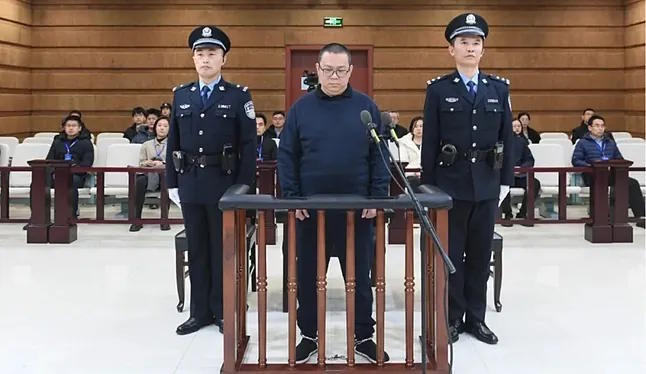
A banker named Bai Tianhui was executed in China on Tuesday for accepting bribes totaling 1.1 billion yuan - approximately 133 million euros - in one of the latest episodes of the relentless anti-corruption campaign driven by Beijing.
Bai had been the General Manager of China Huarong International Holdings, a subsidiary of the state-owned group China Huarong Asset Management, a company created in the late 1990s with the aim of absorbing non-performing loans from small public banks hit by the Asian financial crisis.
A Chinese court sentenced him to death in May 2024, after finding him guilty of using his position to grant financial favors in exchange for million-dollar commissions. His execution closes a case that symbolizes Huarong's drift from its original mission of banking cleanup towards a complex and opaque financial conglomerate, where, according to authorities, systemic corruption and abuse of power flourished.
Bai's case is closely linked to that of his former superior, Lai Xiaomin, former president of Huarong, who was executed in 2021. Lai was involved in one of the biggest corporate corruption scandals in recent Chinese history: he was convicted of embezzling public funds and accepting bribes totaling 1.79 billion yuan (around 217 million euros). During the trial, prosecutors described a network of personal enrichment sustained over years, with mansions full of cash and large-scale discretionary use of state resources.
Huarong was originally tasked with a technical and limited function - buying non-performing loans, attempting to recover value, and liquidating toxic assets - but over time aggressively expanded its scope into investment banking, capital markets, and high-risk credit. This expansion, encouraged by a fast-growing environment and lax supervision, eventually turned it into a symbol of excesses in the Chinese financial sector, where some state entities operated as personal empires of their executives.
In recent years, several high-ranking officials have been sentenced to death. This year, the former president of the Bank of China, the country's fourth-largest bank, was sentenced to death for a corruption scandal involving over 60 million euros. For similar offenses, another veteran banker and senior Communist Party official, Zhang Hongli, former vice president of the Industrial and Commercial Bank of China (ICBC), also received the maximum penalty.
China's anti-corruption campaign has affected over five million people in the last decade, including about one and a half million officials at all levels of the administration. It is not just about punishing individual crimes but also about sending a deterrent message in a system where the Communist Party seeks to reaffirm absolute control over political, economic, and financial power.
In late June, Liu Yuejin, former head of the police anti-narcotics brigade and former advisor to the country's main political advisory body, was sentenced to death for accepting bribes valued at around 14 million euros. In his case, the sentence included a two-year suspension, a common practice in China: if the convicted individual does not commit new serious crimes during that period, the penalty is automatically commuted to life imprisonment.
For a bribery case exceeding 35 million euros, Wang Yong, former vice president of the Tibet Autonomous Region, was also sentenced to death. The sentence, issued by a court in the central province of Hunan, stated that Wang was stripped of his political rights for life and all his personal assets would be confiscated, after proving that he used his position to favor specific companies in public procurement processes in exchange for illegal commissions.
Another suspended death sentence was handed down in May to Han Yong, former provincial-level Communist Party leader and government advisor, accused of accepting bribes worth 32 million euros over three decades. Months earlier, an official from the Inner Mongolia region was executed after being found guilty of embezzling over 400 million euros, one of the largest financial cases recorded locally.
China maintains the death penalty for 46 offenses beyond murder, such as drug trafficking and corruption. China executes more people per year than the rest of the world combined. This is indicated in the latest Amnesty International report, but the exact number is never made public. Executions are considered a state secret.
When the death penalty is issued by provincial courts (without suspension for possible commutation to life imprisonment), the Supreme Court must always review the case before giving approval and setting a date for lethal injection or execution by firing squad.