Dr. Irina Malykhina, 32, was one of the thousands of residents of Kramatorsk who left the city at the beginning of 2022 when Moscow launched the general invasion of Ukraine. She returned in April of last year when she thought that the Russian troops were unable to advance in that same territory and opened her cosmetic clinic.
Every week, she says, she receives half a dozen clients asking for Botox injections. "Ukrainian women are very coquettish, even in the most difficult situations. We don't want wrinkles," she says. Even more surprisingly, the majority of those who come to the clinic - between "60 and 70%, she points out - are military personnel fighting in the area. "Mostly women but also men."
Irina is aware of the duality in which the residents of this town or the neighboring Sloviansk currently find themselves, both immersed in a more than atypical situation, where they can still enjoy luxuries like cosmetic treatments or a plethora of sushi restaurants, but also have to deal with the increasingly frequent attacks of drones or 250-kilo KAB bombs.
The sense of tranquility that prevails in Irina's clinic contrasted brutally with the sounds that were heard hours earlier in Sloviansk. Around 9:30 p.m., the darkness of the night was interrupted by a huge flash of light accompanied by a monumental roar. It was the first of many explosions. The impacts made the apartment block tremble. The windows shook, on the verge of breaking. They were the feared KAB bombs.
The enormous, devastating devices have become part of the daily routine in Sloviansk, where several tens of thousands of people still live.
Twenty-four hours earlier, on the 3rd, the Russians launched nine similar devices against its streets, leaving nearly a dozen injured.
One of the KABs fell on the avenue leading to the train station, now inoperative.
"I was watching TV with my son and we ended up on the floor," recalled Tatiana (who did not want to give her last name), 44, as she prepared a wooden board to replace the windows destroyed by the incident.
Defying logic, the Ukrainian woman's family emerged unscathed even though the device razed the neighboring house. The blast ripped doors, windows, walls, and pieces of roofs from over a dozen surrounding homes. One of Tatiana's neighbors was among the injured. He suffered severe burns. "He was inside the car and it caught fire," the woman recounts.
Along with the rest of the urban centers in the Donetsk province still under Ukrainian control, Sloviansk has become the main target of flying bombs this year. According to the local Ministry of Defense, the Russians have launched 44,000 of these projectiles across the country.
Sloviansk was the epicenter of the Russian intervention in Ukraine in the spring of 2014 when Moscow encouraged the uprising of separatist groups. The city became the headquarters of the forces commanded at that time by the former Russian military Igor Girkin, who maintained control until the first days of July when the Ukrainian army regained it, while also liberating Kramatorsk.
Just over a decade later, the conflict has returned to the vicinity of these two urban centers as part of the general offensive launched by the Russians against the territory of the Donetsk province still controlled by Ukraine.
Fueled by the acknowledged superiority in manpower and military logistics they benefit from, the Moscow army has not stopped advancing on this front, despite the casualties it suffers. The slow but steady progress has allowed them to expand the "death zone" where their drones operate to almost the entire space dominated by the Ukrainians, where nearly 200,000 people still live. Towns like Sloviansk, Kramatorsk, Durzhkivk, or Svyatorkirsk are now within the range of action of the unmanned aerial systems (UAS).
According to the Ukrainian website Deep State, specialized in military situation analysis, the Russians occupied more than 500 square kilometers in November, almost doubling the speed of their advance compared to the results of September and October. Ukrainian forces are struggling to maintain control of enclaves like Pokrovsk, Myrnohrad, or Syversk in Donetsk; Vovchansk and Kupyansk in Kharkiv; and Hulyaipole in the Zaporizhia province, but the fate of several of them seems almost decided in favor of President Vladimir Putin's subordinates.
However, the think tank Institute for the Study of War, based in the US, acknowledged that at the current rate of Moscow's soldiers' progress, the capture of the rest of Donetsk would not occur before August 2027.
From the facilities of the Otmo Hospital Center in Kramatorsk, the detonations from the confrontation zone can be heard. "It's 15 kilometers from here," says Dr. Oleksander Heiko, head of the institution.
The medical complex treats cancer patients, as well as those with heart problems or kidney disease.
But in this Ukrainian region, patients not only face these serious illnesses but also have to deal with the devastation left by the Russian advance. The images of burned buildings, markets, or businesses are becoming increasingly evident in these two urban centers, which until last year were rear areas and therefore destinations for the rest of the soldiers fighting in a conflict that was still thought to be distant.
Serhii has laryngeal cancer. He can only communicate through a device installed in his throat that reproduces metallic sounds. He explains that his village "has been razed." "We don't want more war," he adds.
Many of the specialists under Heiko's command, and he himself, have been displaced due to the conflict. The head of Otmo had to leave all his belongings in the city of Donetsk - the provincial capital - when pro-Russian forces occupied it in 2014. The same happened to Svitlana Hetman, head of cardiology.
The latter warns that the pressure on the population has led to an increase in heart conditions among young people. "We have had heart attacks in a 25-year-old soldier or a 30-year-old civilian," she says.
These are not isolated cases among the center's visitors. At least two doctors from Heiko's team - all in their thirties - have died from the same disorder, and two others have had strokes. "It's a completely abnormal ratio of cases. It's obvious that it's related to the stress they experience due to the war," he comments.
In the hemodialysis department, Sergio Cherkasov admits that he had to move from the nearby town of Konstantinivka to Kramatorsk to be closer to the machines he has to connect to three times a week. His home was destroyed three months ago, following the fate of almost the entire city, located near Kramatorsk. If the war continues to approach and evacuation is ordered, the 65-year-old Ukrainian would be faced with a critical situation. He would not survive more than 10 days without blood purification.
"My concerns are divided in half: 50% about the war and 50% about my kidneys," he says resignedly.
Both Heiko and one of his subordinates, 30-year-old Dr. Klim Kietov, share the growing pessimism among the local population and many soldiers fighting in this region.
"Sooner or later we will lose Kramatorsk. It won't be now but in two or three years. But before that, we will see how the Russians raze it as they did with Bajmut or Pokrovsk," Heiko considers. Klim agrees. He admits that the residents of this locality - where he is native - do not want to talk about the approach of the Russians. "It's a kind of taboo, but unfortunately the situation is getting worse and worse," he acknowledges.
The opinion of these natives of Donetsk coincides with the multiplication in recent weeks of increasingly alarmist comments from prominent figures in the country, who have begun to express themselves in that sense as the Ukrainian retreat was confirmed on most fronts.
In November, the well-known activist Serhii Sternenko estimated that the country is heading "towards a strategic disaster that could mean the loss of the State."
No one can accuse Sternenko of pro-Russian leanings, having survived two assassination attempts that he attributed to Moscow and leading a foundation that provides tons of material to the local armed forces.
"Our defense is crumbling," wrote the popular blogger on social media.
One of the country's most significant military analysts, Taras Chmut - whose foundation also assists the Armed Forces - shared the same assessment in those days. The activist, who fought in the first phase of the war between 2015 and 2017, said that the "dynamics of losing positions and retreats continue to increase, and there are no prospects of changing it." Chmut was blunt. For him, the Ukrainian army faces a possible "collapse" due to the lack of soldiers, with brigades that only have a few hundred uniformed personnel when they should group thousands.
Another expert, Austrian military Tom Cooper, whose comments regularly appear in the local newspaper Pravda Ukraine, published a more than pessimistic analysis a few weeks ago in which he concluded that "Ukraine is losing the war." Cooper specified that Ukrainians face a significant disadvantage both in material and forces. According to his calculation, Russia can deploy eight soldiers for every Ukrainian in some sectors.
"The estimated time for total collapse (of the local armed forces) ranges from four to six months, to eight or ten," he concluded.
Ihor Lutsenko, a former Ukrainian deputy and now commander of a drone unit, admitted to local media that the vast majority of Ukrainian Brigades "have run out of infantry or almost entirely."
According to him, the average number of men that the units of his army can deploy to control each kilometer of the dividing line is five soldiers. "That means we have almost no infantry," he insisted.
The military personnel trying to stop the continuous Russian assaults are divided between those like Igor 'Archibaldt', 39, who admit that Donetsk "will be lost in one or two years," and those who still cling to hope.
Figures like Ilya Leaf, alias 'Izia', a 38-year-old businessman who sold chocolate and coffee, who enlisted in the army in 2022 and, leveraging his devotion to aeromodelling, has established one of the most innovative formations among those fighting in Donetsk.
"Who could have thought that the German armies would be defeated in 1941?", he asserts in the makeshift workshop where his subordinates work.
His followers are dedicated to building their own drones to support the infantry soldiers defending the Konstantinivka sector. One of them has been named "Quasimodo." "It can carry up to 20 kilos of payload over 20 kilometers. Everything is automated. You touch the button, it goes to the destination point, drops the payload, and returns," he specifies.
"We fight for our land, and that also matters in war," one of his comrades-in-arms echoes.
General Viktor Nazarov, a former military advisor to the Ukrainian president, is another who does not endorse the pessimism. For him, Ukraine's situation "is not critical." "For there to be a significant penetration, the Russians would need to advance 20 or 30 kilometers. That is not possible today under the action of drones," he clarifies in a phone conversation.
Dominated by uncertainty, the civilians still living in Donetsk have resumed the exodus that the region experienced in 2022, when panic spread due to Moscow's general offensive. According to Radio Bezkoshtovne, a local station, in October of last year, the population was only 200,000 inhabitants, less than half of the 460,000 counted in August of the previous year. Tens of thousands have left the area in recent months.
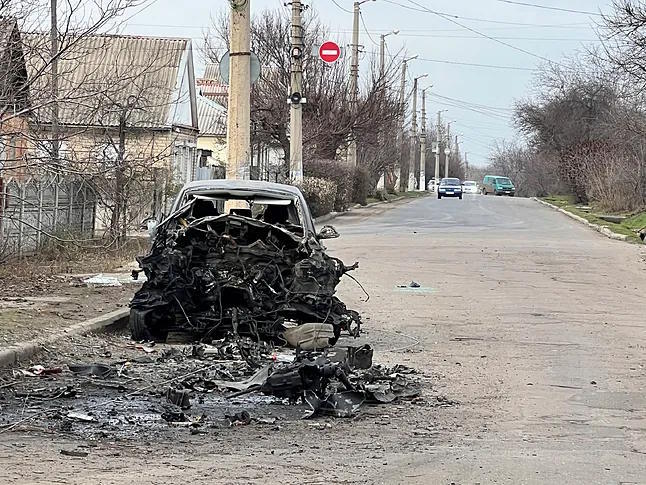
This is what Viktoria Borotkina, 52, owner of a funeral home in Druzhkivka, is planning to do. The streets around exhibit the tears left by the constant assaults of Russian artillery and UAS. The main avenue is dotted with homes, factories, municipal buildings, and even the local cinema, reduced to rubble by the harassment of the Moscow army. In recent days, Russian UAS have left at least two cars turned into scrap metal, attacking them in the middle of the town.
Someone has written a string of messages in English on the walls of that street. "Tomahawk is the best negotiator with Russia," reads one referring to the US missiles, which the leader of that country, Donald Trump, refuses to deliver to Kiev.
"In these last three months, we have buried dozens of people. Most are victims of KABs but also of drones," she comments.
Here, the blasts from the confrontation area occur every few seconds, which does not prevent the neighbors from taking advantage of the few hours they have each day to go out on the street. In Druzhkivka, the curfew is only lifted for four hours a day.
"The front line is getting closer every day, and every night I go to bed with fear. We are thinking of going to Ivano Frankivsk (in the west of the country)," Borotkina adds.
Anatoli Tokarev lives just outside Ukrainian Donbas, in the city of Pavlograd. A veteran of the 2014 war, 'Grandpa' - his military alias - dedicates himself to collecting military paraphernalia, from 'Shaheed' drones to armored vehicles, or missiles.
The Ukrainian shares with his former comrades the pessimistic prediction regarding the future of the war and does not hold back from criticizing the country's political leadership. "If you see that your leaders are corrupt, how does that affect your morale?" he asks.
However, even assuming that the Russians "will destroy" Pavlograd, Anatoli refuses to surrender Donbas as proposed in the hypothetical peace plan sponsored by Donald Trump, to end hostilities with Russia.
"I am doomed. The Russians have lists of people who fought in 2014. We are marked. They will kill me if we sign peace or if we continue fighting. So I prefer to fight to the end," he concludes.
"It's about continuing to fight even if they ravage all of Donetsk because then, in two or three years, they will have lost so many soldiers that they won't be able to keep advancing," Igor 'Archibaldt' echoes.